La Mesa’s hills make this a different conversation than a flat-lot city. Before you compare quotes for an automatic driveway gate, you need to know whether your driveway’s grade and width even allow both gate types, because in a lot of East County neighborhoods they don’t.
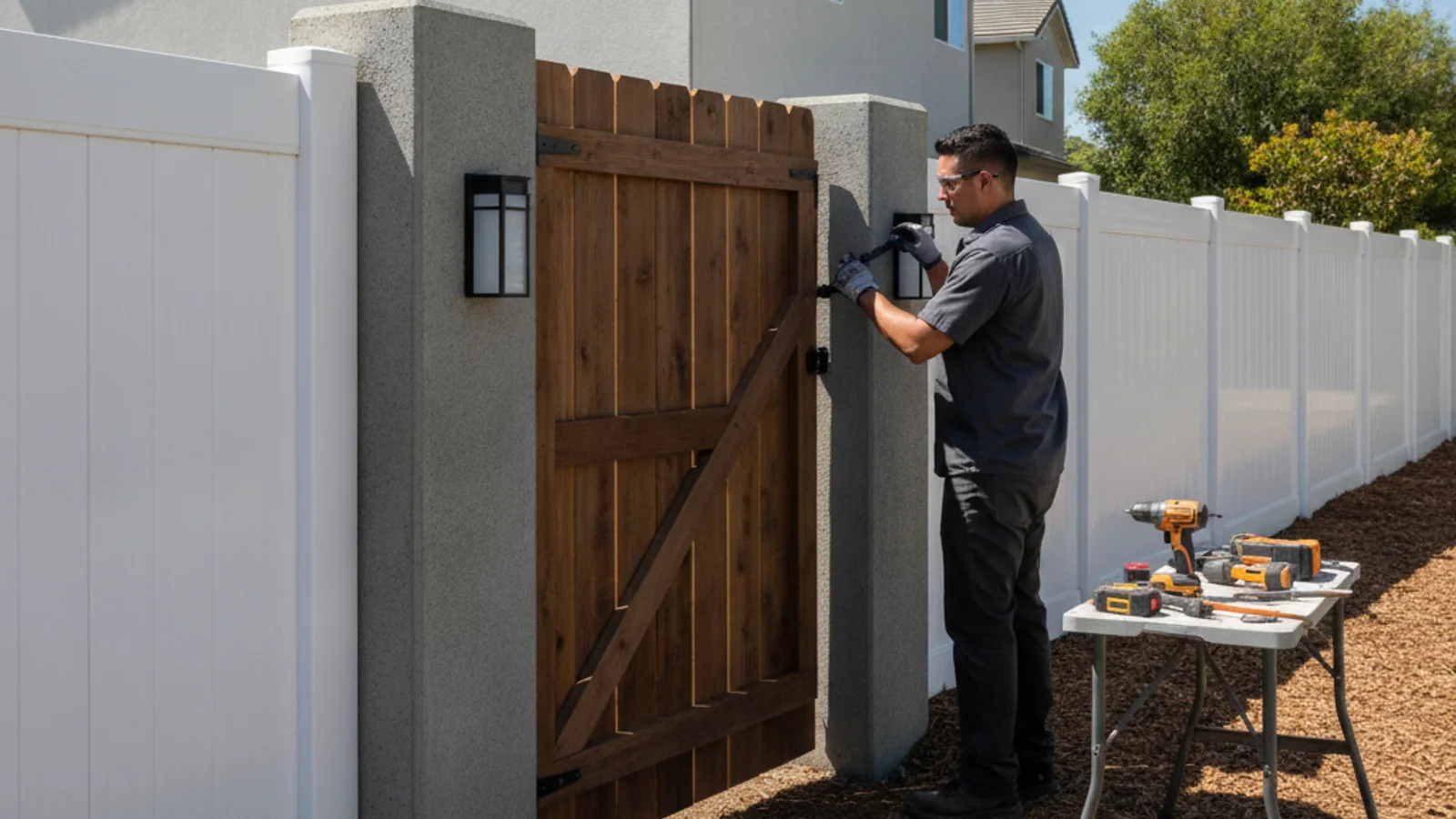
Swing and sliding layouts for La Mesa lots and slopes
A swing gate needs a roughly level pad to arc through and enough clear space behind the opening for the panel to travel without dragging on the pavement. On a lot with any meaningful rise from the street to the garage, which describes a lot of La Mesa’s older hillside streets, that clearance is hard to get without regrading.
A sliding gate solves the grade problem differently. Instead of arcing open, it travels sideways along a track or a cantilever arm parallel to a fence line. That works well on a slope as long as the ground beside the driveway is level enough for the track, or the property can support a cantilever design that doesn’t touch the ground at all. La Mesa’s mid-century neighborhoods, many built with narrow side yards, sometimes don’t have that space either, which is why a site visit matters more here than a phone estimate.
Some La Mesa properties end up with neither a straightforward swing nor a straightforward slide, and instead need a cantilever slider engineered for the specific grade and clearance available. That’s not a downgrade. It’s usually the correct answer for a hillside lot, and an installer who suggests it after seeing your property in person is doing the job right.
How driveway width, grade, and setback shape the gate plan
Three measurements decide more of this than any style preference: the width of the opening, the slope of the driveway from the street to where the gate would sit, and how far back from the property line the gate needs to be set to avoid blocking the sidewalk when it swings or sits open.
Older La Mesa lots were platted before automatic gates were common, so setbacks and driveway widths weren’t designed with a gate operator in mind. That’s not a dealbreaker, but it means the installer needs to physically measure the site rather than quote off a satellite photo. A driveway that looks wide enough on a map can turn out to be just short of what a swing gate needs once you account for a parked car, a trash bin enclosure, or a retaining wall at the property line.
If your home sits on a corner lot or has a driveway that curves before reaching the garage, mention that when you call for quotes. A curved approach changes where the gate can physically sit and may push the decision toward a slide gate even on a property where a swing would otherwise work.
Retaining walls are common on La Mesa’s hillside streets, and they routinely eat into the width an installer has to work with. A driveway that looks generous at the sidewalk can narrow once a retaining wall or a raised planter bed near the garage is accounted for, and that narrower point is what actually determines whether a swing gate’s panels will clear on both sides. Measuring at the street and assuming that width holds all the way to the gate location is one of the more common mistakes homeowners make before calling for quotes.
Power, controls, and safety features to discuss with the installer
Every automatic gate needs power to the operator, whether that’s a wired circuit run in conduit or, less commonly on a typical La Mesa residential lot, a solar setup. Ask where the power source will come from and who’s responsible for the electrical permit and rough-in, since that’s a separate scope from the gate structure itself.
Safety sensors matter as much as the gate panel. A photo-eye or contact sensor that stops the gate from closing on an obstruction isn’t optional equipment, it’s a basic safety feature that should be part of every residential installation. Ask how the installer tests and calibrates those sensors after install, and ask about a manual disconnect or release in case of a power outage, since a hillside home losing power is not a rare event here.
Controls are the part homeowners often skip discussing and then regret. Keypad codes, remote clickers, and smartphone apps all have different tradeoffs for reliability and ease of use. If more than one household member needs access, or you want a code you can hand out temporarily to a contractor or guest, ask what the base system supports before you assume it’s included.
If your property is on a street with weaker cell signal, which does happen in some of La Mesa’s canyon-adjacent pockets, ask whether the control system depends on a cellular connection or works independently of one. A smartphone app that relies on a signal that drops out at your specific address isn’t a reliable primary control method, even if it works fine as a backup.
What to compare in two gate proposals
| What to check | Why it matters in La Mesa |
|---|---|
| Gate type recommended | Should match your actual slope and clearance, not a default answer |
| Site visit before quoting | A hillside lot can’t be accurately measured from a satellite photo |
| Hardware and operator brand | Determines service availability and parts if something fails later |
| Electrical scope and permit | Confirm who pulls the permit for the power run to the operator |
| Safety sensor type and testing | Ask how it’s calibrated and tested after installation |
| Manual disconnect | Confirm the gate can be opened by hand during a power outage |
Two proposals recommending different gate types for the same property isn’t automatically a red flag. It can mean one installer measured more carefully, or it can mean they’re solving for different priorities. Ask each one to explain why they recommended what they did, specifically referencing your driveway’s grade and clearance, not a generic pitch.
For general background on how swing and slide gates work before you start collecting quotes, see our automatic driveway gate guide for San Diego. If you’re also evaluating fence contractors for other work on the property, our La Mesa fence company guide covers what to look for in a quote more broadly. A gate installation project in La Mesa is worth verifying against the CSLB’s license lookup at cslb.ca.gov before signing anything.
Frequently asked questions
Can I put a swing gate on a sloped La Mesa driveway?
Sometimes, if there’s enough level clearance behind the opening for the panel to arc through without dragging. On steeper hillside lots, a sliding or cantilever gate usually works better because it travels along the grade instead of swinging through it.
What’s a cantilever gate and why would I need one in La Mesa?
A cantilever slider moves on an arm that doesn’t touch the ground, which avoids the track problems a standard sliding gate can run into on uneven or sloped terrain. It’s a common solution for East County hillside driveways where neither a swing nor a standard slider fits cleanly.
Who handles the electrical work for an automatic gate operator?
The gate contractor typically coordinates with a licensed electrician for the power run and permit, since powering an automatic operator is electrical work separate from building the gate structure itself. Confirm with your installer who’s responsible for pulling that permit.
Why did two installers recommend different gate types for my property?
That can happen when installers weigh clearance, grade, and cost differently, or when one measured the site more carefully than the other. Ask each to explain their recommendation against your specific driveway’s slope and width rather than accepting a generic answer.
When to call us
An automatic gate on a La Mesa hillside lot needs a site visit before anyone can recommend the right layout, since grade and clearance vary block to block here. Have your driveway’s approximate width and slope in mind, plus a couple of photos, when you reach out. Call us at (858) 400-4906 and we’ll connect you with a licensed local gate installer.