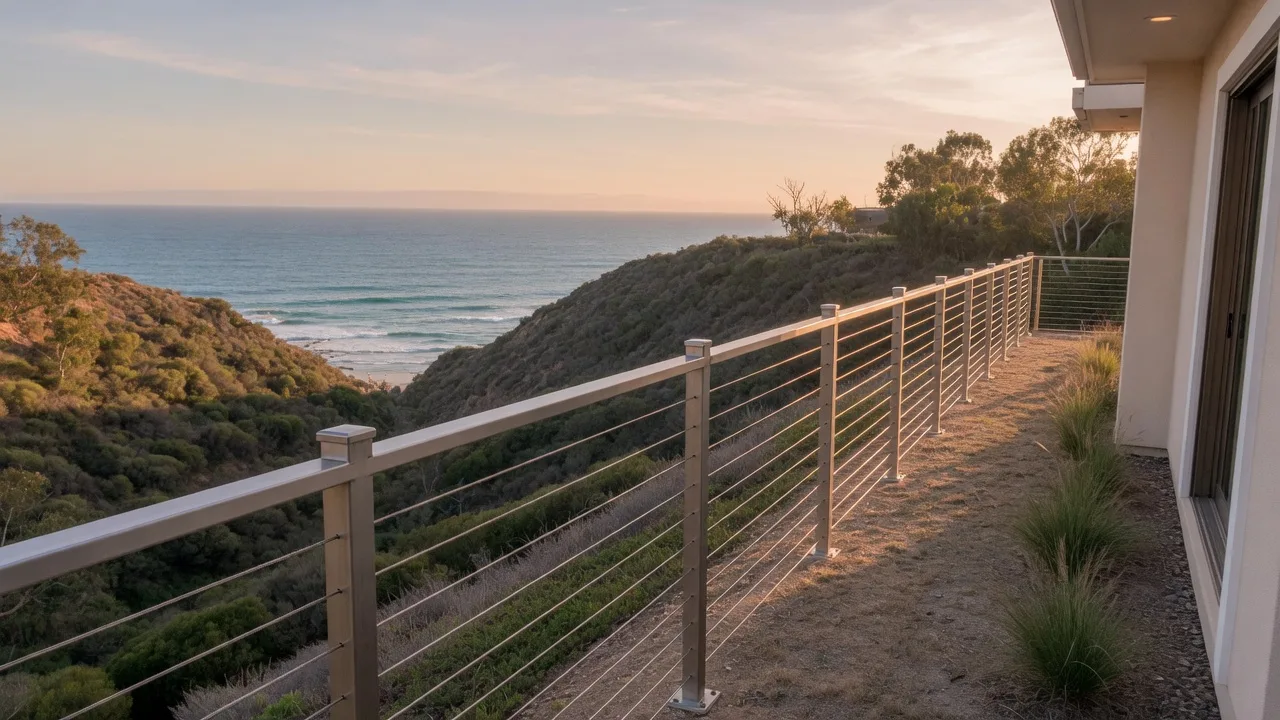
A cable rail fence on a San Diego lot is usually a view fence: horizontal stainless cables between metal posts along a bluff, a canyon, or a pool terrace where a solid board would kill the sightline. Search results are full of deck-railing kits. A deck guard and a property-line fence are different permits, different loads, and often different trades.
Property line versus deck guard
A deck cable railing is part of a walking surface. Guard height, opening size, and attachment to the deck framing are building-code questions for that structure. This site does not publish a statewide guard-height number for every deck. Confirm the current California Building Code requirement with the building department for that deck.
A property-line view fence is a fence. C-13 covers fences, gates, posts, railings, and related work, and excludes masonry walls. A matched fencing contractor can bid a cable view run on grade. If the same cables sit on a second-story deck, ask who is the contractor of record for the guard, and whether a building permit is required for that guard. Do not assume a fence bid covers a deck rebuild.
This is also not the metal fence guide comparison of aluminum versus steel pickets. Picket spacing is a privacy and climb question. Cable spacing is a view and “what can pass through” question. Dogs, toddlers, and pool enclosure rules do not care that the ocean looks good.
If the run is part of a private pool enclosure, California Health and Safety Code §115923 still applies: minimum 60-inch height, maximum 2-inch ground clearance, no 4-inch-or-larger sphere passage, gates that swing away from the pool, self-closing and self-latching hardware with the latching device at least 60 inches, and an exterior that lacks child climb features. Horizontal cables can be climbable. Confirm with the building department whether a cable view run is allowed as the enclosure. Many lots keep a code enclosure at the water and a cable view fence at the bluff.
Coastal salt in La Jolla, Point Loma, and Encinitas eats cheap fittings. Inland sun in El Cajon does not. Ask for the alloy and the fitting finish in writing. This site has no verified lifespan for stainless cable.
What belongs on a cable view-fence proposal
- Post size, material, spacing, and footing. Cable tension pulls posts inward. Light decorative posts fail first.
- Cable diameter, strand count, height of each run, and end fittings (through-post, lag, or hidden).
- How tension is applied and who retensions after the first season.
- Top rail or no top rail. A top rail changes the look and the climb.
- Terminal posts versus line posts. Corners and ends take the load.
- Gate: a cable gate is a different frame. Hinges, latch, and how cables terminate at the leaf.
- Grade: stepping versus racking. Cables that follow a steep canyon need a plan at each break.
- Height against City Table 142-03A and County PDS070 zoning summary, confirmed for the parcel. A view fence on a front bluff is often in the street-side height band.
- HOA or coastal review if the lot has one. Get the current rule. Do not use a neighbor’s old approval.
Civil Code §841 still applies on a shared side line. Thirty days’ written notice before you spend.
A kit from a national cable-railing shop is materials. Setting posts in decomposing granite on a Point Loma grade is the job. Business and Professions Code §7048’s $1,000 exemption is not a bluff-top railing advertised as contractor work. Verify the C-13.
Fence Pros San Diego is a referral service. We do not fabricate cable, we do not install, and we do not set prices. We match you with licensed, independent local fence professionals. You contract with the pro directly.
Call when you want a view fence of cables and posts on a San Diego County lot, and a licensed contractor to spec the posts, tension, and whether the run is a fence, a deck guard, or both. Call us at (858) 400-4906 and we will connect you with a licensed fence contractor.