A concrete fence post is the post itself, poured or precast, not the footing that holds a wood or steel post in the ground. People use the two terms interchangeably, and that mix-up is where most confusion about cost and durability starts.
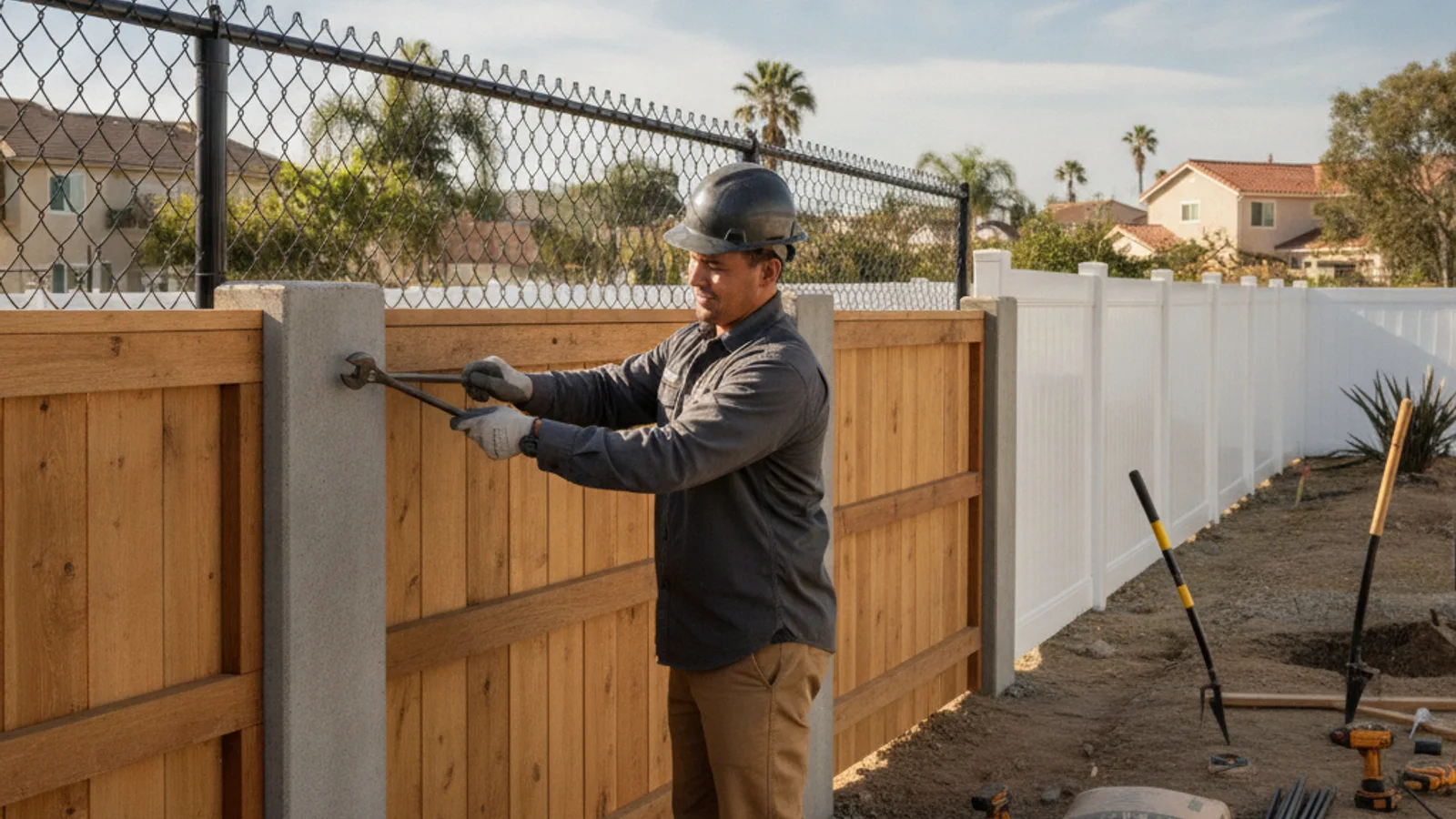
San Diego’s soil is not uniform. The coastal plain and much of the central city sit on expansive clay that swells when it rains and shrinks in the dry months, while East County runs into decomposed granite and rock that resists digging but drains fast. Either condition can change whether a concrete post, a wood post, or a steel post makes the most sense for a given yard.
Concrete posts versus wood and steel
A wood post is lumber set into a footing, usually pressure-treated pine or cedar. A steel post is a galvanized or powder-coated tube. It’s often hidden behind wood rails. That way, the fence still looks like solid wood from both sides. A concrete post is different from both. The post itself is precast concrete. It may have a decorative cap or grooves for sliding panels. It never has a wood core to rot.
That removes one failure point entirely. Wood posts fail first at the soil line, where moisture sits longest. Steel posts resist rot but can still corrode at welds or cut edges if the coating is damaged during installation. Concrete posts don’t have that vulnerability, which is why they show up most often on commercial and high-wind properties, and increasingly on residential jobs where a homeowner wants a fence they won’t think about again for decades. The tradeoff is weight and handling: concrete posts are heavier to move and set, which affects labor more than material cost.
How San Diego’s soil changes the footing decision
The footing, the concrete collar poured around the base of any post, behaves differently depending on where you live. In clay-heavy areas near the coast and through the central valleys, the ground expands when saturated and contracts when it dries. That cycle can crack footings and push posts out of plumb. Over time, the same movement can undermine a good post. This can happen regardless of the post’s material.
East County properties, from El Cajon out toward Alpine and Descanso, often hit decomposed granite or bedrock a foot or two down. That soil doesn’t swell the way clay does, but it’s harder to dig and can require different equipment or a different footing shape to get a solid anchor. A contractor who has worked both sides of the county will size the footing to the soil in front of them, not to a generic spec sheet.
If your property has a history of leaning fences or cracked concrete on a previous fence, mention that during the estimate. It tells the contractor something about the soil that a fresh site visit alone might miss.
Where rot actually starts on a mixed-material fence
Most fences that use concrete posts still attach wood or vinyl panels between them, and the spot where those two materials meet is where drainage problems show up first. Concrete holds moisture longer than the surrounding soil, and if a wood rail sits directly against a damp concrete surface with nowhere for water to escape, that rail rots faster than the same rail would on an all-wood wood fence with open ground underneath.
The fix isn’t complicated: a small air gap, a drip edge, or a bracket that holds the wood rail slightly off the post face instead of flush against it. Ask whoever quotes the job how they plan to handle that connection point. If the answer is a shrug, that’s worth noting before you sign anything.
Attaching wood or vinyl panels to a concrete post
Concrete posts are usually cast with a groove, a routed channel, or embedded brackets that panels slide or bolt into, rather than nailed the way a wood post accepts a rail. That’s a design decision made at the factory, so the post and the panel system often need to come from compatible product lines, or the installer needs hardware built to bridge the two. This is one more reason to ask early in the process rather than after the posts are already in the ground.
Vinyl panels typically use a similar slotted approach, which is part of why concrete posts and vinyl fence systems get paired together fairly often on the coast, where salt air is harder on exposed steel hardware than on concrete or vinyl.
What a bid should specify in writing
Two bids for the same fence can describe completely different posts underground, even if the fence looks identical once it’s built. Rather than quote a specific post depth or footing diameter here, since the right number depends on your soil, your fence height, and local wind exposure, ask any contractor bidding the job to put these details in writing:
| Ask for in the bid | Why it matters |
|---|---|
| Post depth below grade | Shallow-set posts are the most common cause of a leaning fence within a few years |
| Footing diameter and shape | A footing sized for the post, not a generic default, holds better in clay and rocky soil alike |
| Drainage detail at the concrete-to-wood joint | Determines how fast the adjoining wood or hardware deteriorates |
| Whether posts are precast or poured on site | Changes lead time, handling, and how repairs are done later |
A written bid that answers all four questions is worth more than a verbal number that answers none of them. If you’re comparing that to a fence with wood posts, our guide to steel posts for wood fences covers the middle option between standard wood and full concrete.
When concrete posts are the smartest investment
Concrete posts make the most sense on fences that face heavy wind exposure, commercial or rental properties where nobody wants recurring fence post repair, and any site where a previous wood-post fence has already failed once from rot or soil movement. They’re a poor fit for a small, low-stakes backyard project where a standard wood post with a solid footing would do the job at lower material cost and less handling labor. Either way, a contractor scoping a new fence installation should walk you through the tradeoff for your specific property rather than defaulting to one post type.
Frequently asked questions
Are concrete fence posts stronger than steel posts?
Both resist rot completely, which is the main advantage over wood. Concrete adds mass and rigidity that resists wind load well, while steel adds strength with less weight to handle during installation. Neither is a clear winner across every site; the right choice depends on wind exposure, soil, and what the fence panels are designed to attach to.
Do concrete posts need a different footing than wood posts?
Often yes, because the post itself is heavier and the connection to the footing works differently than a wood post embedded in wet concrete. Ask the contractor bidding the job how they size the footing for a concrete post specifically, not for a generic post type.
Will a concrete post crack in San Diego’s clay soil?
The post itself is much less likely to crack than the footing around a wood or steel post, since expansive clay mostly affects the ground movement around the base, not the post material. A properly sized footing, matched to the soil on your property, is still the part that determines whether the whole assembly stays plumb over time.
Can I mix concrete posts with an existing wood fence?
Sometimes, if you’re replacing failed end posts or corner posts one at a time. The panel attachment method has to match, though, so confirm with the installer that the concrete post’s groove or bracket system is compatible with your existing rails before treating this as a simple swap.
When to call us
A fence project that involves changing post material, mixed footings, or a soil condition that’s already caused problems once is worth a site visit before you commit to a bid. Have your property address, the fence’s current age and material, and any photos of past leaning or cracking ready when you call. Call us at (858) 400-4906 and we’ll connect you with a licensed fence contractor.