National City’s lots sit on a tight urban grid, and most driveways here are short, often just a car length or two from the sidewalk to the garage or carport. That changes the driveway gate conversation from “what style do you want” to “what fits, and what does it need to keep secure.” Security is usually the driving reason someone in National City is looking at a gate in the first place.
Why wrought iron is the common choice here
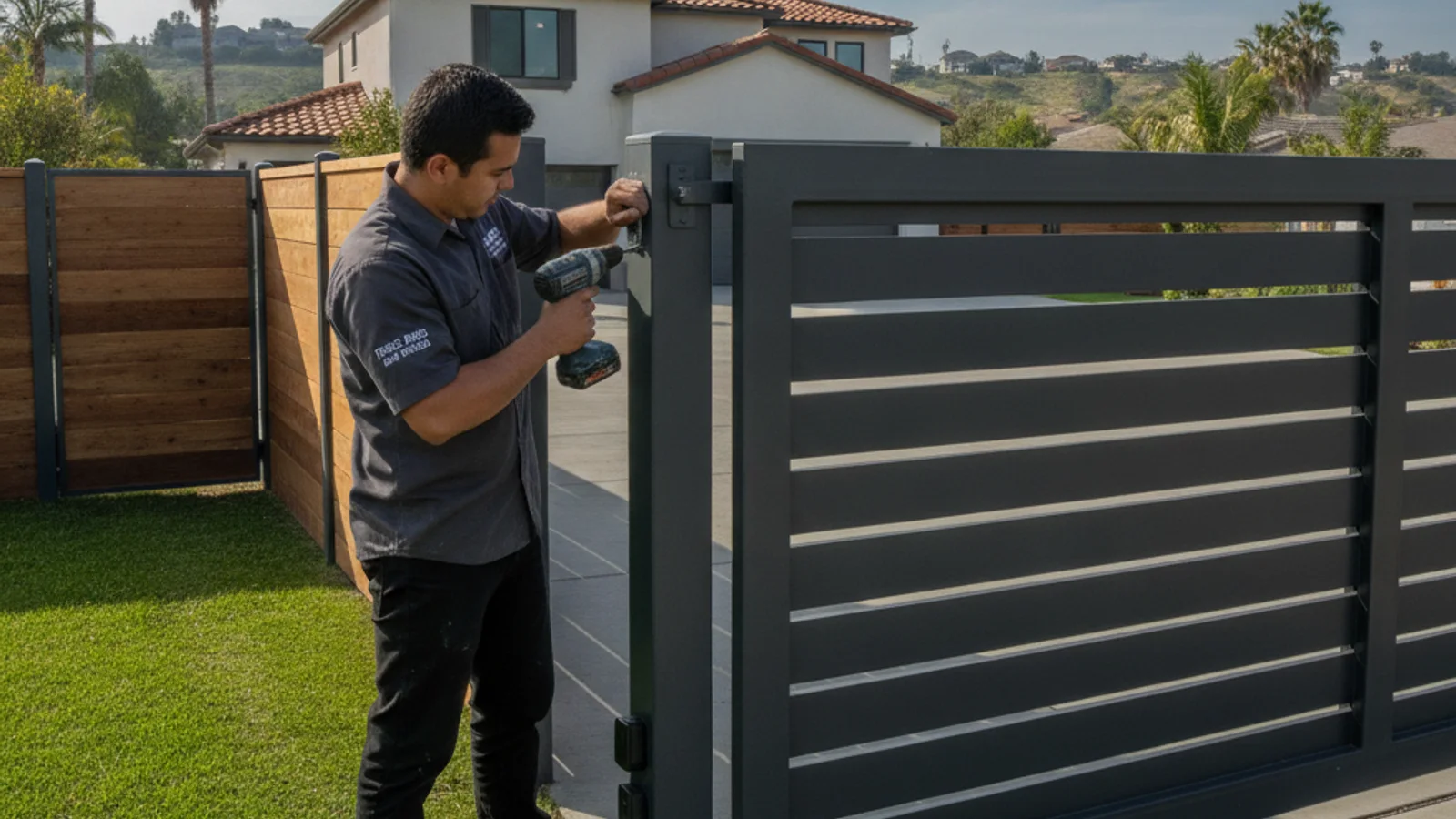
Wrought iron and ornamental steel are the fence and gate idiom you see most often across National City’s older residential streets, and there’s a practical reason beyond appearance. A short driveway doesn’t leave much room for a wide swing arc or a long slide track, and an iron gate’s narrower, sturdier profile suits a compact opening better than a bulkier wood panel would.
Iron also holds a security-focused design well, with narrower picket spacing that limits hand and foot holds without blocking visibility the way a solid panel does. On a short driveway close to the sidewalk, being able to see who’s at the gate matters, and an open picket design supports that better than a solid barrier. Our wrought iron fence guide for National City covers design and hardware options specific to this material in more depth.
Fitting a gate to a short driveway
A short driveway limits your swing and slide options more than a longer one would. A single swing panel needs open space to arc into, and on a driveway just long enough for one car, that arc may eat into usable space or conflict with a walkway or planting bed along the side.
Ask the bidder to measure your actual opening width and the clearance on either side before proposing a layout. A narrow double-swing gate, where two smaller panels open inward or outward, can sometimes work in a space where a single wide panel wouldn’t. A short sliding gate is another option, though it still needs a level run along the property line for the gate’s width plus overrun, which a tight urban lot may or may not have.
If your home sits close to the front property line, as many National City houses do, ask how close the gate can sit to that line without crossing into the public right of way, and confirm the current answer with the city rather than assuming.
Access control for a security-focused gate
Since security is usually the reason for the gate, spend real time on how you’ll control access before you finalize the design. A keypad mounted at the gate lets you assign and change codes without handing out a physical key. An intercom with a camera lets you see and talk to whoever’s at the gate before it opens, which matters on a lot set close to a public sidewalk.
Ask whether the proposed system integrates with an existing home security setup if you have one, or whether it’s a standalone unit. Ask, too, how remote access works if you want to open the gate from inside the house without walking to it, and how many remotes or codes the base system supports if multiple household members need access.
A gate is only as secure as its weakest connection point, so ask the bidder how the gate posts and hinges are reinforced against forced entry, not just how the automation works. On a security-focused install, the hardware spec matters as much as the opener brand.
Safety devices on a compact automated gate
An automated gate on a short driveway needs the same core safety hardware any automated gate needs: an obstruction sensor that stops or reverses the gate if a person, pet, or vehicle is in its path. On a compact National City lot, the gate’s swing or slide path is often close to a walkway, a parked car, or the sidewalk itself, so ask the bidder how the sensor is positioned to cover the full path, not just the leading edge of the panel.
Ask, too, how the gate behaves during a power interruption. A gate that fails in the open position is a security gap, and one that fails in the closed position without a manual release can trap a vehicle inside. Ask specifically how the manual release works and where it’s located, since on a tight lot that release needs to be reachable without squeezing past a parked car.
If children live in or visit the home, ask how the gate’s automation avoids closing on someone standing in the opening, and whether a keypad or intercom placement keeps a person clear of the moving panel while they enter a code or wait for a response.
Matching the gate to your existing fence and property line
A driveway gate on a National City lot usually connects to a fence that already runs along a tight side yard or property line, and the bid should describe how the new gate posts tie into that line. Ask the bidder to look at the condition of the fence sections on either side of the planned gate, since an older National City property may have fence sections with different ages, materials, or wear than the new gate will have.
If your property line is unclear or has never been surveyed, resolve that before any post is set. A contractor’s tape measure isn’t a substitute for a property survey, and on a tight urban lot where inches matter, a gate set slightly off the true line can create a dispute with a neighbor that’s harder to fix after the concrete has cured.
California Civil Code Section 841 generally presumes that adjoining landowners share equal responsibility for the reasonable costs of a dividing fence, unless they’ve agreed otherwise in writing, and requires 30 days’ written notice to affected neighbors before incurring shared costs. That notice needs to describe the problem, the proposed solution, estimated costs, the proposed cost split, and a timeline. If your gate project touches a shared property line fence, that notice requirement is worth understanding before you start.
Confirm National City’s current permit rules
National City has its own permit process, separate from the county and separate from neighboring Chula Vista or San Diego. Confirm current setback, height, and permit requirements directly with the city before finalizing your gate design, and ask the bidder to state in writing who handles that confirmation and any required paperwork.
If your lot is close to a corner or an intersection, ask specifically about visibility requirements, since a solid gate or fence near a corner can raise a different review question than the same design set mid-block. Our permit guide by city explains how these requirements vary by jurisdiction across the county, and the gate installation service page covers the base scope for a new install.
What to compare in two National City bids
Line up your quotes and check that both specify the same gate width, the same picket spacing or panel style, and the same access control components. A bid that says “security gate with keypad” without naming the keypad model or the reinforcement at the hinge side is hard to compare against one that spells it out.
Verify each bidder’s license through the CSLB license lookup before signing. A C-13 fencing license covers gates and related hardware but excludes masonry walls, so if your entry design includes a block or stone pillar, confirm which license covers that portion of the work.
When to call us
A National City driveway gate is usually about security first, and that means the access control and hardware spec deserve as much attention as the gate’s look. Fence Pros San Diego is a referral service. We do not employ crews and we do not certify insurance. Verify C-13 yourself at cslb.ca.gov. Call us at (858) 400-4906 and we’ll connect you with an independent fence contractor.