A driveway gate in Oceanside has to survive salt air, not just look good in a driveway. The city runs from harbor-adjacent lots that catch the marine layer every morning to inland tracts near Rancho del Oro that barely notice it, and that difference changes what hardware and layout actually make sense here.
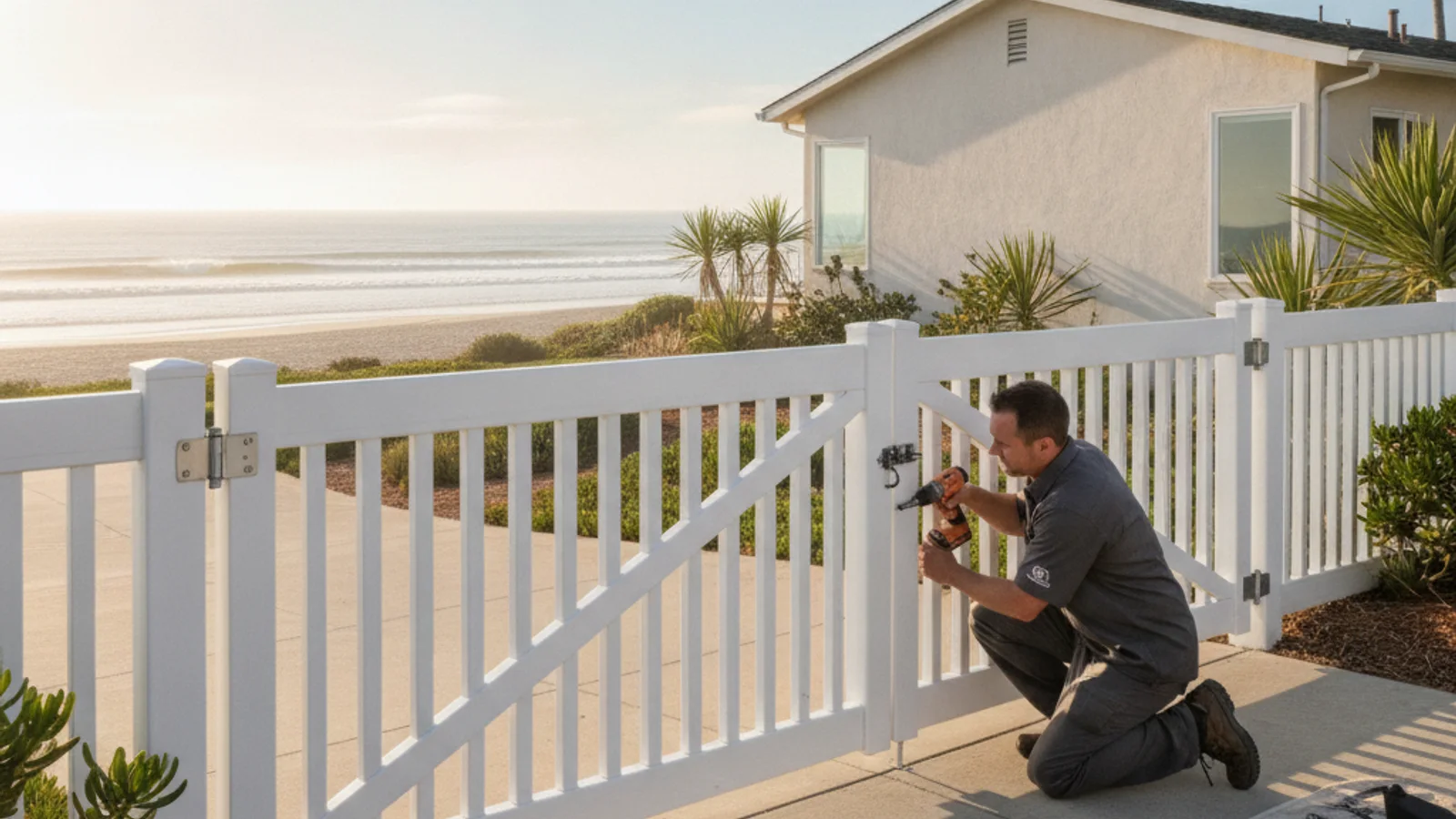
Oceanside’s coastline decides more of this than the driveway does
Most gate guides start with swing versus slide. In Oceanside, start with distance from the water instead, because that’s what determines whether a plain gate spec will hold up. The marine layer rolls in most mornings and carries salt inland well past the beach blocks, so a property that “isn’t on the coast” by a few streets can still sit inside the corrosion zone.
That matters because a gate at any distance from the water still needs to open and close a few times a day for years. A hinge or latch that starts corroding in year two turns into a service call, and a control box that wasn’t sealed against moisture is a common failure point on the west side of the city. None of this is a reason to skip an automatic gate. It’s a reason to have the installer walk the property and talk about hardware grade before the layout gets finalized.
The older neighborhoods near the harbor and downtown tend to have narrower lots with less room to work with, while the newer tracts inland toward Mission and South Oceanside were built with wider driveways and more setback from the street. Both situations support an automatic gate. They just support different gate types.
Beach-adjacent lots versus the inland tracts
On the older, beach-adjacent lots, driveways are frequently narrower and closer to the front property line, which limits how far a swing gate can arc without clipping a parked car or a planter bed. A sliding gate that runs along a side fence line often fits these lots better, provided there’s a clear run beside the driveway for the gate to travel into when it opens.
Inland, the newer tracts generally have more room. A wider driveway with a level approach gives a swing gate the clearance it needs, and there’s often enough side yard for a slide gate too, so the decision comes down more to what the homeowner wants than what the lot forces. A property that backs up to a slope, which does happen in the eastern parts of Oceanside, may need the same grade considerations that inland North County cities deal with, and that’s worth flagging to your installer during the site visit rather than after materials are ordered.
Either way, the installer needs an accurate measurement of the opening width, the available side clearance if you’re considering a slider, and any obstructions like a mailbox, meter box, or slope that could interfere with the swing or track.
Hardware that holds up against the marine layer
This is the part of the spec that’s easy to skip and expensive to fix later. Standard zinc-plated hardware corrodes faster near the coast than most people expect, not just at the beach itself but for a meaningful stretch inland while the marine layer is still thick enough to deposit salt. Stainless steel or hot-dip galvanized hardware costs more upfront and holds up longer in that environment, which matters more for a gate than for almost any other part of a fence, because a gate has moving parts that need to keep working, not just stand there.
Ask specifically what grade of hardware is going into the hinges, the latch mechanism, and the fasteners holding the operator arm to the post. Ask whether the control box is rated for outdoor, moisture-heavy environments, not just “weatherproof” in general terms. If your property sits close enough to the water that you notice salt residue on your car windows in the morning, that’s a reasonable signal to ask harder questions about the hardware spec before you sign anything.
Camp Pendleton turnover and what it means for gate specs
Oceanside has a large population of military families connected to Camp Pendleton, many of whom move on a several-year cycle. That reality shows up in the rental market here more than in most San Diego cities, and it changes what a landlord or property manager might prioritize in a gate installation compared to an owner-occupant.
A rental property with regular tenant turnover sees more cycles on a gate operator and more wear on remotes and keypads than an owner-occupied home does. If you’re installing a gate on a rental, ask the installer about a control setup that’s easy to reprogram between tenants, rather than one that requires a technician visit every time the access code needs to change. That’s a conversation worth having up front, since retrofitting a simpler control system later usually costs more than specifying it correctly the first time.
What to bring to a gate quote in Oceanside
Before you call around for quotes, know your driveway’s opening width, whether you’re working with a level approach or any grade change, and roughly how far from the coast your property sits. Take a few photos of the driveway from the street and from inside the property, including anything that might obstruct a swing arc or slide track. If the property is a rental, mention that upfront so the installer can talk through control options that fit tenant turnover.
A gate installation in Oceanside is an electrical project as much as a fencing one, since the operator, sensors, and any keypad or intercom need a wired or solar power source and proper conduit runs. Confirm your installer’s license status through the CSLB’s online lookup before work begins. For a broader look at swing versus slide mechanics, our automatic driveway gate guide for San Diego covers the fundamentals that apply countywide, and our coastal fence and salt-air hardware post goes deeper into hardware grades for properties near the water. If you’re comparing fence contractors generally in the area, see our Oceanside fence company guide.
Frequently asked questions
Do I need special hardware for a driveway gate near the Oceanside coast?
Standard zinc-plated hardware corrodes faster in Oceanside’s marine layer than it does further inland, and the corrosion zone reaches well past the immediate beach blocks. Ask your installer about stainless steel or hot-dip galvanized hardware for hinges, latches, and fasteners, and confirm the control box is rated for a moisture-heavy outdoor environment.
Should I choose a swing gate or a sliding gate for my Oceanside driveway?
It depends on your lot. Older, beach-adjacent lots with narrower driveways often work better with a sliding gate that runs along a side fence line. Newer inland tracts with wider driveways and more setback frequently have room for either type. Have the installer walk the property before deciding.
Does a rental property need a different gate setup than an owner-occupied home in Oceanside?
Not a different gate, but often a different control setup. Rental properties with regular tenant turnover, common in Oceanside because of Camp Pendleton, benefit from a system that’s easy to reprogram between tenants rather than one that requires a service call for every code change.
Do I need a permit for a driveway gate in Oceanside?
The specific permit requirements for driveway gates in Oceanside couldn’t be confirmed from the approved sources. Check the current requirements directly with the City of Oceanside before your installer schedules the work.
When to call us
A driveway gate in Oceanside involves electrical work, moving parts, and a hardware spec that has to match how close you sit to the coast, so it’s worth getting a professional assessment before you commit to a layout. Have your driveway measurements and a few photos ready. Call us at (858) 400-4906 and we’ll connect you with a licensed local gate installer.