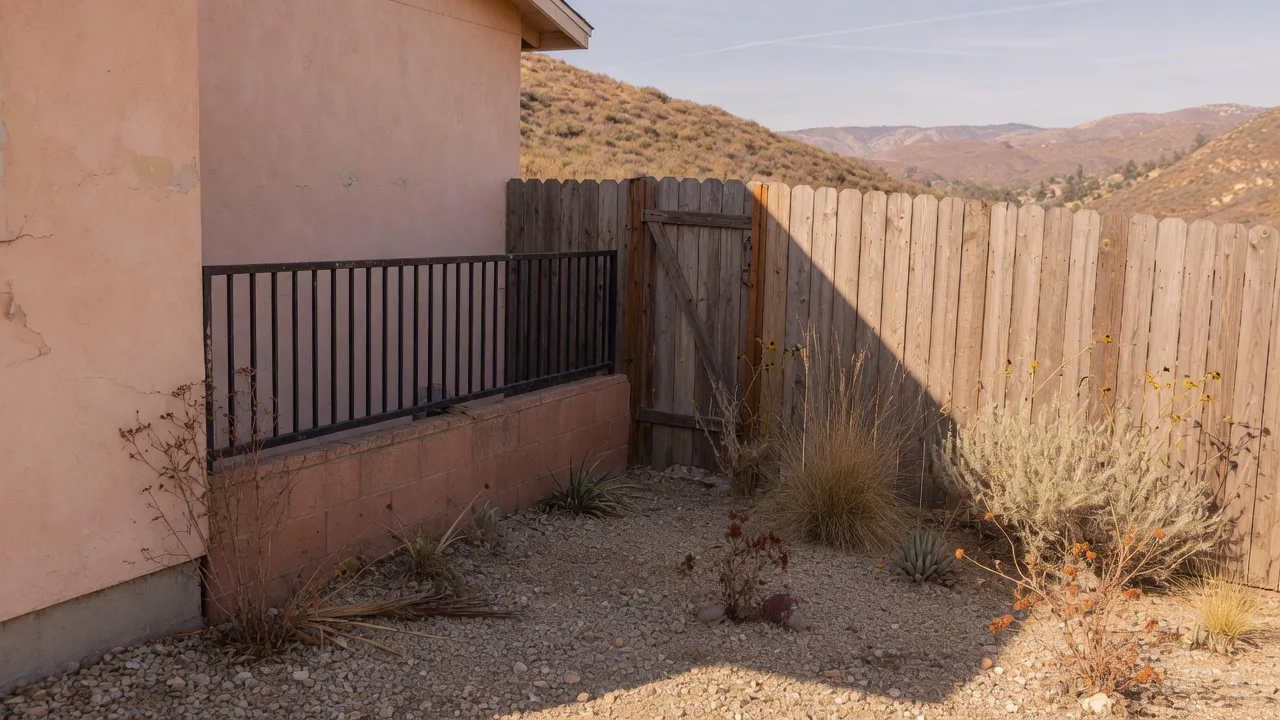
A wood fence that ties into the house is a fire pathway, not only a style choice. Two different governments already published rules for San Diego County lots. They are not the same document. Read the one that matches your address, then confirm it with the fire authority before anyone cuts posts.
City of San Diego: Zone 0 in Very High Fire Hazard Severity Zones
The City’s Fire-Rescue Guide to Defensible Space defines Zone 0 as the area within 5 feet of a home or building, including outbuildings, attached decks, and stairs. One of the listed steps is: replace combustible fencing, gates, and arbors with noncombustible alternatives. The same page says Zone 0 is required for new structures in Very High Fire Severity Zones after February 28, 2026, and that existing owners should aim to meet Zone 0 guidelines by February 2027, pointing to AB 3074. Check whether the parcel is in the City’s Very High Fire Severity Zone.
San Diego Fire-Rescue’s Zone 0 Guidelines for Existing Structures (PDF posted April 2026) interpret SDMC §512.0604. Scope, as written there: these requirements apply to structures in a Very High Fire Hazard Severity Zone within the City of San Diego. Zone 0 applied to new structures on February 28, 2026. It applies to existing structures beginning February 28, 2027. Section 4.6, Fences and Gates, is the fence paragraph:
- Where an existing fence or gate is attached and extends out perpendicular from the structure, a minimum 5-foot non-combustible transitional span is required.
- Fences outside of Zone 0 have no changes or new requirements in that section.
- Parallel combustible fencing within Zone 0 that creates a continuous fuel pathway capable of transmitting fire to a structure is prohibited.
- As part of an approved compliance plan, existing fences and gates within 5 feet of the structure must be non-combustible unless they meet stated exceptions. Existing vinyl, and fencing without combustible reinforcement, may stay within 5 feet if it runs parallel to the structure walls, is no less than 4 feet from the structure, does not present an unreasonable fire risk due to condition, height, or fuel accumulation, is kept free of debris, and has no vegetation between the fence and the structure. Existing wood may be permitted where it does not create a continuous fuel pathway, as determined by the fire code official.
- New parallel wood is permitted if it is fire-retardant treated wood, meets the vinyl conditions, and is on the California Office of the State Fire Marshal WUI Products Handbook for exterior use.
The same guidelines say the City will prioritize education first, with enforcement beginning on or after February 28, 2027, and a phased compliance plan running until February 28, 2029. Insurance and IBHS may be stricter. This page is not an insurance document.
Do not treat a statewide Board of Forestry draft as if it were already your lot’s law. The City PDF notes the Board released an updated draft on April 17, 2026. Use the City guidelines and the fire official for a City address.
Unincorporated County: PDS070, five feet from a building
County of San Diego PDS070, Fences, revised 01/01/2023, is a different paper. It applies in unincorporated areas. Under “Fire-Resistive Construction in Wildland Urban Interface Areas” it states: any portion of a fence within 5 feet of a building shall be constructed of non-combustible material or approved exterior fire-retardant wood or material that meets the same fire resistive standards for exterior walls per Section 707A of the County Building Code.
PDS070 also lists the permit exemption for fences and walls no higher than 6 feet if zoning compliant, and the zoning summary of 42 inches at the front and exterior side and 72 inches at the rear and interior side. WUI material next to the building does not erase those height rules.
Confirm the parcel on current CAL FIRE Fire Hazard Severity Zone maps. City lots and County lots are not interchangeable. A Ramona address and a Tierrasanta address can both sit near wildland and still report to different officials.
What the contractor should write down
- Which jurisdiction: City of San Diego VHFHSZ, another city, or unincorporated County.
- Which document they are bidding against: City Zone 0 guidelines section 4.6, County PDS070, or another city’s fire code. Name it.
- The first 5 feet: material, how it attaches, and whether the span is perpendicular or parallel.
- Whether existing vinyl is being kept under the City exception, with the 4-foot offset measured.
- Gates in that band: combustible gate leaves attached to the house are in the same conversation as the fence.
- Debris and vegetation between the fence and the wall. The City exception requires that space kept clear.
- Height and permit path under Table 142-03A (City) or PDS070 (County), which still apply.
- C-13 scope: fences and gates, not masonry walls. A masonry transitional span is a different license.
Fence Pros San Diego is a referral service. We do not inspect for the Fire-Rescue Department, we do not set prices, and we do not install. We match you with licensed, independent local fence professionals. You contract with the pro directly. Verify the C-13 on the CSLB site.
Call when the fence hits the house in a fire-hazard area and you want a licensed contractor to spec a non-combustible transition, a parallel run, or a replacement that matches the document that governs your parcel. Call us at (858) 400-4906 and we will connect you with a licensed fence contractor.