For wood fence maintenance in San Diego, follow the boards, not a universal calendar. Inspect the fence, clean it gently, renew its finish as directed, and address damage while it remains limited. No verified countywide staining interval appears in this site’s approved claims ledger, so this guide uses visible conditions instead of an invented schedule.
An easy-to-follow yearly maintenance checklist
Set one date each year for a complete fence inspection. Repeat the review after any event that visibly changes the fence. The goal isn’t to predict damage. It’s to document what you can see and decide what needs attention.
Use this checklist:
-
Walk every accessible side. Check the top, middle, and bottom of each section. Stay on your property unless a neighbor gives you permission to enter theirs.
-
Photograph the fence. Take matching pictures from the same locations each year. They’ll help you compare color, alignment, hardware, and surface wear.
-
Look along the fence line. View long sections from each end. Note any board, rail, gate, or post that no longer lines up with the surrounding fence.
-
Check individual boards. Mark boards with splits, soft areas, missing pieces, raised grain, peeling finish, or exposed wood.
-
Inspect visible hardware. Look for lifted fasteners, loose hinges, missing parts, and hardware that has changed position.
-
Operate each gate slowly. Watch where it drags, shifts, binds, or misses the latch. Don’t force a gate that resists movement.
-
Remove loose surface debris. Clear leaves, dirt, and removable items resting against the fence. Don’t alter grading or dig around a post during a basic inspection.
-
Sort the findings. Create separate lists for cleaning, finish work, minor upkeep, and contractor review.
Use the fence’s actual exposure when making that list. A shaded side yard and a sun-facing boundary may show different conditions on the same property. Compare each section with nearby boards instead of expecting identical wear.
The approved claims record doesn’t establish different maintenance intervals for coastal and inland homes. Homeowners in Oceanside, City Heights, Chula Vista, and El Cajon should all rely on visible surface condition and product directions. That approach keeps the checklist useful without pretending one calendar fits every San Diego County property.
How to properly clean your wood fence without damaging it
Start every cleaning job with a dry inspection. If a board moves, a post shifts, or hardware looks unstable, stop there. Cleaning shouldn’t become an accidental repair project.
Begin with the least aggressive method. Remove loose dust and debris with a soft brush. A garden hose may be enough for light surface dirt. If you need a cleaning product, choose one specifically labeled for the wood and existing finish. Follow its directions for dilution, testing, application, rinsing, protective equipment, and disposal.
Test the method on a small, less-visible area. Let that area dry as the product label directs. Check it again before cleaning the entire fence. Look for unwanted color change, lifted fibers, coating damage, or another result you don’t want repeated.
Clean manageable sections from top to bottom. Don’t let the cleaner dry on the boards unless its label specifically calls for that. Rinse nearby surfaces as directed, and keep track of where the runoff goes.
Pressure washing requires extra restraint. There’s no verified universal pressure setting or nozzle distance in this site’s approved record. Follow the washer manufacturer’s instructions and the coating maker’s guidance. Start with the least aggressive approved setup, keep the wand moving, and test an inconspicuous area first.
Stop if the spray cuts grooves, lifts wood fibers, strips an intact finish, or moves a board. More pressure isn’t the answer to every dark mark. Some discoloration may need evaluation rather than stronger washing.
After cleaning, let the wood dry according to the cleaner and finish labels. Don’t invent a fixed waiting period. Shade, airflow, the wood’s condition, and the chosen product can affect the next step. Inspect the dry surface again before sanding, coating, or arranging repairs.
Fence cleaning and staining work best as separate decisions. Cleaning reveals the wood’s condition. That condition, plus the finish manufacturer’s instructions, should guide what happens next.
The importance of staining and sealing in our intense sun
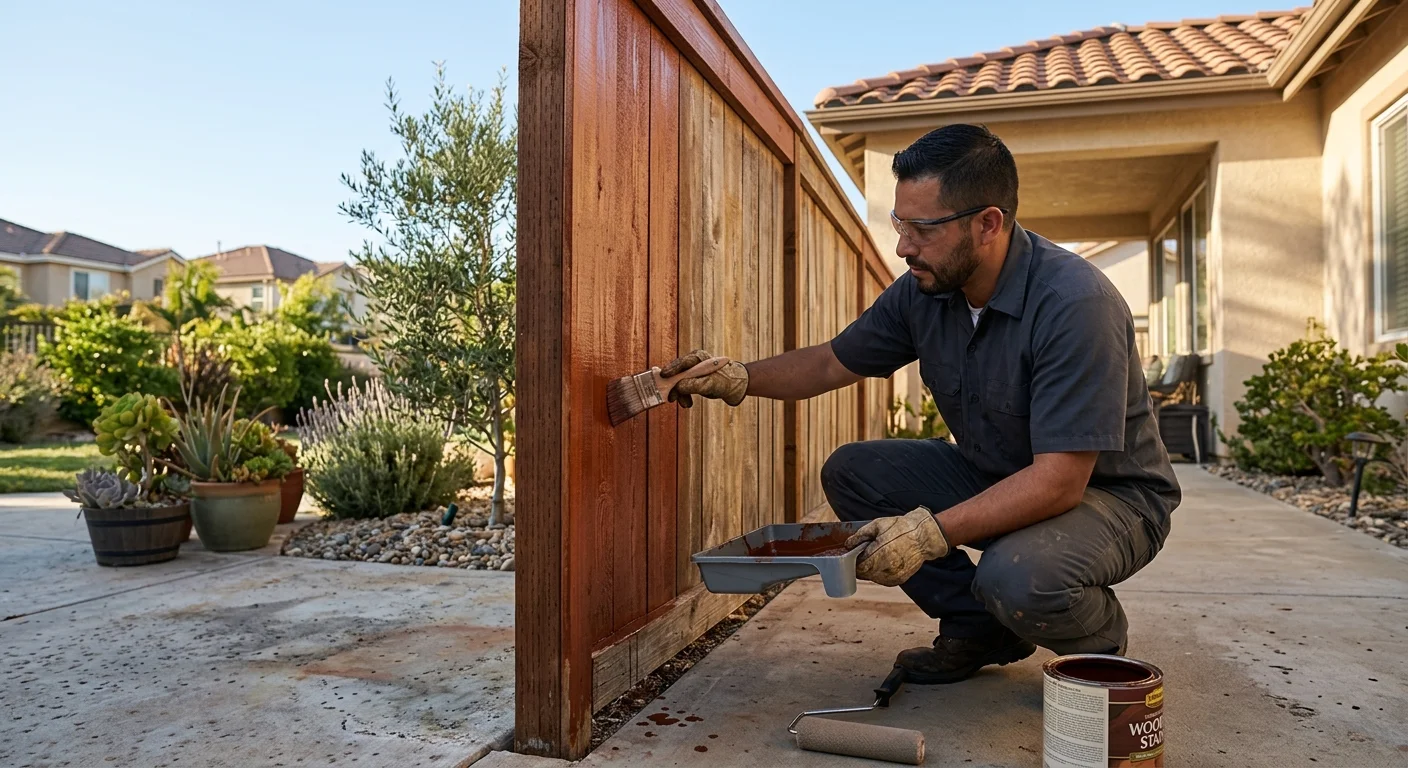
Make the sun-facing side a priority during each inspection. Compare it with shaded sections and with your earlier photographs. Look for fading, uneven color, bare patches, peeling material, raised grain, and places where the finish no longer looks consistent.
Don’t apply a new product simply because a calendar says it’s time. This site’s verified claims don’t establish a single staining interval for San Diego County. The existing coating, board condition, exposure, and manufacturer’s directions should control the decision. Our guide to how often to stain a fence in San Diego explains that condition-based approach in more detail.
First, identify what’s already on the fence. Keep the original product label or contractor paperwork when available. If you can’t identify the coating, ask the product manufacturer or a fence professional before adding another one. Don’t assume every stain, sealer, and painted surface can accept the same preparation or topcoat.
Read the new product label from start to finish. Confirm that it’s intended for exterior wood and compatible with the existing surface. Follow its instructions for preparation, weather conditions, application tools, coats, coverage, and drying. Those directions take priority over a general maintenance article.
Test the chosen finish on a small area. Check the dry appearance in both shade and direct light. A sample can reveal an unwanted color or uneven result before it covers a full fence line.
Treat cut ends, replacement boards, rails, gates, and posts according to the product directions. Don’t leave an obvious bare patch merely because most of the fence still looks coated. At the same time, don’t cover damaged wood to hide a repair problem.
Some homeowners prefer professional help when cleaning, preparation, and coating need to be coordinated. Our fence staining and sealing service connects San Diego County property owners with independent local professionals. The homeowner contracts with and pays the matched contractor directly.
Spotting and fixing small problems before they become big ones
A useful inspection ends with clear notes. Number the fence sections or describe them by location, such as driveway gate, rear boundary, or side yard. Photograph each concern beside a wider view. That record helps you explain the problem without relying on memory.
Watch for these changes:
- A board that has separated from a rail
- A fastener that has lifted or disappeared
- A gate that drags, binds, or misses its latch
- A rail that no longer follows the surrounding line
- A post that moves when the gate operates
- Wood that feels different from adjacent boards
- A split that has changed since the last photograph
- Bare areas where a finish has peeled or worn away
Limit homeowner upkeep to work you can identify and perform without forcing parts or hiding damage. Loose surface debris can be removed. Compatible finish touch-ups can follow the product label. A sound piece of accessible hardware may sometimes need basic adjustment, but stop if the wood won’t hold it or the movement returns.
Don’t push a leaning section back into place and call it fixed. Don’t cover a soft area with stain. Don’t keep tightening hardware when the surrounding wood moves. Those symptoms deserve a closer evaluation because the visible problem may involve more than one component.
For construction repairs, California’s C-13 fencing classification covers contractors who construct, erect, alter, or repair fences and gates, while excluding masonry walls. You can check a contractor’s license status through the CSLB. Fence Pros San Diego is a referral service. It does not warrant workmanship.
Shared boundary fences need coordination before paid maintenance begins. California Civil Code Section 841 presumes adjoining landowners share equal benefit and reasonable maintenance costs unless a written agreement says otherwise. It also requires 30 days’ written notice before a landowner incurs shared-fence costs. The notice must describe the problem, proposed solution, estimated costs, proposed cost sharing, and timeline.
If several boards, a rail, a gate, or a post need evaluation, professional fence repair and restoration can keep separate symptoms from turning into disconnected patchwork.
When to call us
Call when posts move, gates won’t align, boards won’t stay attached, or damage extends across several components. Fence Pros San Diego is a referral service that matches homeowners with licensed, independent local fence contractors. Call us at (858) 400-4906 and we’ll connect you with a licensed fence contractor.