What a wood fence repair costs in San Diego depends far more on scope, access, and matching than on any per-foot number quoted over the phone. Two bids on the same fence can land in different places for reasons that have nothing to do with one contractor overcharging the other.
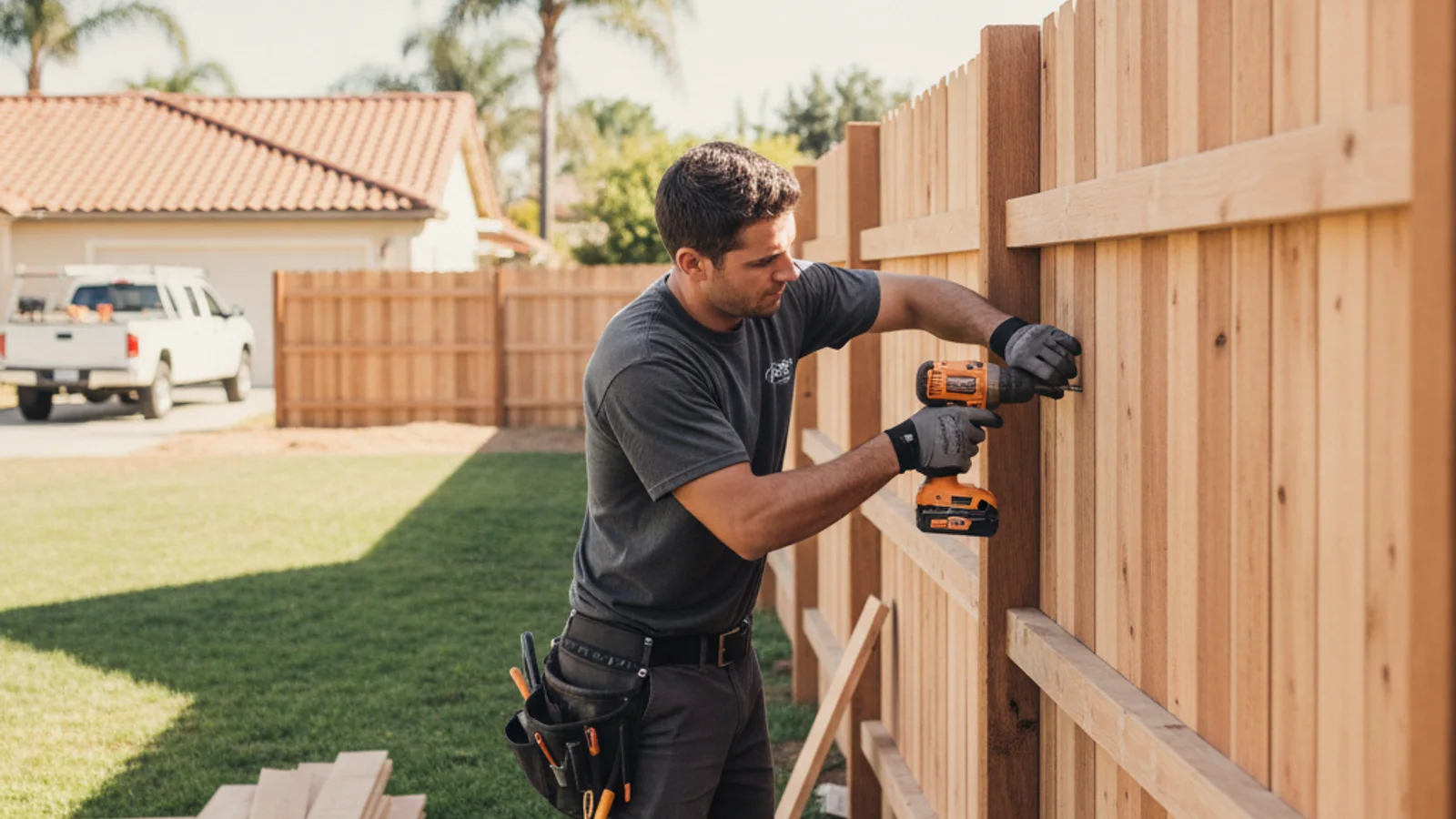
We won’t give you a dollar range here, because a real number depends on your specific fence, and any figure quoted without seeing the damage in person is a guess dressed up as an estimate. What we can walk you through is what actually moves that number, so you know what to ask when the bids come in.
The repair scope ladder
Wood fence repairs fall on a rough ladder, and where your job sits on it matters more than any other single factor. A single loose or split picket is the smallest job, quick to fix and requiring almost no matching. A full panel section, several pickets between two posts, damaged by impact, rot, or storm wind is a step up, since the whole section often needs replacing together rather than board by board. A single failed post is different again: it usually means digging out old concrete, resetting or replacing the post as part of a fence post repair, and reattaching whatever rails and panels connected to it. A full run, multiple posts and panels across one side of the property, approaches the scope of a partial fence repair rather than a single fix, even if some of the original fence stays in place.
A contractor who only hears “my fence needs fixing” over the phone can’t place your job on this ladder without seeing it, which is exactly why a phone quote is close to meaningless. An in-person look, or at minimum clear photos showing the damage from a few angles, is what turns a guess into a real number.
Access and haul-away change the bid more than people expect
A fence along an easy side yard with gate access for a truck is a different job than the same repair on a fence backing a canyon edge or a steep, terraced lot where materials and old debris have to move by hand. San Diego has plenty of both kinds of lots, sometimes on the same street, and a contractor pricing the harder access correctly isn’t padding the bid, they’re accounting for real labor time.
Haul-away is the other overlooked cost driver. Old rotted wood, broken pickets, and sometimes old concrete footing material all need to leave the site somehow, and dump fees and truck time for that debris are part of a complete bid even though they don’t show up as a separate line item on every quote.
Matching weathered wood is harder than it sounds
New lumber doesn’t match a fence that’s spent years in the sun. Cedar and redwood both gray and weather unevenly depending on sun exposure, and a repair that uses fresh, unweathered boards next to older ones creates an obvious patchwork look, at least for the first year or two until the new wood catches up.
Some contractors address this by pre-treating new boards to approximate the weathered tone, others simply set expectations that the patch will stand out initially and blend over time. Neither approach is wrong, but ask which one you’re getting, since it affects how the finished repair looks the day it’s done versus a year later.
Whether the footing is sound changes everything
A post that’s leaning because the panel attached to it took storm damage is a different repair than a post that’s leaning because the concrete footing underneath has cracked or shifted. The first case might only need the panel replaced. The second means digging out and resetting the footing itself, which is a meaningfully bigger job even though the visible symptom, a leaning post, looks identical from the yard.
This is the single biggest reason two bids for what looks like “the same repair” can differ so much: one contractor assumed a sound footing and priced the visible damage, while the other checked underground and priced what they actually found. Ask directly whether the quote assumes the footing is fine or whether someone actually checked it.
Why a per-linear-foot number over the phone tells you nothing
Per-linear-foot pricing works reasonably well for a brand-new fence installation, where the scope is uniform along the whole run. It falls apart for repair, since repair cost is driven by what’s damaged and how it’s damaged, not by how many feet of fence exist on the property. A single per-foot number, given before anyone has seen the fence, is either a rough placeholder the contractor plans to revise after a visit, or a figure not worth trusting. Our breakdown of common San Diego fence repairs shows how different the scopes really are.
How to compare two written bids
| What to check | Why it matters |
|---|---|
| Scope described in the bid | Confirms both contractors are pricing the same job, not different assumptions about damage extent |
| Whether the footing was inspected | A bid that assumes a sound footing without checking can miss the biggest cost driver |
| Wood matching approach | Affects how the repair looks immediately versus after it weathers |
| Access and haul-away noted separately | Shows whether site conditions were actually accounted for |
Get two written, itemized bids rather than two phone numbers. An itemized bid lets you compare what each contractor is actually planning to do, not just what they’re planning to charge.
Frequently asked questions
Why did one contractor’s estimate come in so much higher than another’s for what looks like the same repair?
The most common reason is that one contractor checked the footing and the other didn’t, or the two are pricing different scopes, a single panel versus a full post and panel replacement, based on a phone description rather than an in-person look.
Is a per-linear-foot price a fair way to quote a wood fence repair?
It works for new installation but rarely works for repair, since repair cost depends on the type and extent of damage rather than the total length of fence on the property. Treat a per-foot repair quote given sight-unseen as a placeholder, not a final number.
Will new wood match my existing fence right away?
Not usually. New boards look noticeably lighter and less weathered next to older wood at first, and they typically blend in over the following year or two as the new wood ages in the sun. Ask your contractor how they plan to handle the visual gap if it matters to you.
How do I know if my fence needs a post repair or a full footing repair?
That’s a judgment call best made by someone who can dig around the base and check the concrete condition in person. A post that leans as a single unit rather than bending partway up often points to a footing problem underneath.
When to call us
A wood fence repair is worth an in-person look before you compare numbers, since scope, access, and footing condition drive the bid far more than the fence’s length does. Have photos of the damage from a few angles and the fence’s approximate age ready when you reach out. Call us at (858) 400-4906 and we’ll connect you with a licensed fence contractor.