A driveway gate bid in Santee has to say more than “gate installed.” Santee sits inland in East County, where wind, dust, and heat change how a gate is built and mounted, and the city’s own building department, not some countywide default, decides what needs a permit. Before you sign anything, know what a complete bid looks like here.
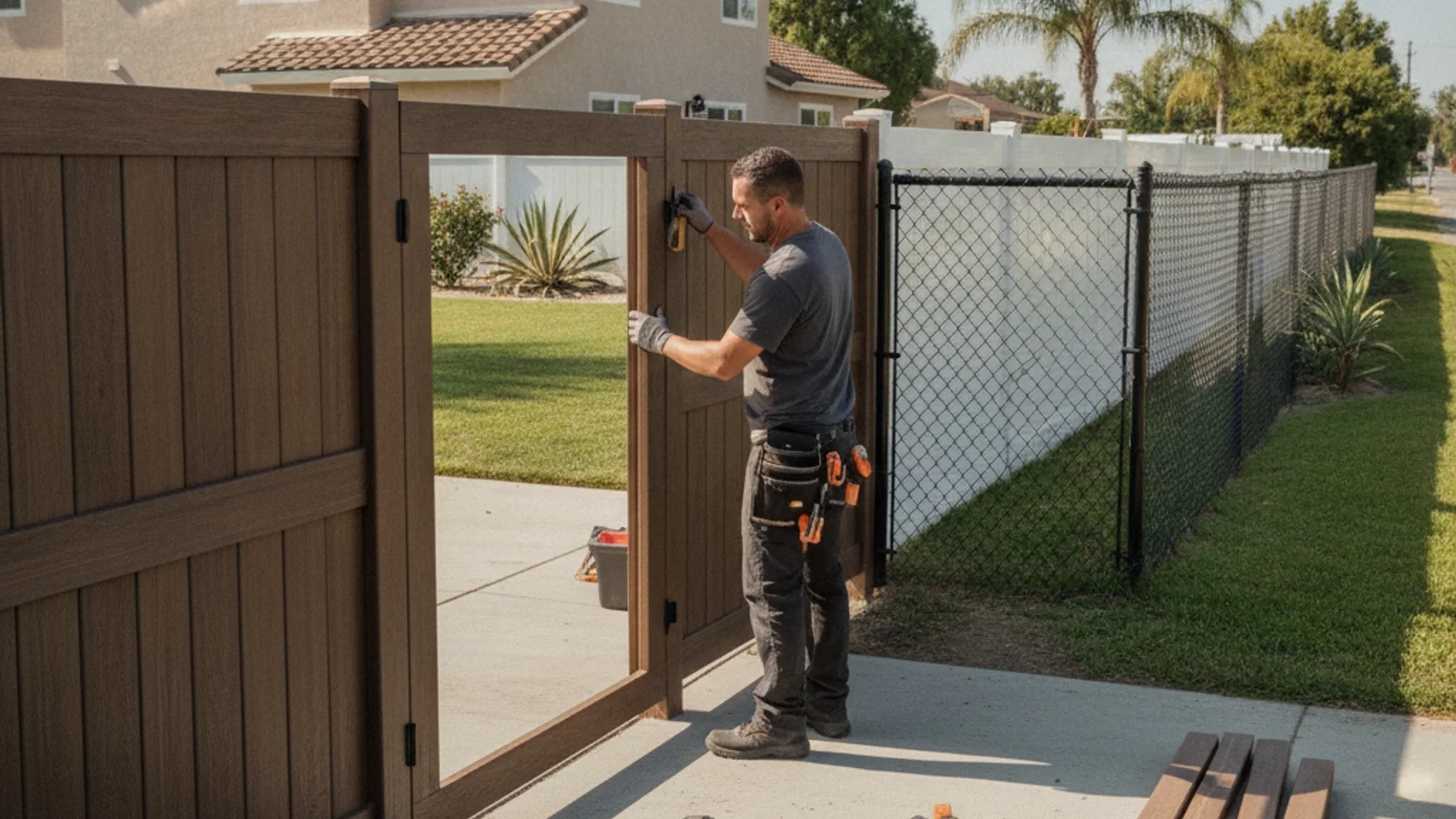
Ask who pulls the permit and confirms the setback
Santee has its own building department, separate from the City of San Diego and separate from the county. That matters because permit rules, review timelines, and inspection scheduling are all set locally, and a bid written for a different jurisdiction won’t match what Santee actually requires.
A complete bid states who is responsible for pulling any required permit: you or the contractor. It should also state that the contractor will confirm current setback and height rules with the City of Santee before finalizing the design, rather than assuming what applied somewhere else. Don’t accept a bid that skips this step because the fence looks like a simple project.
If your property sits near a public right of way or a shared drive, ask the bidder how the gate line interacts with that boundary. A gate that swings or slides across a right of way can trigger a different review than one set entirely on private property. Ask the permitting authority with jurisdiction over your property instead of relying on a contractor’s guess.
Ask, too, whether your lot falls under any HOA covenant. Some of Santee’s newer tracts carry HOA design rules on top of city permitting, and a bid that only accounts for the city misses half the approval path. Our permit guide breaks down how permitting differs by jurisdiction across the county.
Ask for the actual grade and clearance measured on your driveway
A gate bid that skips your specific grade and side clearance is a bid written from a photo, not a site visit. Santee’s lots run wider than a lot of coastal properties, and a wider driveway opening changes what fits.
Ask the bidder to state, in writing, whether your driveway supports a swing layout, a straight slide, or a cantilever slider with no ground track. A swing gate needs open space to arc into on the low side, and a rise or dip right at the street can make that swing bind or drag. A slider needs a level run beside the fence line for the full gate width plus a few feet of overrun, and a Santee lot with a slope running away from the street may not offer that without added grading.
If the bid doesn’t name a specific gate width and a specific clearance measurement, ask for both before you compare price. Two bids for “a driveway gate” that never state the actual opening size aren’t really bids for the same project.
Ask how the bid handles wind, dust, and heat
Santee’s inland location means real Santa Ana wind exposure, particularly in fall, and a driveway gate is one of the largest moving objects on a property. A swinging panel with wind load pushing against it stresses hinges and posts differently than the same gate on a sheltered coastal lot.
Ask the bidder to name the post depth and footing size they plan for your specific gate width and material, not a generic number pulled from a catalog. A wider or heavier gate on an exposed Santee lot needs a deeper, wider footing than a narrow gate tucked against a windbreak. Our Santa Ana wind fence guide covers how wind exposure changes fence and gate planning across East County.
Dust and heat matter for the hardware, not just the structure. Ask what finish is specified on hinges, rollers, and any automation components, and whether that finish is rated for repeated fine-dust exposure. A bid that lists “standard hardware” without naming the material is a bid you can’t compare against another one.
Ask for a written scope on automation and power
If the gate will be automated, the bid needs to separate the gate itself from the opener, the power run, and any safety sensors. These are different scopes of work, and a single lump number hides which parts you’re actually paying for.
Ask what powers the opener: a hardwired run from the house or a solar setup, and how far the conduit trench runs if it’s hardwired. On a wider Santee lot, that trench can be longer than on a tight urban lot, and trenching length is a real cost driver the bid should show separately. If solar is proposed instead, ask whether the panel’s proposed location gets enough consistent sun for your expected number of daily cycles.
Ask also whether the opener includes a manual release for a power outage, and how that release works if you need to get a vehicle in or out by hand. Our automatic driveway gate guide and the site’s gate installation service page cover what automation options typically involve.
Ask what safety devices are included
An automated gate is a moving barrier with real force behind it, and the bid should name the safety hardware included, not just the opener brand. Ask specifically about an obstruction sensor that stops or reverses the gate if something is in its path, and whether photo-eye sensors are included at the swing or slide path.
Ask, too, how the system behaves during a power interruption and whether it defaults to a safe, stopped position rather than continuing to move. These questions matter more on an automated gate than on a manual one, and a bid that’s silent on safety hardware is a bid worth sending back with questions before you sign.
Ask how the bid compares to a second one, line for line
Once you have two bids, lay them side by side. Do they list the same gate width, the same material, the same finish on hardware, and the same permit responsibility. If one bid is a single number and the other breaks out gate, posts, footings, automation, and site work, ask the shorter bid to match that detail before you compare price at all.
Ask each bidder for their current CSLB license number and check it yourself using the CSLB license lookup. A C-13 fencing license covers gates, posts, and related barriers, but it excludes masonry walls, so if your project includes a masonry pillar or wall section, ask which license covers that portion.
Ask how the gate matches the rest of your fence line
A driveway gate rarely stands alone. It ties into a fence that already runs along your property line, and the bid should say how the new gate posts connect to that existing line, including whether the current fence needs any repair before the gate goes in.
Ask the bidder to inspect the fence sections on either side of the planned gate, not just the gate opening itself. On an older Santee property, wood posts near the gate may have taken more wind and sun exposure than posts further down the line, and a contractor who only measures the gate opening can miss a post that needs replacing before the new gate is even hung. If your existing fence is wood and the new gate is metal, or the reverse, ask how the transition point will look and whether that matters to you before materials are ordered.
If part of your planned entry includes a masonry pillar or a block wall section framing the gate, ask which license covers that portion of the work. A C-13 fencing license covers the gate itself, the posts, and related hardware, but it excludes masonry walls, so a mixed project may need a separate qualified professional for that piece.
When to call us
A driveway gate in Santee’s wind and dust needs a bid that names footing, hardware, and permit responsibility, not a guess borrowed from a coastal job. Fence Pros San Diego is a referral service. We do not employ crews and we do not certify insurance. Verify C-13 yourself at cslb.ca.gov. Call us at (858) 400-4906 and we’ll connect you with an independent fence contractor.