An automatic driveway gate in Oceanside needs more planning than adding a motor. The opening, driveway grade, gate travel, power source, controls, and safety devices all need a site review. A clear proposal should explain each choice before installation begins.
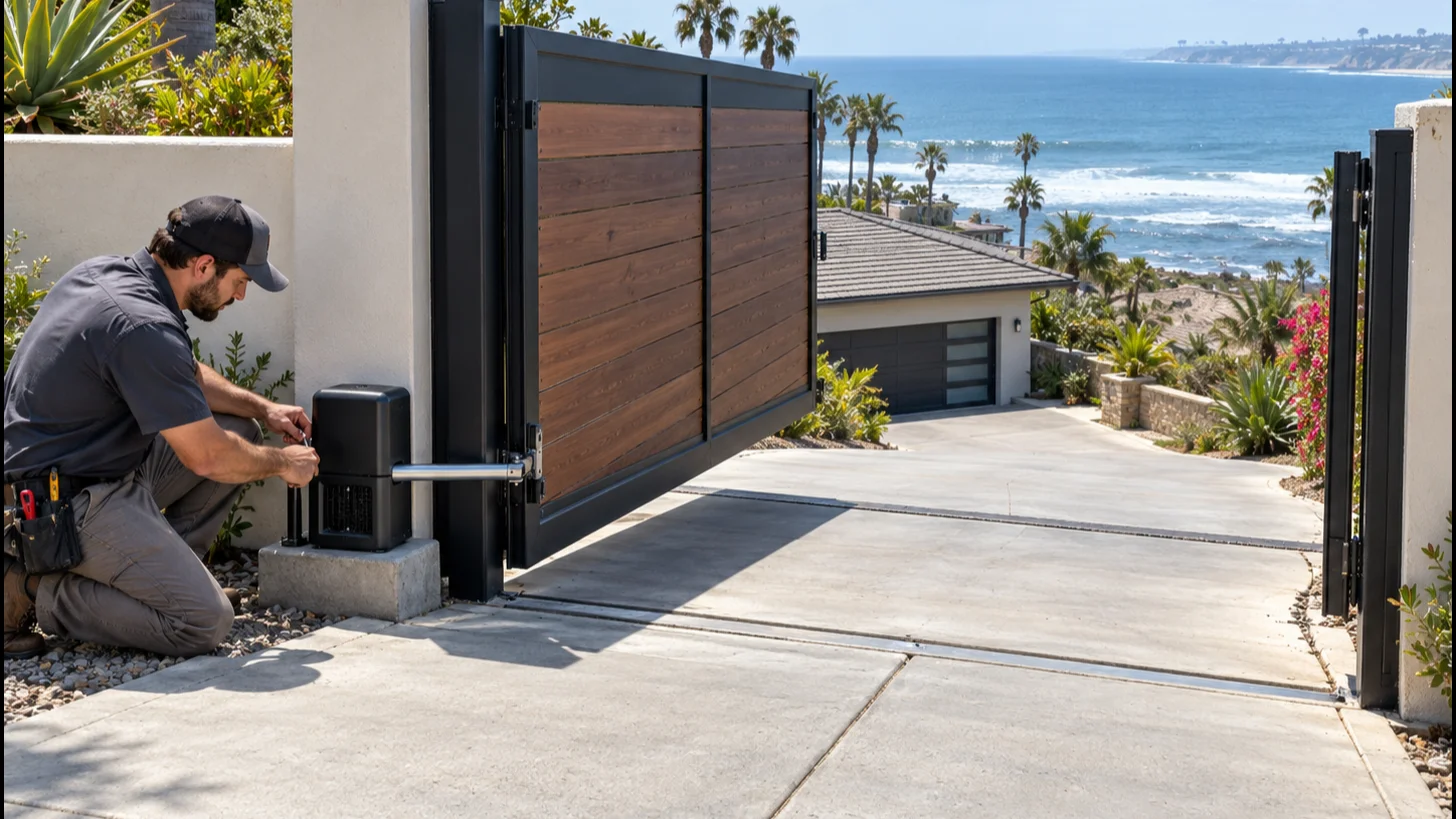
How Oceanside driveways change from the coast to inland neighborhoods
Oceanside properties don’t all present the same gate conditions. A driveway near the coast may have different visible exposure and maintenance concerns than an inland property. The contractor should inspect the actual site instead of choosing equipment from a city name or ZIP code.
Start with the driveway itself. Record its width, grade, surface, drainage path, and turning space. Note where vehicles wait while the gate opens. Check whether an open gate would interfere with parking, walkways, landscaping, or access around the home.
Coastal exposure also deserves a written discussion. Look for existing corrosion, salt residue, peeling coatings, or stiff hardware. Those observations help a contractor discuss materials, finishes, hinges, rollers, fasteners, and maintenance. They don’t support a blanket promise about how long any component will last. Our guide to salt air and coastal fence hardware explains why the visible site conditions matter.
Farther inland, the same inspection still applies. Sun exposure, wind at the opening, irrigation overspray, soil around the posts, and driveway slope can vary from one parcel to another. The proposal should identify what the contractor actually saw.
Bring several vehicle types into the conversation. A narrow daily-use car and a longer delivery vehicle may approach the opening differently. The contractor can then plan gate travel and control placement around real use.
For broader local planning, see our guide to choosing a fence company in Oceanside. Fence Pros San Diego connects homeowners with licensed, independent local fence professionals. The homeowner contracts with and pays the selected contractor directly.
What swing, sliding, and side-clearance details belong in writing
A swing gate moves through an arc. A sliding gate travels alongside the fence line. Neither layout is automatically right for every Oceanside driveway. The available space and the way vehicles approach should guide the comparison.
For a swing design, the written plan should identify the opening direction. It should also show the complete travel area. Ask the contractor to mark where each gate leaf sits when fully open. That drawing should account for parked vehicles, walkways, slopes, landscaping, and nearby structures.
A double-swing design divides the opening between two leaves. That changes the hardware, operator layout, and coordination between the leaves. The proposal should say whether one or both leaves provide everyday access. It should also identify the planned closed position and any physical stops.
A sliding design needs a clear path beside the driveway. Ask how much usable side space the proposed gate requires. The plan should identify the gate’s open position, guide hardware, rollers or other support, and the area that must stay clear. Landscaping, storage, grade changes, and fence corners can affect that path.
Don’t accept “automatic gate” as the full description. Ask the proposal to include:
- Gate configuration and opening direction
- Gate material and frame description
- Post and support plan
- Operator location
- Closed and fully open positions
- Required side or swing clearance
- Manual-release location
- Control and safety-device locations
- Any work excluded from the proposal
A contractor should also inspect the existing gate before proposing automation. A gate that drags, twists, or doesn’t align needs an explanation. The proposal should state whether the existing gate will remain, be modified, or be replaced.
Our published guide to manual driveway gates in Oceanside covers the gate opening itself. For contractor matching, visit our gate installation and automation service.
Which power, controls, and photo-eye details need site review
Power planning starts at the property, not in a product brochure. Ask the gate contractor to identify the proposed power source, route, disconnect location, and any work that another licensed trade may need to perform. The scope should separate gate work from electrical work when different contractors are involved.
Don’t assume solar power fits every site. Ask where the panel would sit and what could shade it. The proposal should identify the planned battery, charging arrangement, and enclosure. It should also explain how the gate will operate during a power interruption. Avoid accepting vague phrases such as “battery ready” without the included components being listed.
Controls need the same detail. A remote, keypad, vehicle detector, intercom, phone-based control, or scheduled access system serves a different use pattern. Ask who needs entry, how often codes will change, and how guests or service providers will request access. Rental properties, shared driveways, and homes with frequent deliveries may need different control plans.
The proposal should identify every included control by type and location. It should also explain how access credentials are added, removed, or replaced. If an internet connection or separate service is involved, ask the contractor to identify that dependency. Don’t assume an app, subscription, or cellular connection is included.
Photo eyes and other safety devices require an on-site layout. Ask the contractor to show where each device will be mounted and what area it will monitor. The written plan should explain how the operator responds when a device is triggered. It should also identify areas near the gate’s movement that need attention.
No Oceanside-specific requirement for gate operators, photo eyes, control placement, or backup power appears in the approved claims ledger for this page. The contractor and City of Oceanside should confirm which current rules and approvals apply to the parcel and proposed system.
For a countywide overview of operator choices, read our automatic driveway gate guide for San Diego.
How this differs from a manual Oceanside driveway gate
A manual gate proposal focuses mainly on the gate, posts, hinges or rollers, latch, opening direction, and clear travel area. Automation adds power, an operator, controls, safety devices, release access, and coordination between those parts.
That difference changes the site conversation. A manual gate can be evaluated by opening and closing it by hand. An automatic system needs a written operating sequence. Ask what happens when a resident arrives, a visitor requests entry, the gate encounters an obstruction, or utility power isn’t available.
Maintenance discussions also become more detailed. The contractor should separate care for the gate structure from care for the operator and controls. Ask which components need inspection, cleaning, adjustment, battery checks, or manufacturer-directed service. Any proposed schedule should come from the selected equipment documentation or the responsible contractor, not an unsupported citywide rule.
Automation can’t correct every structural problem. Existing posts, frames, hinges, rollers, tracks, and stops should be assessed before an operator is selected. Ask the contractor to document any repairs or modifications included in the scope.
The handoff matters too. Request the operator documentation, control instructions, manual-release procedure, and a list of installed components. Ask who handles gate adjustments and who handles electrical or access-control issues. Warranty terms weren’t verified for this article, so get any contractor or manufacturer coverage in writing before signing.
The best comparison uses the same opening and property conditions. Compare a complete manual-gate scope with a complete automated-gate scope. That makes the added equipment, site work, and responsibilities easier to see.
Which property questions need City of Oceanside confirmation
The approved claims ledger doesn’t contain verified Oceanside-specific driveway-gate setbacks, visibility rules, permit triggers, electrical requirements, or coastal provisions. Those details couldn’t be confirmed for this page. Ask the City of Oceanside which current rules apply before approving the final layout.
Give the city a specific project description. “Driveway gate” may not provide enough context. State whether the gate is new or existing, manual or automatic, swing or sliding, and whether posts, power, controls, or other site work are proposed.
Ask the City of Oceanside to confirm:
- Whether the proposed gate or related work needs approval
- Which property-line or setback rules apply
- Whether the opening direction affects the review
- Whether visibility requirements affect the gate or nearby fencing
- Whether any part may enter a public right-of-way
- Whether the driveway location changes the review
- Whether the parcel has an overlay or other property-specific condition
- Which documents or drawings the city expects
- Whether separate electrical review or approval applies
An HOA or private agreement may also affect the project. That isn’t a substitute for city confirmation. Ask each responsible party separately and keep the responses with the proposal.
Confirm the contractor’s license status through the California Contractors State License Board. California’s C-13 classification covers constructing, altering, and repairing gates, while excluding masonry walls. Ask the contractor to explain the licensed scope for every part of the proposed project, including any electrical work.
Don’t rely on a neighboring property’s gate as proof of approval. Its installation date, parcel conditions, or project scope may differ. A site plan and written city response provide a clearer basis for the contractor’s final design.
When to call us
Call when your Oceanside project needs a licensed fence professional to compare gate movement, site clearance, power, controls, or an existing gate’s condition. Call us at (858) 400-4906 and we’ll connect you with a licensed fence contractor.