A board-on-board fence gets its privacy from how far the second layer of pickets overlaps the first, not just from the fact that it’s built in two layers.
That distinction matters when you’re comparing quotes. Two contractors can both call their fence “board on board.” Yet their overlap may differ enough to change the finished sightlines. One fence may close every gap, while another still shows daylight. If you’re weighing this style against a shadowbox fence, this post assumes you’ve already landed on total privacy and want to understand what makes a board-on-board build good or mediocre.
How the overlap is actually built
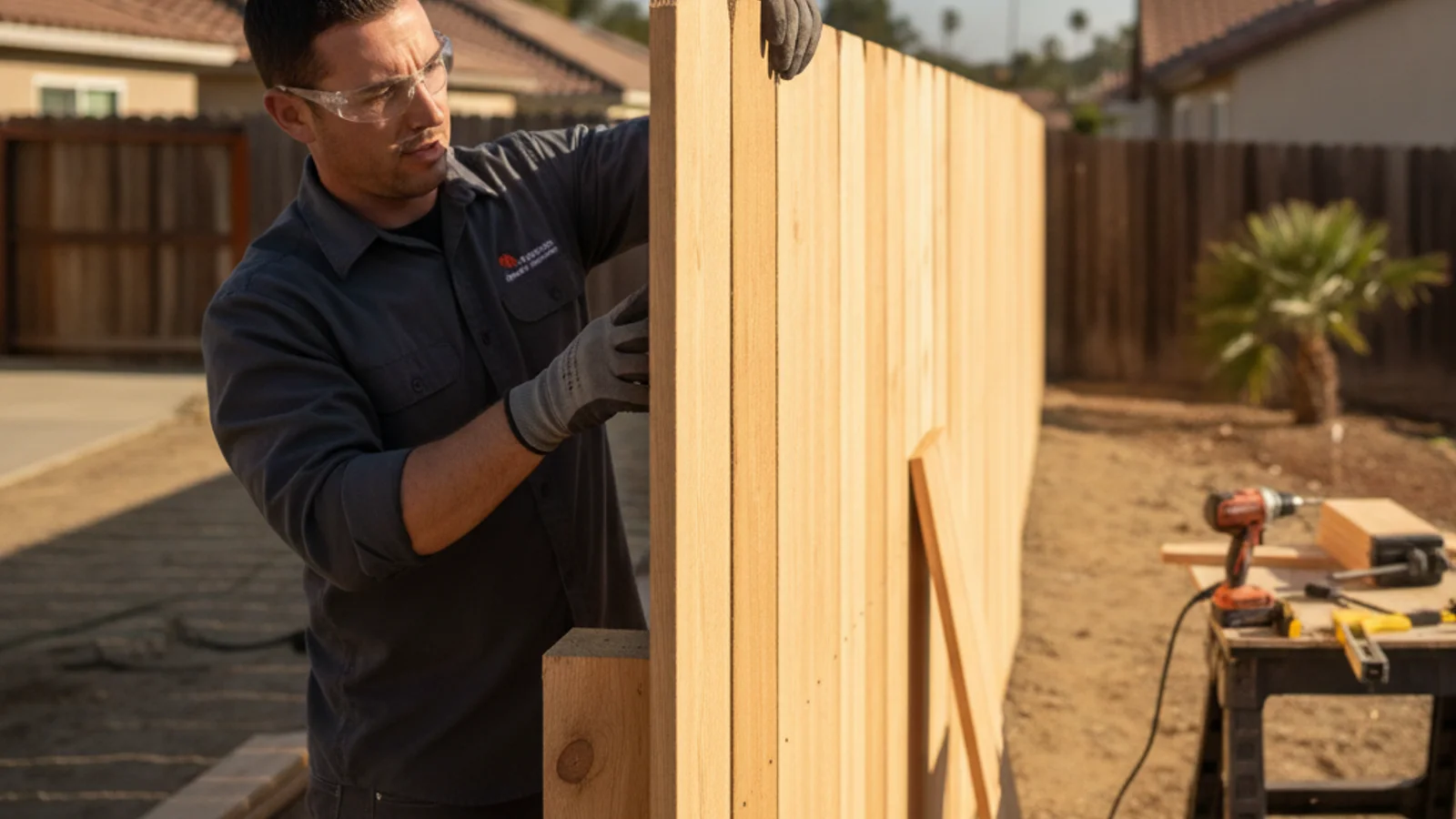
A board-on-board fence starts with a base layer of pickets fastened to the rails with consistent gaps between them, though that spacing varies by design. A second layer of pickets is then fastened over that base layer, centered on each gap, so the second board’s edges land on top of the first layer’s boards rather than just meeting them edge to edge.
The overlap is the amount of the second board that sits on top of the first board’s edge on each side. A wider overlap closes the gap more completely and tolerates more wood shrinkage over time before a sightline opens up. A narrow overlap can look the same on installation day. Yet gaps may appear sooner as the boards dry and narrow. That change is a normal property of lumber, not a defect. This is the single detail that separates a board-on-board fence with enough overlap from one that can show thin gaps as the boards dry.
Framing and post spacing behind the pickets
The framing behind a board-on-board fence carries more picket weight per linear foot than a single-layer fence, because you’re hanging two overlapping layers of wood instead of one. That changes what the rails and posts need to do.
Rails need to support the combined weight of both picket layers. Their size and spacing help prevent sagging over time. Post spacing must also account for a solid fence’s wind load. That load is higher than it is for a fence with airflow. A privacy fence built this way needs posts set to a depth and spacing that match the local soil and exposure, which is a site-specific call a fence pro makes after walking the actual run, not a number that applies the same way to every yard.
One-sided vs two-sided appearance
One advantage of the classic board-on-board layout, compared to shadowbox, is that it can be built to look nearly identical from both sides of the fence line. Because the overlap covers the gaps regardless of which layer faces which yard, neither neighbor is left staring at a fence back that looks obviously different from the front.
Some builders vary this by alternating which layer sits on the street side versus the backyard side down the run, which changes the shadow-line texture slightly but keeps both faces fully private. If a shared fence line and a neighbor’s opinion of the finished look matter to the project, this is worth raising with the fence pro during the estimate, since it’s a design choice made at framing time, not something adjusted after the fact.
Wind behavior in Santa Ana conditions
A solid, gapless fence presents a full wall of surface area to wind, which is a real consideration during San Diego’s Santa Ana events, when gusts move through inland valleys and canyon-adjacent lots with far more force than the coastal breeze most of the county deals with day to day.
This is where post depth, post spacing, and the quality of the post-to-footing connection matter more than the picket style itself. A board-on-board fence built with undersized posts or footings that were adequate for a lighter, gapped fence style can be more likely to rack or lean after a strong wind event, because there’s nowhere for the gust to pass through. Fence pros who build regularly in wind-exposed areas like Ramona, Alpine, or the East County foothills generally account for this in how they space and set posts on a solid-fence job, which is one more reason this isn’t a fence style to have built without a site walk.
Gate placement in a board-on-board run
Gates deserve their own conversation on a board-on-board project, because a solid, double-layer gate is heavier than most standard gate hardware is built to carry over time. A gate frame that’s undersized for the added picket weight can sag at the latch side, even when the fence panels on either side hold up fine.
Where a run needs a gate, a fence pro should be specifying hardware, hinges, and frame bracing sized for the actual weight of a board-on-board panel, not a generic gate kit meant for single-layer pickets. This is also where gate installation work often gets bundled into a larger fence project rather than handled as an afterthought, since the gate is the piece of the fence that takes the most repeated mechanical stress.
What a bid should itemize
A board-on-board quote that only lists a price per linear foot is hard to evaluate against a competing bid. Ask the contractor to break out post spacing and depth, the overlap width they plan to build to, and whether rails are sized for the doubled picket load or reused from a standard single-layer spec.
It’s also worth asking what wood species and grade are quoted, since the wood you choose changes both the look and how the boards will behave as they dry and shrink over the seasons. A quote should also state whether it includes gate hardware sized for the added weight, and whether finishing is included or left to the homeowner as a separate step once the wood has had time to dry after installation.
Ask, too, how the contractor plans to handle a sloped yard, which is common across much of San Diego’s hillside terrain. A board-on-board fence on a slope can be stepped, with each panel level and a small drop between sections, or racked, where the rails follow the grade at an angle. Racking is more common with board-on-board because keeping the overlap consistent is easier when the pickets themselves stay vertical even as the rail line angles with the slope, but it’s a detail worth confirming rather than assuming. Two bids quoting the same linear footage can represent very different fences once you know what to ask for, and a contractor willing to walk through those specifics before quoting is usually the more reliable one to hire.
Frequently asked questions
Does board-on-board cost more than a standard privacy fence?
It generally uses more lumber per linear foot than a single-layer privacy fence, since two overlapping layers of pickets go into the same run of fence line. The exact difference depends on the wood species and overlap width quoted.
Can an existing single-layer fence be converted to board-on-board?
Sometimes, if the existing posts and rails are sound and sized for the added weight. In many cases a fence pro will recommend assessing the framing first, since converting onto undersized rails can shorten how well the new build holds up.
Does board-on-board work well with vinyl or only wood?
The overlap principle applies to wood construction specifically. Vinyl privacy panels use a different manufactured design and don’t use the same board-on-board build method.
When to call us
A board-on-board fence is a framing decision as much as a picket-style decision, and getting the post spacing and overlap wrong is expensive to fix after the fact. Call us at (858) 400-4906 and we’ll connect you with a licensed fence contractor.