Board-on-board gives you visual privacy from every angle because the pickets overlap. Shadowbox trades some seclusion for airflow and a neighbor-facing look from both sides. If your top priority is a closed backyard, board-on-board wins. If you need wind relief, a lower lumber count, or a fence that reads the same on both faces, shadowbox is usually the better call. Fence Pros San Diego is a referral service. We do not publish a per-foot markup or a lifespan warranty. Both are wood privacy options, and if you’re still deciding on species, our guide to the best wood for a San Diego fence compares cedar, redwood, and pine.
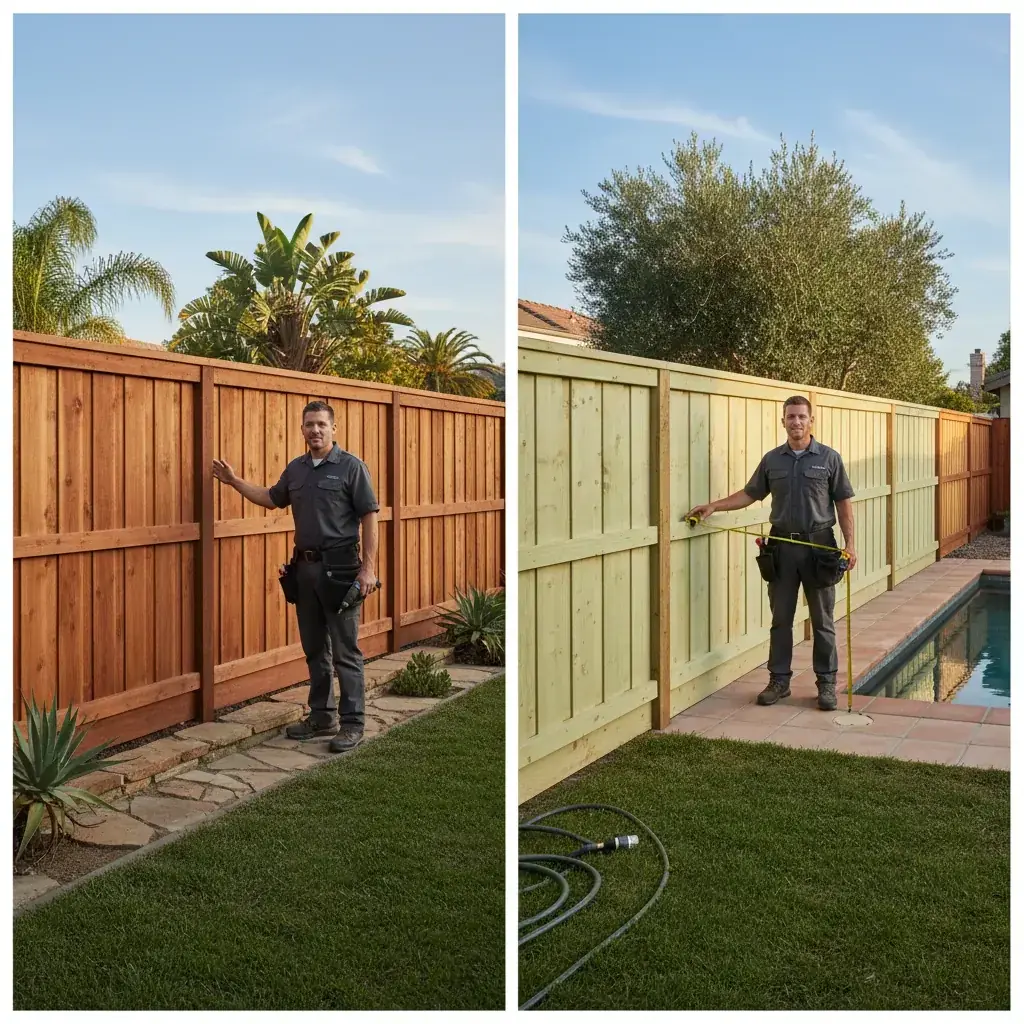
Making the right choice depends on your specific needs, your property’s location, and even your relationship with your neighbors. Let’s break down the key differences to help you decide.
Visual difference: total privacy vs airflow
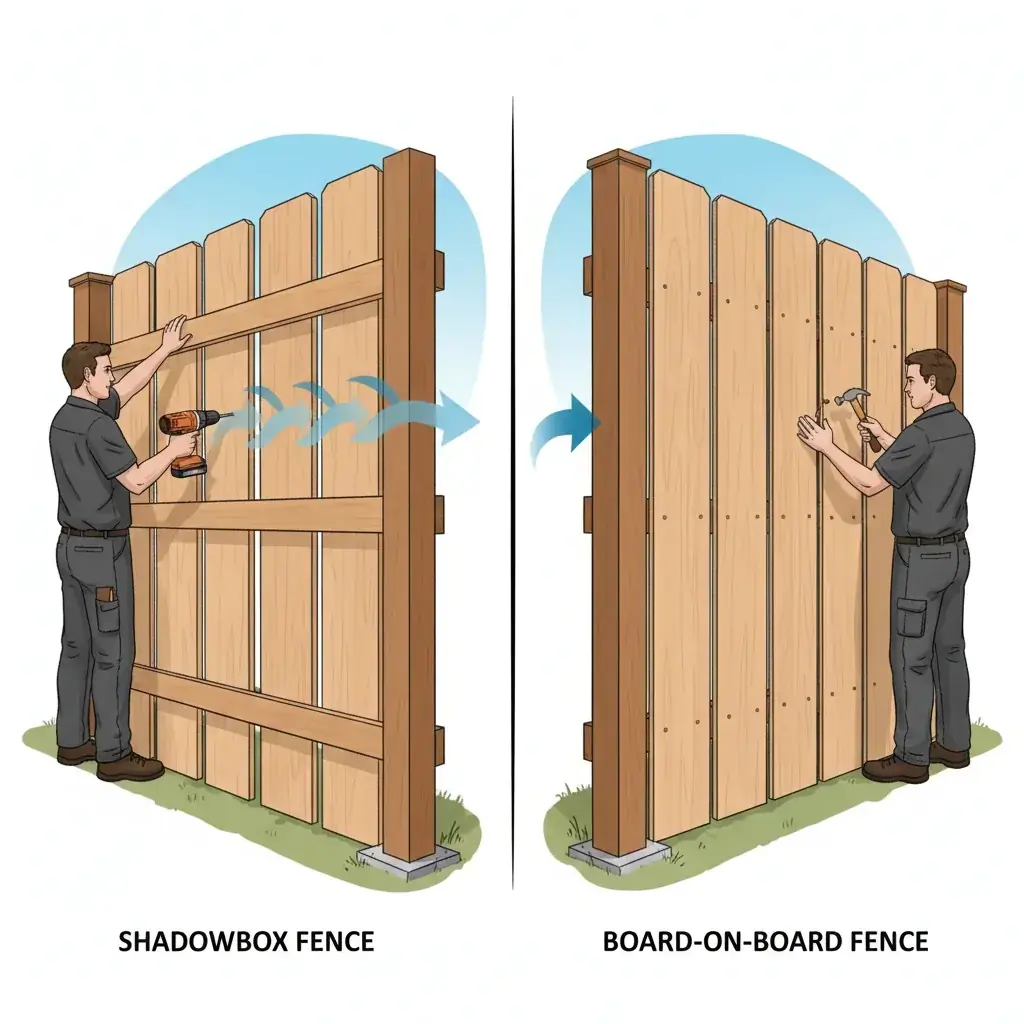
The core difference between these two fence styles comes down to how the pickets are attached to the rails. This construction detail creates a distinct look and level of privacy for each.
Board-on-board fences for absolute privacy
A board-on-board fence is built with an overlapping pattern of vertical pickets. First, a row of pickets is attached to the rails with small gaps between them. Then, a second layer of wider pickets is installed over the first, covering the gaps completely.
The result is a solid, gapless barrier. This style provides visual privacy from every angle when the overlap is wide enough. That makes it a common pick for backyards with pools, hot tubs, or anyone who wants maximum seclusion. The overlapping boards also create a textured look with strong shadow lines. If your primary goal is a private sanctuary, a privacy fence built board-on-board is the usual path. “100% privacy” still depends on the overlap staying closed as the boards dry.
Shadowbox fences for partial privacy and light
A shadowbox fence, also known as a board-and-space or alternating board fence, is constructed differently. Pickets are attached to both sides of the central rails in an alternating pattern. One picket goes on the front of the rail, the next goes on the back, and so on.
This creates small gaps between the boards. When you look at a shadowbox fence straight on, it appears solid and private. However, when viewed from an angle, you can see through the gaps. This design allows light and air to pass through, which can make your yard feel more open and less closed-in. For San Diego’s sunny climate, this can be a huge benefit, preventing your yard from feeling like a dark box and allowing coastal breezes to circulate. It’s a compromise: you get a sense of privacy without completely blocking your connection to the outside world.
Which style stands up better to Santa Ana winds
In San Diego County, especially in areas like Poway, Santee, and the eastern foothills, the seasonal Santa Ana winds are a serious consideration for any fence installation. A fence that can’t handle powerful gusts is a liability.
The design of a shadowbox fence gives it a significant advantage in high-wind areas. The alternating picket pattern allows wind to pass through the gaps. This dramatically reduces the “sail effect,” where a solid fence catches the wind like a ship’s sail, putting immense pressure on the posts and panels. By letting air flow through, a shadowbox fence experiences less strain. This makes it a more durable and lower-risk option for properties exposed to strong, consistent winds. The fence can breathe, which helps it withstand gusts that might otherwise topple or damage a solid structure.
A board-on-board fence, by contrast, is a solid wall. It takes the full force of the wind head-on. While it offers more privacy, that solid face is the wind-load problem during a Santa Ana. The quote should name thicker posts if needed, footing depth, and concrete. Proper installation is critical for any wood fence, and it is not optional on a solid fence in a windy neighborhood. We do not specify 4x6 versus 4x4 as a county recipe. Ask each independent contractor to size posts for the measured exposure. A thin bid that skips that conversation is a gap, not a bargain.
Cost comparison per linear foot for installation
When budgeting for your new fence, it’s important to understand how these two styles compare in price. While many factors influence the final cost, like the type of wood, fence height, and terrain, there’s a general cost difference based on materials and labor.
Generally, a board-on-board fence bids higher than a shadowbox fence of the same height and species. The overlapping design uses more pickets to cover the same length. More lumber usually means a higher material line. We do not publish a 15-25% or 30% markup.
Labor can also take longer because the overlap has to stay consistent. That is a contractor scheduling question, not a Fence Pros crew rate.
Shadowbox typically uses fewer pickets per linear foot. The alternating pattern is efficient with materials. Alignment on both faces still has to be in the scope.
Wood species, height, and site prep still move the total. Most homeowners also price fence staining as a separate step. Compare two complete written scopes on the same footage instead of a percent rule of thumb.
Which style is more ‘neighbor-friendly’ and why it matters
In the dense neighborhoods of San Diego, from North Park to Carlsbad, maintaining good relationships with your neighbors is important. Your choice of fence can play a surprising role in that. This is where the concept of a “good neighbor fence” comes in, and the shadowbox style is the clear winner.
A good neighbor fence is one that looks the same from both sides. With a shadowbox fence, the alternating picket design means both you and your neighbor get the same finished, attractive view. There is no “good side” or “bad side.” This is a significant advantage, as it prevents any potential disputes over who has to look at the less-appealing structural side with the visible rails and posts. Many Homeowners Associations (HOAs) in San Diego actually require this style of fence for exactly this reason. For the full rundown on dual-sided designs and how California splits the cost, see our guide on what a good neighbor fence is.
A board-on-board fence, on the other hand, has a distinct front and back. One side (your side, typically) shows the clean, overlapping picket face. The other side (your neighbor’s side) displays the horizontal rails and vertical posts that the pickets are attached to. While this “backside” is structurally necessary, it’s not as aesthetically pleasing. This can lead to conversations about whose property line the fence is on and who gets the “good” view. According to San Diego County zoning ordinances, property line fences are often a shared responsibility, making a mutually agreeable style even more important.
If you share a property line and are splitting the cost with a neighbor, a shadowbox fence is almost always the easier, more diplomatic choice. If absolute privacy is your non-negotiable priority and you opt for board-on-board, it’s a good practice to discuss it with your neighbor beforehand to manage expectations.
Frequently asked questions
Which fence style costs more, board-on-board or shadowbox?
Board-on-board typically bids higher per linear foot than shadowbox because the overlap uses more wood. The difference belongs on two quotes of the same species, height, and footage. We do not publish a 15 to 25 percent or several-hundred-dollar delta.
Is board-on-board or shadowbox better for coastal and windy San Diego areas?
Shadowbox is the better choice for windy locations like Poway, Santee, and neighborhoods that take Santa Ana winds. The alternating gaps let air pass through, which reduces the sail effect on a solid wall. Board-on-board takes the full force of the wind, so the bid should name post size and footing depth for that exposure.
Does a shadowbox fence provide enough privacy?
When viewed straight on, a shadowbox fence looks solid and provides a strong sense of privacy. At an angle, small gaps become visible between the alternating boards. For most San Diego backyards, that level of privacy is more than adequate. If you want zero sightlines from any direction, board-on-board is the right pick. See our privacy fence page for a full breakdown of privacy options.
Do I need a permit to install a board-on-board or shadowbox fence in San Diego?
Most residential fences up to 6 feet tall in San Diego County do not require a building permit, but rules vary by city, HOA, and whether the fence is in a front or rear yard. Check with the planning department before work begins. An independent fence installation contractor can say what they will pull. Fence Pros San Diego does not pull permits.
How long does a wood privacy fence last in San Diego’s climate?
There is no 15-to-20-year warranty on this page. Cedar and redwood last longer with stain or sealer than they do left bare. Coastal salt and UV speed weathering. Board-on-board and shadowbox age similarly when the same wood and finish are used. Ask the contractor for a maintenance plan, not a decade count.
Which style do HOAs in San Diego more commonly allow?
Shadowbox is the style most HOAs prefer because it looks the same from both sides, so neither homeowner ends up with the “back” of the fence facing their yard. Many HOA CC&Rs in San Diego communities explicitly require a good-neighbor design, and shadowbox satisfies that standard. Always review your HOA rules before committing to a style.
When to call us
Deciding between board-on-board and shadowbox means weighing privacy against airflow, lumber count against wind, and your needs against a neighbor-facing face. An independent professional can walk the line, assess exposure, and quote both styles. Fence Pros San Diego does not install or warrant the fence.
Call us at (858) 400-4906 and we’ll connect you with a licensed fence contractor.