Ornamental fencing gives a commercial property a finished, upscale look without the mass of a solid wall, but the spec sheet is where the actual decisions get made. Picket profile, finish, and gate hardware determine whether the fence still looks good and functions correctly years in, not just on installation day. This is a narrower question than general commercial security fencing: it’s specifically about aluminum and steel ornamental picket systems, the kind you see fronting office parks, medical buildings, and retail centers across the county.
Aluminum vs steel ornamental picket systems
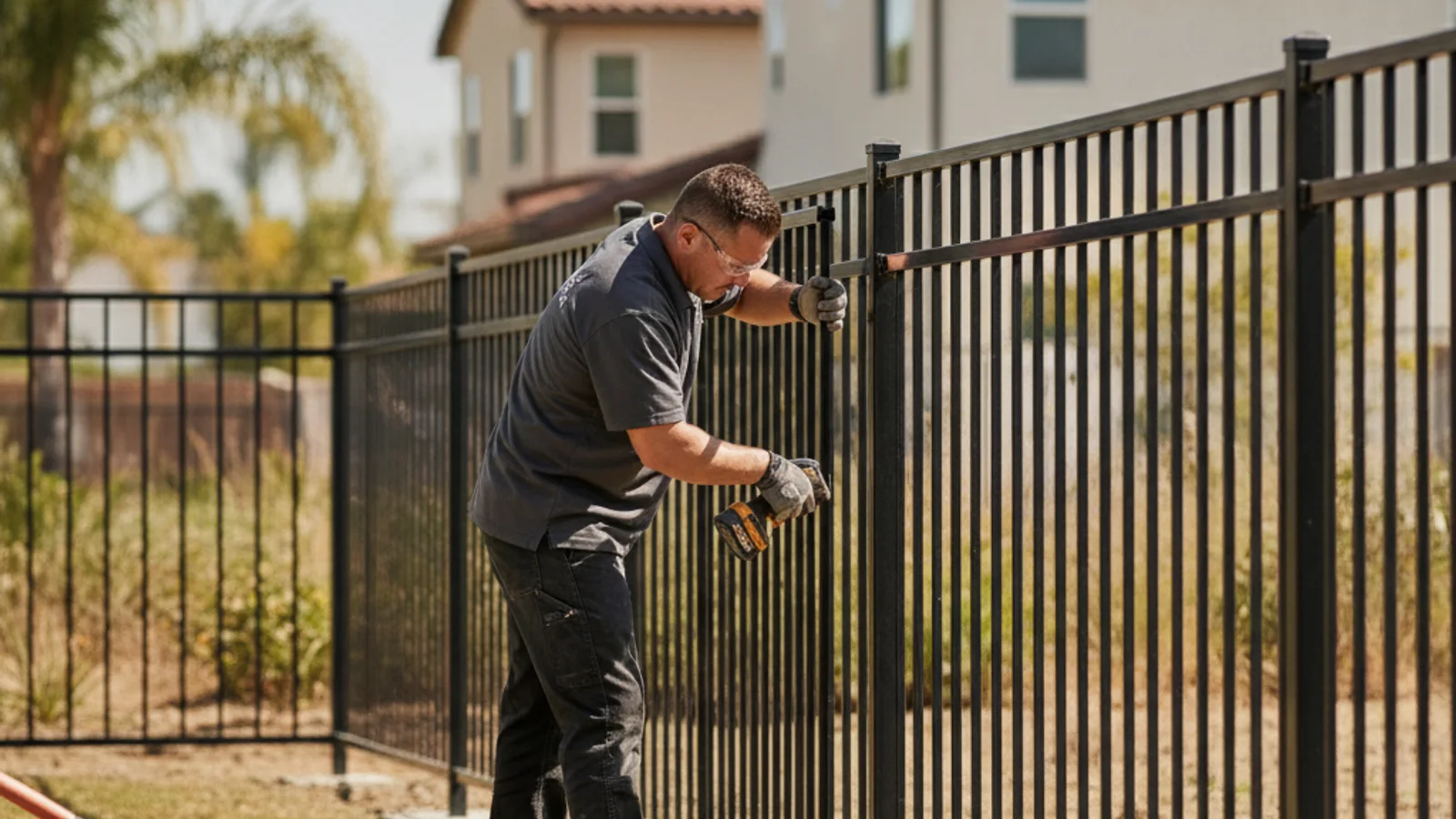
Ornamental picket fencing is built to read as a modern version of traditional wrought iron: vertical pickets, a top and bottom rail, and posts set at regular intervals, usually without the solid infill of a privacy fence. Aluminum ornamental systems are lighter, don’t rust the way bare steel does, and are the more common commercial choice today because they hold a powder-coat finish well and cost less to maintain over time. Steel ornamental systems are heavier and stiffer, which matters for taller runs or higher-security applications, but they need a more complete coating system to manage corrosion, since steel rusts if the coating ever fails.
The picket spacing and profile you choose affects both appearance and function. Wider spacing reads as more open and less imposing, which fits a retail or office frontage. Tighter spacing with anti-climb features fits a property that needs the ornamental look but also wants a real security function, like a self-storage facility or a utility yard that still wants street-facing curb appeal. Our guide to matching fence type to business security needs covers that deterrence-versus-appearance tradeoff in more depth if security is the bigger driver on your project.
Powder-coat finish and coastal corrosion
Powder coating is the standard finish for both aluminum and steel ornamental fencing because it’s more durable than wet paint and holds color better under UV exposure. The coating itself is only as good as its application, though, and the difference between a properly cured powder coat and a rushed one shows up years later as chalking, chipping, or bubbling.
Coastal San Diego properties, anything within a few miles of the water in areas like Point Loma, Coronado, or La Jolla, face a harder corrosion environment than inland properties. Salt-laden marine air accelerates corrosion at any point where the coating is compromised, whether from a manufacturing defect, a field cut that wasn’t properly re-coated, or simple wear at hinge and latch points. Steel systems are more exposed to this risk than aluminum, since aluminum’s own oxide layer is naturally more corrosion-resistant even if the coating is damaged. For a coastal commercial property, that difference is worth weighing against the stiffness advantage steel offers. Our coastal fence hardware guide goes deeper into how salt air affects fence hardware generally, which applies to gate hinges and latches on an ornamental system just as much as it does to a residential fence.
ADA-relevant access and egress considerations
Commercial properties open to the public need to think about access and egress at every gate location, not just the main entrance. This means clear width through gate openings, hardware that doesn’t require tight grasping or twisting to operate, and thresholds that don’t create a trip or wheel-catch hazard. The exact requirements depend on the specific building, its occupancy classification, and which code cycle applies to the project, so this is a conversation to have with your architect or the reviewing building department rather than something a fence contractor determines independently. What a fence contractor can do is build to the access specifications the design team hands them and flag anything in the existing site conditions, like an uneven approach or an undersized gate opening, that might create a problem before it’s built rather than after.
Vehicle gates and operators
Ornamental fencing often pairs with a vehicle gate, whether that’s a swing gate at a driveway entrance or a slide gate across a wider commercial access point. Swing gates need clear swing radius on both sides and work well where there’s room and the traffic volume is moderate. Slide gates take up less depth and handle higher traffic volumes better, but they need a straight track run and enough side clearance to fully open.
Gate operators, the motorized hardware that opens and closes the gate automatically, add their own spec questions: power source, backup access during an outage, and how the operator integrates with any existing access control or intercom system on the property. These are worth nailing down at the proposal stage rather than as a change order once the fence is already up, since retrofitting an operator to a gate that wasn’t designed for one is more expensive than specifying it correctly the first time. The gate installation service page covers the installation side of this in more detail.
Reading a spec sheet and submittal package
For any commercial job of real size, expect the contractor to provide a formal submittal package: material specifications, finish and coating data sheets, gate hardware cut sheets, and shop drawings showing post spacing, footing details, and gate locations. This isn’t paperwork for its own sake. It’s what lets your architect, property manager, or general contractor verify that what’s being installed actually matches what was specified, and it’s what you’d reference later if a finish issue or hardware failure needs to be traced back to a specific product.
If a contractor can’t produce a real submittal package for a commercial job, that’s worth asking about directly before signing anything.
What an itemized commercial bid should break out
A useful bid separates material cost by linear foot from gate cost, since gates (especially motorized ones) carry a disproportionate share of the total price relative to their footage. It should also separate site work, demolition of an existing fence, grading, or footing excavation, from the fence and gate installation itself, since site conditions vary property to property and shouldn’t be buried inside a single lump number. Ask that finish and coating specifications appear by name, not just “powder coated,” so you can compare what’s actually being proposed across different bids on the same project. A commercial fence proposal that itemizes these pieces separately is easier to compare against a competing bid than one lump figure.
Maintenance and inspection after installation
An ornamental fence’s finish is the thing most likely to need attention over the life of the fence, and building a simple inspection routine into your property management schedule catches problems while they’re still cheap to fix. Look for chipping or chalking on the coating, especially at welds, field cuts, and anywhere hardware attaches to the fence, since those are the spots a coating is most likely to fail first. Gate hinges and hardware deserve a closer look on a coastal property, since that’s where moving parts and salt exposure combine. Catching a small coating failure early and touching it up is a much smaller job than replacing a section after corrosion has spread underneath the finish.
If the property has a motorized gate operator, that hardware has its own maintenance needs separate from the fence finish, including battery backup checks if the gate is meant to keep working during a power outage. Rolling that into the same annual walk-through as the fence inspection keeps both from being forgotten.
Frequently asked questions
Is aluminum or steel better for a commercial ornamental fence?
Aluminum is lighter, resists corrosion better on its own, and is the more common commercial choice today. Steel is stiffer and often preferred for taller or higher-security runs, but it depends more heavily on the coating staying intact to resist rust, especially near the coast.
How does salt air affect a powder-coated ornamental fence?
Salt air accelerates corrosion at any point where the coating is compromised, such as a field cut, a chip, or worn hardware. Coastal properties see this more than inland ones, and steel is more vulnerable to it than aluminum.
What should a commercial fence submittal package include?
Material specifications, finish and coating data sheets, gate hardware cut sheets, and shop drawings showing post spacing and gate locations. This lets the design team verify what’s being installed against what was specified.
Do commercial gates need to meet access requirements?
Public-facing commercial properties need to consider clear width, operable hardware, and threshold conditions at every gate. The exact requirements depend on the building’s occupancy and applicable code cycle, which your architect or the building department can confirm.
When to call us
If you’re planning an ornamental fence for a commercial property, especially one with gates, a coastal location, or public access considerations, it helps to start with a site walk before a formal bid. Call (858) 400-4906 with your property address and a rough sense of the linear footage and gate locations, and we’ll connect you with a licensed independent local fence contractor.