Santa Ana winds hit solid San Diego fences like a sail. Open styles let air through. Solid wood or vinyl still works on many lots, but only if posts, hardware, and spacing match the site. This page does not publish a countywide wind speed, a required post depth, or a repair price. Those numbers are not in the approved claims ledger. Ask the contractor for the inches and materials they will use at your address.
Fence Pros San Diego is a referral service. It does not send crews, stock posts, or promise a storm clock.
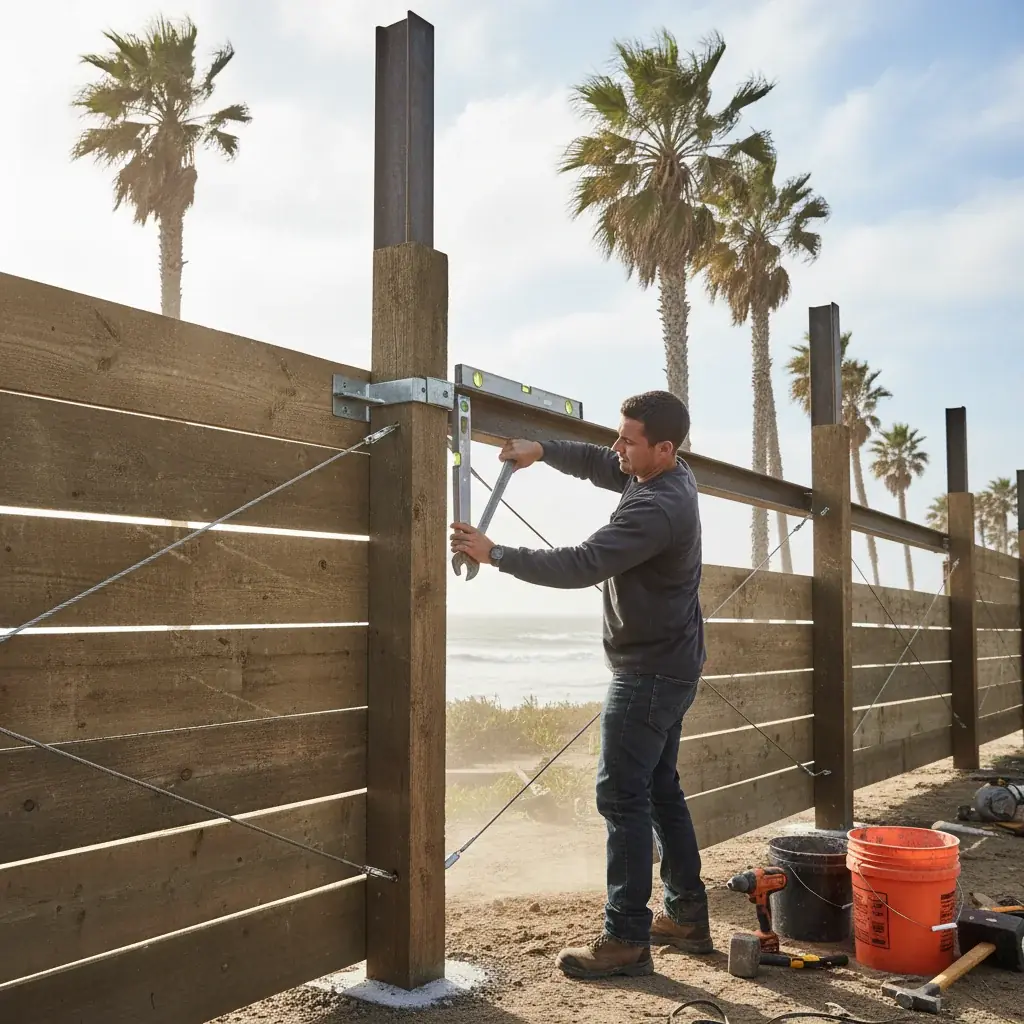
This guide covers why these winds are hard on fences, which layouts reduce sail area, what to inspect before wind season, and what to do after a section fails. For the first-hour checklist after a collapse, see fence storm damage in San Diego.
Why Santa Ana winds are so destructive to fences
A long solid run can go down in one night. The load is not only average wind. Gusts and direction changes push, then pull, on the same posts. Hills, canyons, and ridgelines in San Diego County can concentrate that load. A lot in Alpine or a canyon edge in El Cajon is not the same exposure as a sheltered inland courtyard. A coastal lot in Point Loma adds salt to the hardware conversation. None of that is a published mph map on this page.
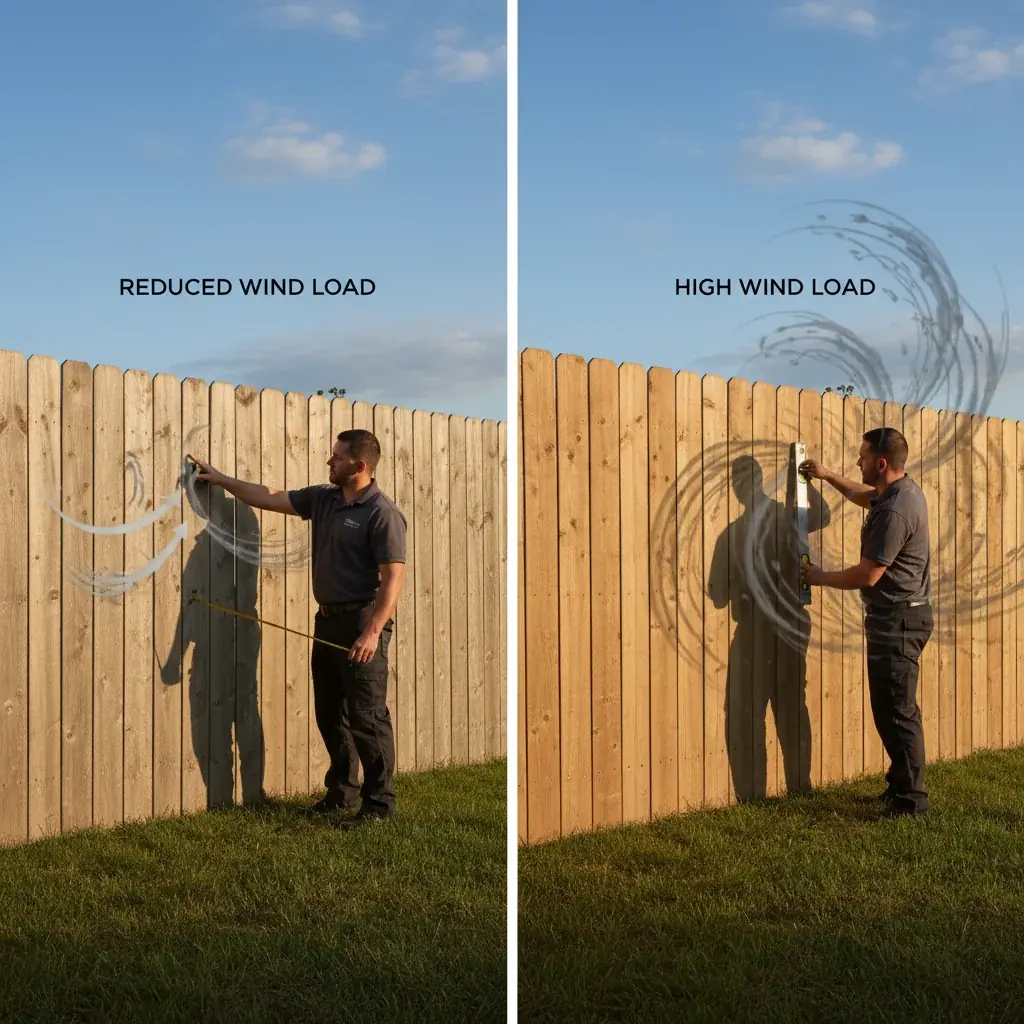
The sail problem is simple. A solid privacy fence, wood or vinyl, presents a large face. Wind that cannot pass through transfers into the posts and footings. If a post is already rotten at grade, or if fasteners have pulled, that face is the first to lean. Open fabric, shadowbox gaps, and ornamental pickets reduce the face. They do not make a fence immune.
Dry Santa Ana air also dries untreated wood. Boards that have already checked or split have less to give when the next gust hits. That is a condition to inspect. It is not a lifespan guarantee.
Fence styles that perform best in high winds (and which to avoid)
Start with permeability. Can air move through the fence, or does it have to push the whole panel?
Layouts that let wind through
- Chain link. Open mesh has little face for the wind to grab. Privacy slats and screening change that math. If you add slats, say so in the proposal so the contractor sizes posts and bracing for the extra load. See chain link.
- Shadowbox / good-neighbor. Pickets alternate on each side of the rail. Small gaps remain. That is a privacy compromise, not a sail-proof rating.
- Horizontal slats with named gaps. The gap size belongs in the drawing. “About an inch” is not a spec until the bidder writes it.
- Ornamental metal. Open pickets behave more like chain link than like a solid board wall. Finish still matters near salt air. See metal fence questions.
Solid privacy fences
Solid wood and vinyl are the usual Santa Ana failures when posts or hardware were already weak. That does not ban privacy. It means the proposal should name post size, depth, spacing, and concrete, not just “6-foot privacy fence.” County PDS 070 lists wood-post footing notes as recommendations only, including a 12-inch-diameter concrete note and about 24 inches into undisturbed ground or compacted fill. That is not a City of San Diego recipe, and it is not a 30-to-36-inch upgrade rule. Ask the bidder for the inches at this soil and this height.
Reducing post spacing, upsizing posts, or switching to steel posts inside a wood face are options. Price them as line items. Do not treat a brand name as a verified county standard.
Reinforcement tips for existing fences
Do this before wind season, not during a red-flag night.
Check the posts
Shake each post. Look at the soil line. Soft wood, mushrooms, or cracked concrete at the base are reasons to photograph the post and ask for a post repair scope. Replacing one post is a different job than rebuilding the run.
Strengthen connections
Look at rails and pickets. Rusted nails that have backed out will not hold a sail. Exterior screws and metal brackets at rail-to-post joints are common upgrades. Ask the contractor to name the fastener, not “better hardware.”
Trees over the line
A limb that sits over the fence is a tree job first. A fence contractor does not replace an arborist. If a neighbor’s tree is the issue, photograph both. Civil Code 841 may matter if the fence is a dividing fence. It does not decide tree liability by itself.
What to do immediately after wind damage
Stay away from the downed section if it sits near wires. Call 911 and the utility if you see downed lines. In San Diego, SDG&E is the usual electric utility to notify for wires. Do not pull a fence off a line.
Photograph before you move much: wide shots, close-ups of broken posts, and anything that caused the hit. If the fence is a pool isolation barrier, Health and Safety Code 115923 still wants a 60-inch enclosure, a small ground gap, no 4-inch-sphere openings, and self-closing, self-latching gates. A child-sized hole is a safety problem. Temporary panels or plywood are a stopgap, not the permanent enclosure.
If the damaged run is a shared boundary, do not assume you can bill the neighbor after the fact. Civil Code 841 requires 30 days’ prior written notice before you incur shared-fence costs, with the presumption of equal responsibility, the problem, the proposed solution, estimated costs, the proposed split, and the timeline.
Fence Pros San Diego does not run emergency fence as an in-house crew. The independent contractor sets the schedule.
Frequently asked questions
What is the best fence style for a high wind area in San Diego?
Open styles (chain link, shadowbox, ornamental metal) present less sail than a solid privacy wall. Solid privacy can still be specified if the proposal names posts, depth, spacing, and hardware for that lot. This page does not crown a single winner for every canyon, bluff, or courtyard.
How fast do Santa Ana winds get in San Diego County?
The approved claims ledger does not include a verified Santa Ana speed table for this page. National Weather Service and local alerts are the place to read the event. Do not design from a blog’s mph guess.
Do I need a permit to repair or replace a fence damaged by wind?
Not as a countywide letter. City of San Diego Table 142-03A still uses 7 feet for that division’s building-permit split. Unincorporated County PDS 070 excepts qualifying fences not over 6 feet that also meet zoning. Raising height, moving the line, or repairing a pool enclosure can change the desk. Confirm with the authority for the address. See the permit-by-city guide.
How deep should fence posts be set to survive high winds?
There is no verified citywide “Santa Ana depth” in the claims ledger. County PDS 070’s wood-post notes are recommendations, not a 24- or 36-inch mandate. Ask the contractor to write the depth and diameter for this soil. Driven no-dig spikes are a different product family. See no-dig fence anchors.
Can I install a wind-resistant fence myself, or should I hire a pro?
C-13 work is licensed fence construction when it exceeds the B&P 7048 casual-work exemption. This page does not score DIY skill. If you hire, confirm the license on the CSLB site. Fence Pros San Diego refers. You contract with the professional directly.
How long does a properly installed wood fence last in San Diego’s climate?
No verified 15-to-20-year clock is in the ledger. Species, finish, soil, irrigation spray, and whether posts were already termite-damaged all change the answer. Inspect annually. Repair loose fasteners before the next wind event. See wood fence repair vs replacement.
When to call us
Call when posts wobble, a section is leaning, or you want a written scope that names wind exposure, post spec, and whether the line is shared. Bring photos and the address.
Call us at (858) 400-4906 and we’ll connect you with a licensed fence contractor.