TL;DR
- A walk gate that drags or misses the latch is usually a hinge-side post that moved, a racked frame, or worn hinges. Often more than one.
- Check the post for plumb first. Then measure the frame diagonals. Then wiggle the hinge plates.
- An anti-sag cable kit only holds if the hinge post is still solid and plumb.
- If the post is rotted at grade, replace or sleeve the post before you tension anything.
- Coastal San Diego gates fail faster when zinc-plated hinges and screws rust. Stainless hardware is the lasting fix, not another adjustment.
If your fence gate drags on the concrete, won’t latch unless you lift it, or shows a gap on the latch side, diagnose the load path before you buy parts. The hinge post carries the whole leaf. When that post leans, the frame racks, or the hinges loosen, the latch and strike no longer meet.
Fence Pros San Diego is a referral line. We match you with an independent gate repair contractor. That contractor quotes after seeing the post, the frame, and the hardware. We do not publish repair price lists.
Why gates sag
The hinge side of a fence gate carries all the weight. Over time, three things happen.
1. The hinge-side post moves. Concrete cracks or settles. Soil packs differently on one side. Sandy coastal fill and wet winters make that worse. The post is no longer plumb, and the gate falls with it.
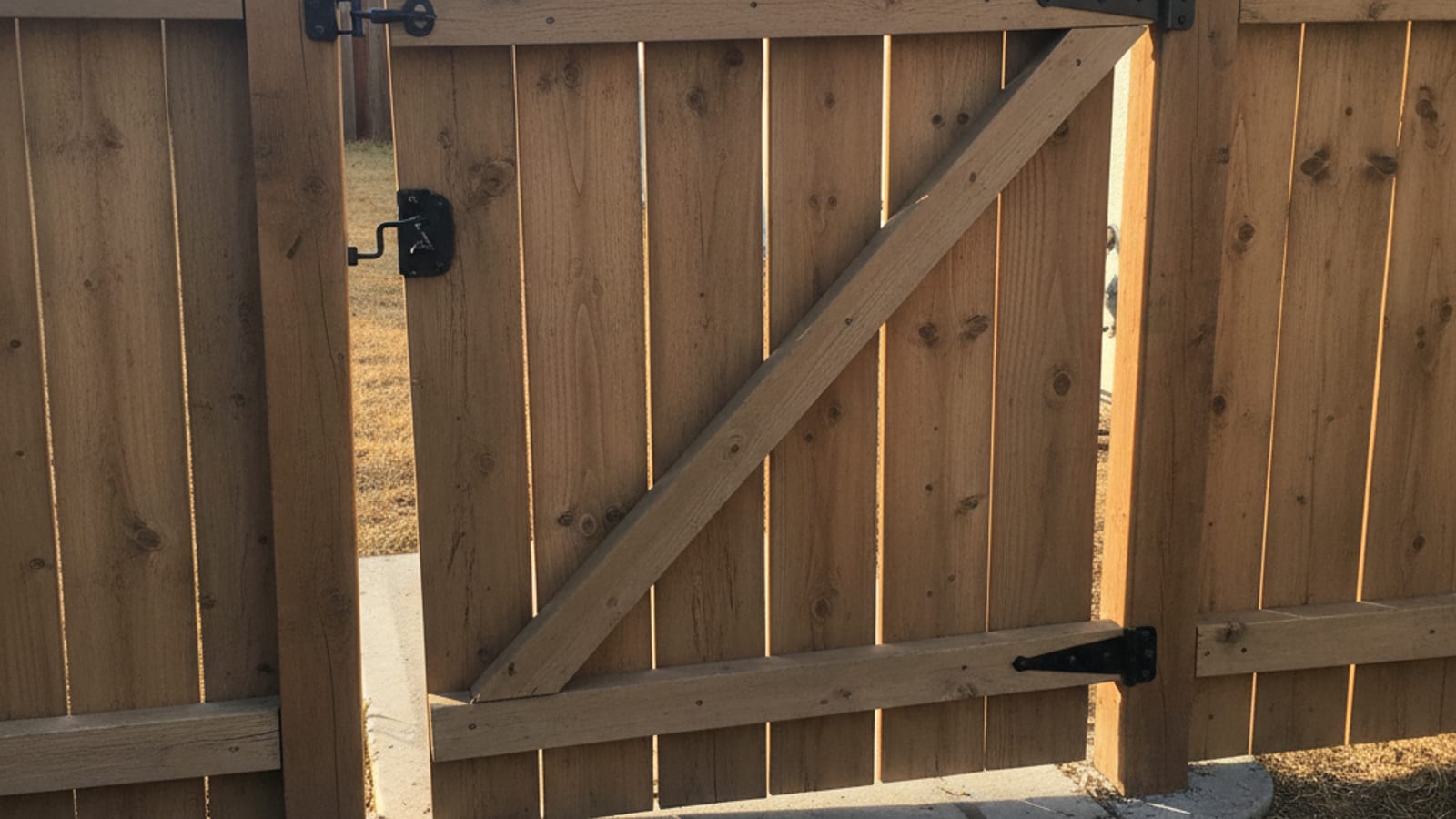
2. The gate frame racks. A rectangular frame with no diagonal brace loses square. The top-hinge corner drops. The bottom-latch corner drags. The latch side swings wide of the strike.
3. Hinges loosen. Screws strip out of the wood. Plates bend. Bushings wear. The gate drops relative to the post even if the post is still straight.
An anti-sag cable kit can square a racked frame. It does not straighten a moved post. Fresh hinges do not save a post that is rotten at grade.
Diagnose it in about a minute
Stand at the latch side. Check three things.
Is the hinge-side post plumb? Hold a 4-foot level on two faces of the post. If the bubble is off, the post has moved. That is the first fix.
Is the gate frame square? Measure both diagonals of the leaf: top-hinge to bottom-latch, then top-latch to bottom-hinge. If they differ by more than 1/4 inch, the frame is racked. That is the second fix.
Are the hinge screws tight? Try to wiggle each hinge plate with your fingers. Play means loose screws or stripped wood. That is the third fix.
Most sagging gates have two of the three. Work in order: post, then frame, then hinges.
Fix 1: Reset the hinge-side post
If the post has moved:
Minor lean, footing still sound: Brace the post plumb. A galvanized repair sleeve (a product such as Simpson Strong-Tie E-Z Mender) can reinforce a post that has not failed at the base. Bolt it to sound wood, not to rot.
Cracked concrete footing: The old concrete has to come out. Dig, break the footing, plumb the post, and pour a new footing. Depth and diameter belong in the contractor’s spec for your soil and wind, not in a generic statewide number.
Rotted wood at grade: Pull the post or sleeve it. Cedar or pressure-treated 4x4 in a new footing is the full replacement. If the existing concrete is still sound, some jobs set a steel sleeve in that footing and drop a new shorter post into it. Our fence post repair page covers when a sleeve is enough and when it is not.
Do not tension an anti-sag kit against a post that is already failing. The kit loads the post harder than the sagging leaf did.
Fix 2: Install an anti-sag cable kit
The kit is a steel cable run on the diagonal, tensioned with a turnbuckle, that pulls the dropped corner back to square.
Parts: Cable, two clamps, a turnbuckle, two corner brackets. Hardware stores sell kits. Use stainless cable and fittings within a few miles of the ocean. Galvanized is the inland default.
Installation:
- Fasten one bracket at the top-hinge corner of the gate frame.
- Fasten the other at the bottom-latch corner.
- Run the cable through the turnbuckle between those brackets.
- Clamp the loops.
- Tighten the turnbuckle in small turns until the latch lines up with the strike. Stop when the leaf hangs plumb. Do not crush the frame.
This is a one-afternoon job on a walk gate if the post is plumb and the wood still takes screws. It is not the repair when the post has moved or the leaf is twisted in three dimensions.
Fix 3: Fresh hinges
If screws are stripped or plates are bent, replace the hinges.
- Outdoor gates need hot-dip galvanized or stainless hinges. Coastal yards need stainless.
- Step up one size from the old pair so new screws bite fresh wood.
- Use longer screws into the post than the ones that already stripped.
- Pre-drill so you do not split the post.
A drive gate on an operator is not a walk-gate hinge swap. Stored spring or motor force can injure you. If the opener is part of the problem, start with troubleshooting automatic gate problems and have the contractor handle the operator.
When DIY will not hold
Call a contractor if:
- The hinge-side post is rotten through at grade.
- The leaf is twisted, not just racked in plane.
- The footing is cracked and still settling.
- The gate is a large drive leaf with an operator.
- The repair is on an HOA-visible elevation and the association has a written spec you have to match.
Pool gates are a code item, not just a latch annoyance. A gate that no longer self-closes or self-latches can fail the enclosure rules in California Health and Safety Code section 115923. See our California pool fence code guide before you “just lift it to latch” on a pool barrier.
Coastal gate notes
Coastal San Diego hardware rusts. Once the zinc on hinges or screws pits, the grip weakens and the leaf drops. If a coastal walk gate has sagged more than once, the lasting fix is a full hardware swap: stainless hinges, stainless lags, stainless cable, stainless latch. Another zinc kit repeats the same failure.
Ask the contractor to put the metal grade on the written quote. “Outdoor hinges” is not the same as 304 or 316 stainless.
When the gate should be replaced
Replace the leaf instead of repairing it if:
- Several frame members are rotten, not one corner.
- The wood is so checked that new fasteners will not grip.
- The gate was built without a brace and sagged when it was new.
- Both the hinge post and the latch post are failing. Salvaging two bad posts plus a rotten leaf is usually a worse plan than a new leaf on new posts.
A new walk gate should match the existing fence species, height, and hardware grade. Automatic drive gates are a separate scope: leaf, posts, operator, and safety devices quoted together.
Frequently asked questions
Why does my fence gate sag after just a few years?
Most walk gates sag because the hinge-side post shifts or the rectangular frame racks without a diagonal brace. Sandy soils and wet winters move posts. Salt air near the coast corrodes zinc hardware and lets the leaf drop.
How much does it cost to fix a sagging fence gate that won’t latch?
There is no honest countywide price for that call. A cable kit on a sound, plumb post is a small parts-and-labor job. A post reset with new concrete is a different job. A drive gate on an operator is another. Ask for a written quote that names the post, the leaf, and the hardware. Call (858) 400-4906 and we will match you with an independent contractor who can price what is actually failing.
Can I fix a sagging gate myself or do I need a pro?
You can install an anti-sag kit or swap walk-gate hinges if the post is plumb and solid. Get a contractor when the post is rotten at grade, the footing is cracked, the leaf is twisted, or an operator is involved.
What causes a fence gate to not latch in coastal San Diego?
Salt air pits zinc-plated hinges and screws. The leaf drops and the latch misses the strike. Replacing the hardware with stainless, after the post is plumb, is what stops the cycle. The fence repair contractors we refer can spec stainless on coastal calls. Confirm the grade on the quote.
How long does a fence gate repair last?
That depends on the post, the wood, and the metal, not on a calendar promise. A squared leaf on a reset post with stainless hardware is built to last. A zinc kit on a leaning coastal post is not. No referral page here can warrant another company’s labor.
Do I need a permit to repair or replace a fence gate in San Diego?
Like-for-like walk-gate repairs on an existing residential fence often do not need a new building permit, but that is a city call, not ours. Height changes, a new automatic operator, and any pool-barrier gate have extra rules. Confirm with the jurisdiction and, for pool gates, with the Swimming Pool Safety Act notes in our pool fence code article.
What a gate call typically involves
Send photos of the latch-side gap, both faces of the hinge post at grade, and the hinges. The contractor still has to confirm plumb and rot on site before a firm price. Fence Pros San Diego does not send a crew and does not stock trucks. We connect you with an independent pro. Call (858) 400-4906.