A good fence repair inspection starts with the damaged section, then expands outward. An Oceanside contractor should check the posts, rails, boards, and gate before recommending a repair scope.
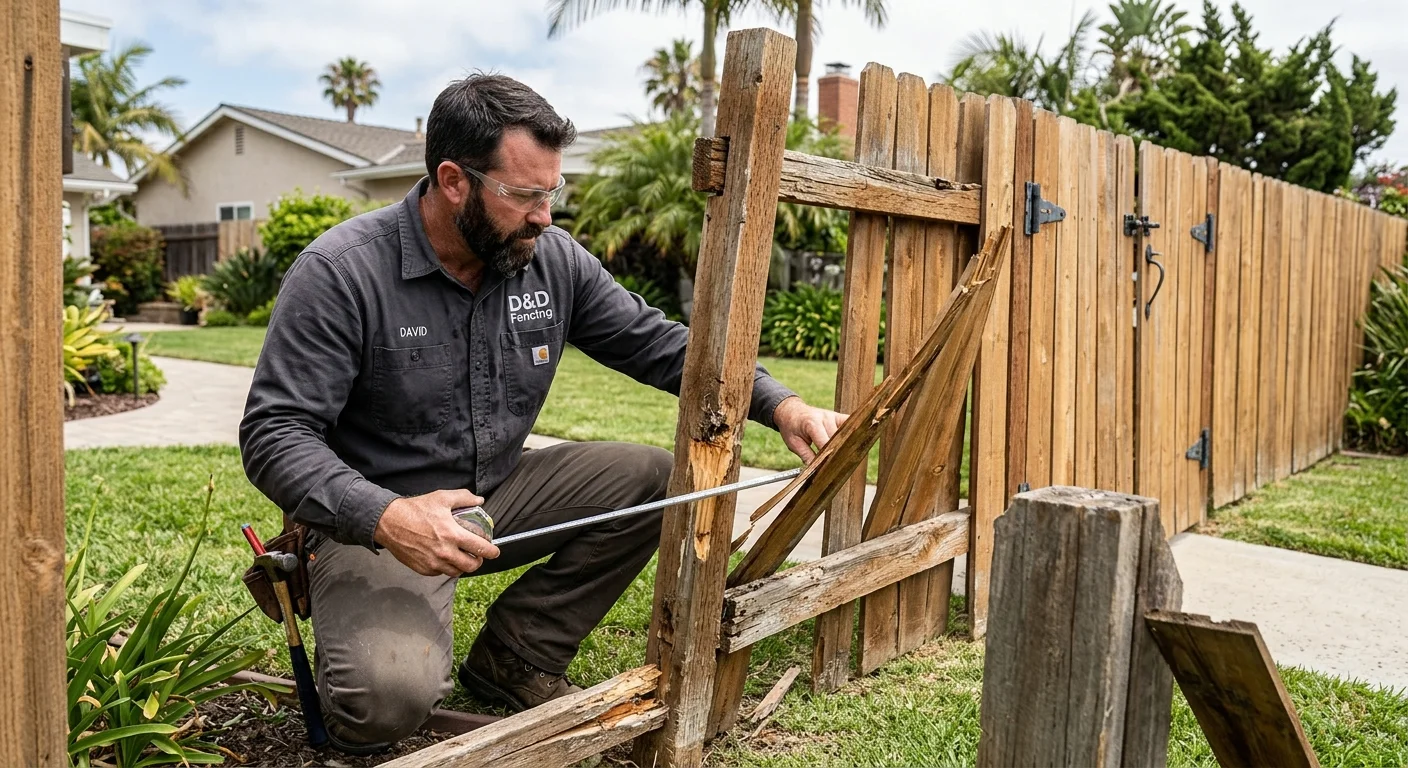
How to document the damaged section before requesting quotes
Good photos help a contractor understand the visible problem before visiting. They also give you a consistent record for comparing later proposals.
Start with one photo showing the entire fence section. Include the ground, top edge, and nearby gate when possible. Then take closer photos of each damaged part.
Photograph these areas separately:
- Each post beside the damaged section
- The post bases where they meet the ground
- Rails connected to those posts
- Loose, split, missing, or tilted boards
- Hinges, latches, rollers, and gate frames
- Any gaps that appear wider than nearby gaps
- Both sides of the fence when you have access
Take one photo while standing square to the fence. Take another from an angle. The second view can reveal movement that’s difficult to see head-on.
For gate repair in Oceanside, record the gate closed and partly open. Show the latch, hinge side, and clearance below the gate. Don’t force a gate that binds or feels unstable just to create a photo.
Add a short written note for every problem. Describe what you can observe without diagnosing the cause. “The gate drags near the latch” is more useful than guessing that the hinge failed.
Note whether the section sits west or east of Interstate 5. That location doesn’t diagnose the damage. It simply helps the contractor prepare the right site questions. Include access details, nearby landscaping, and anything that could limit work around the fence.
Our fence repair and restoration service can connect you with a licensed independent contractor. Your photos will help define what needs an on-site inspection.
What pros inspect on posts, rails, boards, and gates
A repair inspection should follow the fence as a connected system. Replacing one visible board won’t answer why the surrounding section moved.
Contractors commonly begin with the posts. They’ll look for movement, leaning, splits, damaged material, and changes around the post base. They may compare the damaged post with nearby posts that remain aligned.
Next come the rails. The contractor can inspect each rail connection and check whether the rail remains supported. A detached rail may be an isolated repair. Several affected connections may point to a broader section that deserves closer review.
Board condition comes after the supporting structure. The inspection should distinguish surface wear from material that’s loose, cracked, missing, or no longer held securely. For wood fence repair in Oceanside, ask the contractor to identify which boards are included in the proposal. That prevents confusion about whether the quote covers one board or the full damaged run.
Gates need their own inspection. A contractor may check:
- Post movement on both sides of the opening
- Hinge attachment and visible wear
- Frame alignment
- Latch contact
- Bottom clearance across the swing path
- Rollers or tracks on sliding gates
- Connections between the gate and adjoining fence
The gate may be where you notice the problem, but it isn’t always the only part involved. Ask whether the gate itself needs adjustment or whether its supporting posts also need work.
California’s C-13 fencing classification covers the construction, alteration, and repair of fences and gates. It excludes masonry walls. You can review that scope and check a contractor’s license through the CSLB.
How properties west and east of Interstate 5 call for different questions
Interstate 5 gives Oceanside homeowners a useful way to organize inspection questions. It isn’t a technical boundary, and location alone doesn’t establish why a fence failed.
For a property west of Interstate 5, ask the contractor to inspect every exposed connector. Request close attention to screws, brackets, hinges, latches, and post hardware. Visible rust, pitting, staining, looseness, or missing coatings should be documented rather than assumed from the address.
Ask which hardware can remain and which pieces are included for replacement. If the proposal recommends a different hardware material or coating, request the exact product description. Our coastal fence hardware guide offers more questions for reviewing exposed connections.
For a property east of Interstate 5, focus the conversation on what’s happening at the fence line. Ask whether the ground level changes across the damaged section. Point out irrigation, drainage paths, planters, roots, slopes, retaining features, and vehicle access when any are present.
These questions aren’t predictions about every eastern Oceanside property. They help the contractor inspect the conditions that actually exist at your address.
For either location, compare the damaged section with the rest of the fence. Ask why one area needs work while the adjoining section doesn’t. The answer should come from visible site conditions, not a broad statement about an Oceanside neighborhood.
Specific local climate or corrosion rates for Oceanside couldn’t be confirmed from the approved source material for this page. Ask the contractor to identify observed damage and the proposed material response. Product manufacturers can confirm current specifications for recommended hardware or fence components.
A broader Oceanside fence company guide can help you prepare questions about materials, access, and contractor selection.
When a focused repair and full replacement each deserve a quote
A focused repair deserves consideration when the contractor can define a limited damaged area. The proposal should name the affected posts, rails, boards, or gate parts. It should also explain how new components will connect with the existing fence.
Full replacement deserves a separate quote when the inspection finds concerns across a longer run. That doesn’t mean replacement is automatically the right choice. It means you need enough detail to compare the two scopes fairly.
Ask the contractor to mark the repair limits during the visit. A simple photo with the starting and ending points can prevent misunderstandings. The written proposal should match those limits.
For a repair option, look for answers to these questions:
- Which existing parts will remain?
- Which parts will be removed and replaced?
- Will the gate be adjusted, rebuilt, or replaced?
- How will replacement rails connect to existing posts?
- Will the finished section differ visibly from the older fence?
- Does the scope include removal of damaged material?
For a replacement option, ask why the larger scope was recommended. The answer should identify observed conditions across the fence. Avoid treating age, appearance, or location alone as proof that everything must be replaced.
A contractor may find that one post affects several connected components. Another inspection may show that a few boards can be addressed without changing the structure. The value of two scopes is that you can compare the reasoning, not just the total.
Our guide to wood fence repair versus replacement provides a closer comparison for wood fences. Use it alongside the site findings from your Oceanside fence contractor.
If a fence divides adjoining private properties, California Civil Code section 841 may affect the conversation. The law presumes equal responsibility for reasonable shared-fence costs unless the owners agree otherwise in writing. It also requires 30 days’ advance written notice before an owner incurs shared-fence costs. Review the current statute and discuss the planned scope with the adjoining owner.
What to compare in two Oceanside repair proposals
Put both proposals beside the photos you took before requesting quotes. Each proposal should make it easy to connect written work with a specific fence section.
First, compare scope. One proposal might address a gate and its hinge post. Another might include both gate posts, adjoining rails, and several boards. Those aren’t equivalent repairs, even if both are labeled “gate repair.”
Next, compare material descriptions. Look for the type, size, finish, and quantity of major components. Generic phrases such as “repair fence as needed” leave too much undefined. Ask the contractor to identify what’s being installed and what’s remaining.
Then compare preparation and removal. The proposal should state whether damaged components will be removed. It should also describe any work planned around post bases, rail connections, or the gate opening.
Review these items line by line:
- Exact repair location
- Number and type of posts
- Rails and boards included
- Gate hardware and adjustment work
- Materials that will remain
- Materials that will be removed
- Access assumptions
- Permit responsibility, if applicable
- Total contract amount and payment terms
- Changes that require written approval
Fence and permit rules for a specific Oceanside address couldn’t be confirmed from the approved source material for this page. Before signing, ask the contractor which public authority governs the property and whether the proposed scope needs approval. Confirm the answer with that authority.
Don’t assume the shorter proposal is more focused. It may simply contain less detail. Ask both contractors to clarify exclusions in writing. That creates a better comparison and helps prevent different interpretations after work begins.
Fence Pros San Diego is a referral service. We connect property owners with licensed independent fence professionals. The homeowner contracts with and pays the selected contractor directly, so proposal terms should come from that contractor.
When to call us
Bring in a licensed fence pro when damage involves posts, connected rails, a gate structure, or work requiring contractor licensing. Call us at (858) 400-4906 and we’ll connect you with a licensed fence contractor.