If damage affects fewer than 20 to 30 percent of your fence, repair is almost always the better call. Once rot, instability, or termite damage spreads beyond half the structure, or your fence is older than 20 years and repeatedly needs work, full replacement delivers better long-term value in San Diego’s coastal climate. The decision hinges on two things: how much of the fence is compromised and how old the remaining wood is. This guide walks through both so you can make a confident call.

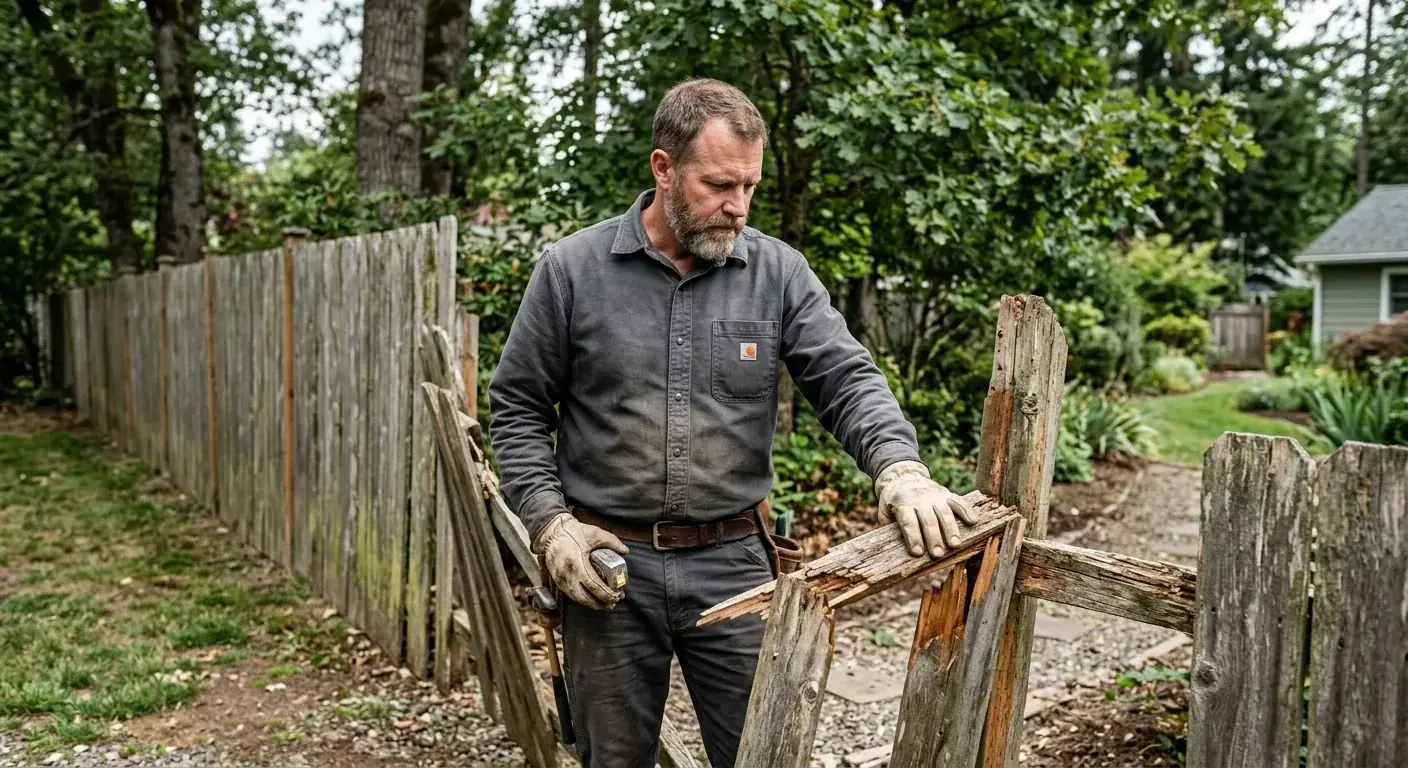
A homeowner thoughtfully looking at a damaged section of their old wood fence, considering their options.

How to assess the damage to your current fence

Before you decide on repair or replacement, you need a clear picture of your fence’s condition. A thorough assessment helps you understand the extent of the damage and predict how much life your fence has left. Start by walking the entire perimeter of your wood fence, paying close attention to these key areas.

First, examine the fence posts. These are the backbone of your fence, and if they fail, the entire structure will follow. Look for signs of rot, especially near the ground line where moisture tends to accumulate. Poke the wood with a screwdriver or a firm stick; if it feels soft or crumbles easily, you’re looking at significant rot. Also, check if posts are loose or leaning. A single loose post might be an easy fix, but multiple compromised posts signal a more widespread problem. San Diego’s varied soil types, from sandy coastal areas to harder clay inland, can affect how quickly posts degrade if not properly installed with concrete footings.

Next, inspect the fence panels or pickets. Are they warped, cracked, or splintering? Look for missing sections, especially after strong winds. Check for pest damage, too. Termites are a common issue in San Diego County, and a widespread infestation can compromise the structural integrity of many panels quickly. While a few broken boards are simple to replace, extensive damage across numerous panels indicates a larger concern.

Finally, don’t forget the gate. Is it sagging, sticking, or failing to latch properly? Gate issues can sometimes be standalone problems, like loose hinges or a misaligned latch, but they can also reflect broader structural weaknesses in the fence itself. A gate that constantly binds might indicate that the adjacent posts are unstable. Take notes as you go, perhaps even photos, to help you categorize the damage as minor, moderate, or severe. This initial inventory will be crucial for your decision-making process.

When a few new posts or panels is all you need

Sometimes, your wood fence just needs a little TLC, not a full overhaul. Repair is often the best and most cost-effective solution when the damage is localized and hasn’t spread throughout the entire structure. This is especially true for newer fences, typically those under 10 to 15 years old, that have otherwise held up well to San Diego’s elements.

If you find just one or two fence posts that are loose, rotted at the base, or snapped, a targeted repair can make a huge difference. Our team can replace individual fence posts without disturbing the rest of your fence, reinforcing the compromised section and extending its lifespan significantly. Similarly, if a few fence panels are broken, warped, or have fallen off due to isolated incidents like a stray ball, a minor collision, or localized weather impact, replacing only those specific panels makes perfect sense. These types of fixes maintain the existing structure and aesthetic without the expense and labor of a full installation.

Minor gate issues also fall into the repair category. A gate that sags can often be re-hung, its hinges tightened, or its bracing adjusted. Latch problems are usually quick fixes, requiring only a new latch mechanism or some alignment. These small, targeted interventions can restore your gate’s functionality and security. Opting for a repair in these scenarios means you’re addressing the immediate problem efficiently. It minimizes disruption to your yard and keeps more money in your pocket upfront. When you need expert help with these kinds of fixes, our Fence Repair & Restoration services are designed to get your fence back in shape quickly.

The tipping point: signs that a full replacement is smarter

There comes a point when repairs become a temporary bandage, not a long-term solution. For homeowners in San Diego, knowing when to stop patching and start fresh is key to avoiding wasted money and recurring frustrations. This “tipping point” usually occurs when the damage is widespread, structural, and affects more than half of your fence’s integrity.

A major sign that replacement is smarter is widespread rot. If you’re finding rot in multiple posts, along the bottom rails, or across numerous panels, you’re likely dealing with a systemic issue rather than isolated incidents. Once wood rot takes hold, it can spread quickly, especially in areas with consistent moisture or high humidity. Similarly, if more than half of your fence posts are leaning, wobbly, or visibly compromised, the entire fence structure is unstable. Trying to brace or replace every other post can be as costly and time-consuming as a full replacement, often without the same longevity.

Age is another critical factor. Most wood fences, even well-maintained ones, have a lifespan of 15-25 years in San Diego’s climate, depending on the wood type and treatment. If your fence is approaching or exceeding this age, and you’re seeing persistent issues despite past repairs, it’s likely nearing the end of its useful life. Continual repairs on an old, decaying fence often prove to be a false economy, costing more over time than a single, comprehensive replacement. Plus, an old fence might have dated aesthetics that don’t match your home’s current style.

Here’s a simple checklist to help you decide if a full replacement is smarter:

  • More than 50% of your fence posts are rotted, leaning, or unstable.
  • Widespread wood rot or pest damage (like termites) across multiple sections.
  • Your fence is over 20 years old and showing significant wear.
  • You’ve made multiple repairs in the last few years, and problems keep reappearing.
  • The fence is failing to provide adequate privacy, security, or safety.
  • You’re unhappy with the overall appearance of the fence, and minor repairs won’t fix it.

If you check off several of these points, it’s a strong indicator that a full replacement will offer better long-term value, security, and curb appeal for your San Diego home. Our new wood fence installation services can help you design and install a durable, beautiful fence that meets your needs for decades to come.

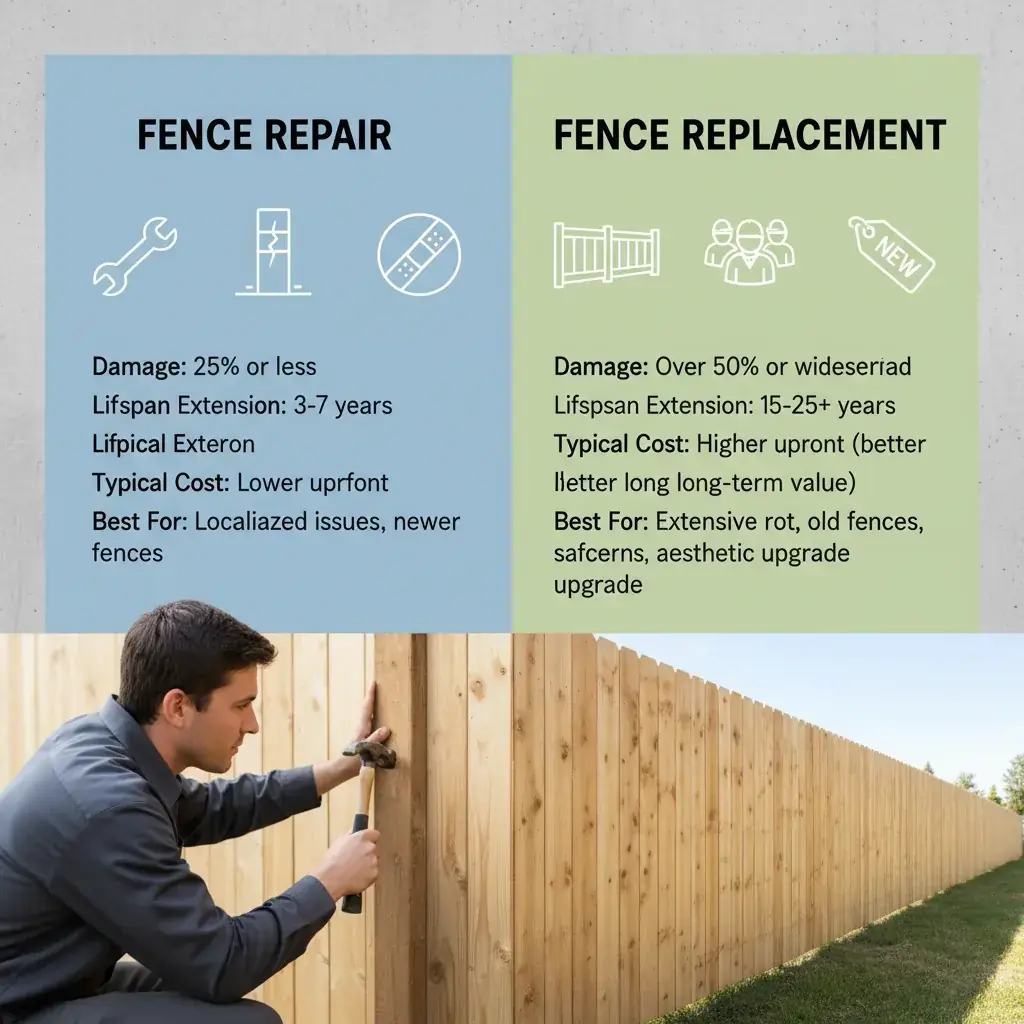
Infographic comparing key factors for wood fence repair versus replacement, including damage percentage, lifespan, cost, and typical scenarios.

Comparing the cost of a major repair to a full new fence

The decision to repair or replace often comes down to dollars and cents, but it’s important to look beyond just the immediate price tag. While a repair typically has a lower upfront cost, a major repair project can sometimes approach or even exceed the cost of a full replacement, especially when factoring in long-term value and recurring issues.

For example, replacing a few rotted posts and several damaged panels might seem cheaper than replacing an entire fence section. However, if those repairs are part of a pattern, and you find yourself making similar fixes year after year, the cumulative cost can quickly outstrip the investment in a new fence. Consider the cost-benefit of a repair that only extends your fence’s life by a few years versus a full replacement that gives you 15-25 years of worry-free performance. You can get a better sense of typical repair costs in our detailed guide on common fence repair costs in San Diego.

A full fence replacement, while a larger initial investment, offers significant advantages. You get a brand new fence with a fresh warranty, ensuring peace of mind. You can also choose updated materials, styles, or treatments that offer better durability against San Diego’s climate, such as pressure-treated pine, cedar, or even composite options. A new fence also significantly boosts your home’s curb appeal and can increase property value, which is a key consideration for many homeowners. It’s often a one-time project that solves all underlying issues, from structural integrity to aesthetics.

When evaluating costs, also consider the disruption factor. Multiple small repairs over time can mean more frequent interruptions to your yard and schedule. A single replacement project, while more extensive, consolidates the work into one timeline. Ultimately, the “cheaper” option isn’t always the most economical in the long run. If your fence has reached the tipping point of 50% or more damage, a full replacement often delivers superior long-term value, durability, and satisfaction.

Frequently asked questions

At what point is it cheaper to replace a fence than repair it?

Replacement typically becomes cheaper when repairs would cost more than 50 to 60 percent of a new fence’s installed price. If your fence is older than 15 to 20 years and you’re spending $800 or more on a single repair, get a full replacement quote first. You may find the gap is smaller than you expect, and a new fence comes with a warranty.

How much does it cost to repair a wood fence in San Diego?

Most wood fence repairs in San Diego run between $150 and $600 for isolated fixes like a broken post or a few damaged pickets. More involved jobs, such as replacing several posts along a long fence run, can reach $1,000 to $2,000. A full section replacement starts around $25 to $45 per linear foot installed, depending on wood species and the complexity of the job.

How long does a wood fence last in San Diego?

A well-built wood fence in San Diego typically lasts 15 to 25 years. Coastal areas with salt air tend to be harder on untreated wood, shortening that range to closer to 15 years unless you use a naturally resistant species like cedar or apply a quality sealant every two to three years. Inland areas with hot, dry summers can also dry out and split wood faster than moderate climates.

Does San Diego require a permit to replace a fence?

Most residential fence replacements in San Diego County do not require a permit if the fence is six feet tall or shorter and follows property line setbacks. Fences taller than six feet, fences in front yard setback zones, and any fence near a pool or retaining wall typically do require a permit. Check with your city’s building department before starting work, since rules vary between San Diego city limits and unincorporated county areas.

What kind of wood fence holds up best near the coast?

Cedar and pressure-treated pine are the two most common choices for San Diego coastal properties. Cedar is naturally resistant to moisture and insects, which helps it handle salt air and marine layer humidity better than standard pine. Whatever wood you choose, sealing or staining it within the first year and reapplying every two to three years makes a significant difference in how long it lasts. You can learn more about protecting your fence in our fence staining services page.

Should I repair or replace just one damaged section of my fence?

If the damaged section is truly isolated, with healthy posts and rails on either side, repairing or replacing just that section makes sense. The main risk is color mismatch: new wood will look noticeably lighter than weathered boards for six to twelve months. If most of your fence is already aged and graying, a sectional replacement may stand out visually until the wood weathers to match.

When to call us

Deciding whether to repair or replace your wood fence can feel overwhelming, but you don’t have to make the choice alone. If you’re seeing signs of wear, unsure about the extent of damage, or want a professional opinion on the best long-term solution for your San Diego home, it’s time to bring in the experts. Our team at Fence Pros San Diego can provide a thorough assessment and clear, honest recommendations. Call us at (858) 925-5546 for a same-day estimate.