TL;DR
- Pull the CC&Rs for your HOA before anyone quotes fence work.
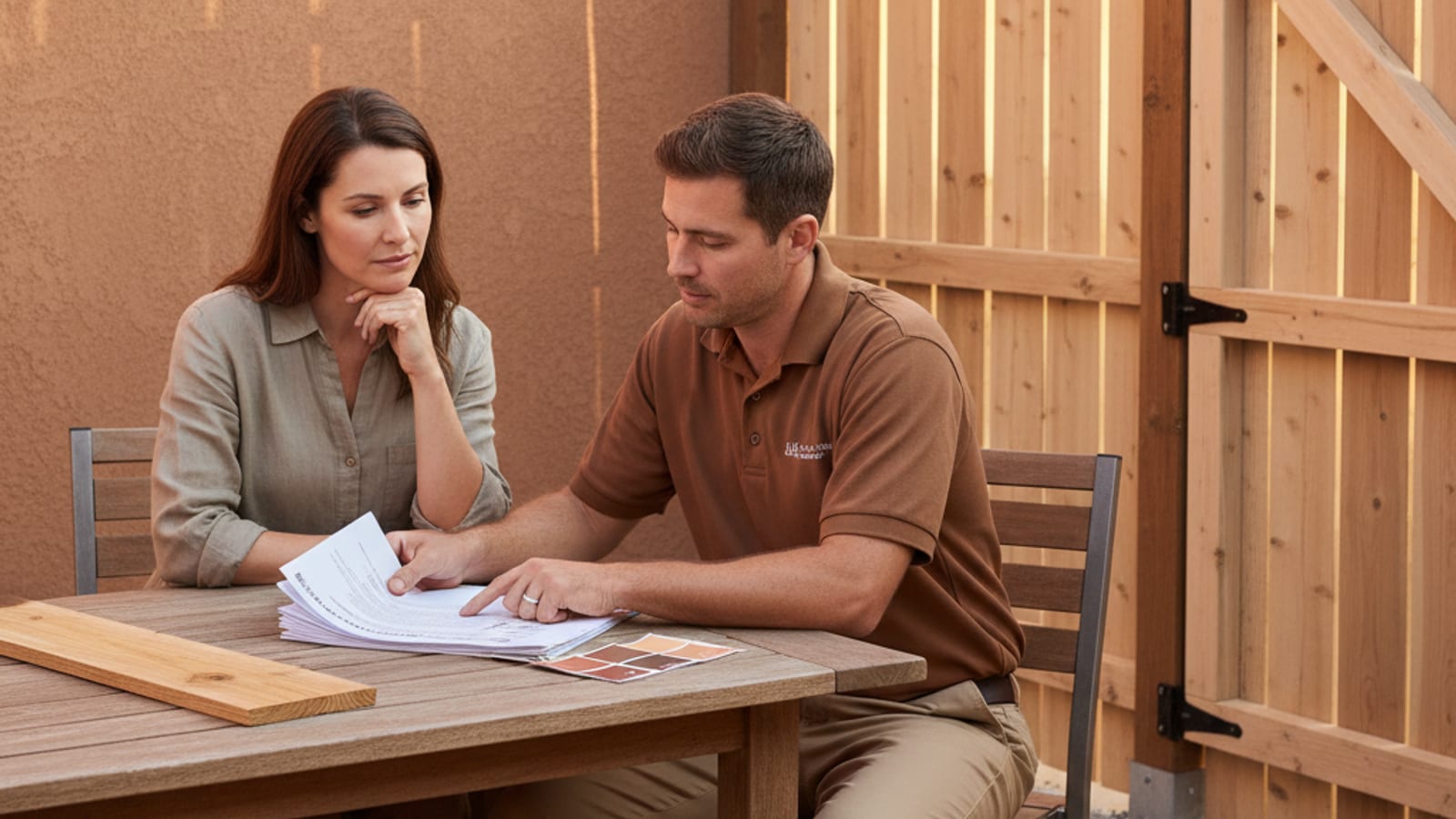
- Approval usually means a written architectural submission: drawings, material samples, sometimes stain chips and neighbor notice.
- Review calendars are set by your association, not by a county-wide clock on this page.
- Installing without written approval can mean a violation notice, fines in the CC&Rs, and a rebuild order.
- A licensed contractor may prepare the package if the contract says so. That is not automatically free, and Fence Pros San Diego does not file it for you.
Most San Diego master-planned communities have fence language in the CC&Rs. Otay Ranch, EastLake, Carlsbad La Costa, Rancho Santa Fe, Carmel Valley, Scripps Ranch, and Rancho Bernardo are examples of places where you should assume an architectural review exists until the management company says otherwise. HOA approval sits on top of city permits (San Diego fence permit guide). Getting the paper right the first time is cheaper than tearing a finished fence down.
Fence Pros San Diego is a referral line. We do not keep a private library of every sub-association’s stain code.
What’s in a fence CC&R
Most fence CC&Rs specify some or all of:
- Material: cedar, vinyl, ornamental aluminum, or a short approved list. Many jobs land on wood or vinyl because that is what the document names.
- Height: often a 6-foot backyard cap, sometimes lower, sometimes no front-yard fence at all.
- Picket profile: dog-ear, flat-top, gothic, scalloped.
- Stain or vinyl color: a named code, often from a paint manufacturer or a fence brand chart.
- Construction style: board-on-board vs single-sided. Some associations require both-sides-finished.
- Post caps and gate hardware: color, style, sometimes brand.
- Process: written application, drawings, samples, photos of the existing fence, sometimes neighbor acknowledgment.
- Review window: whatever that board published. Ask for it in writing.
The CC&R packet can run dozens to hundreds of pages. The fence section is usually short. The management company can send it.
Do not copy the neighbor’s fence as law
Public marketing and street photos are not your CC&R. Some fences were approved under older rules. Some were never approved. Verify with the association:
- What materials are on the current approved list
- Whether vinyl or ornamental metal is allowed in your sub-association
- Exact stain or color codes
- Height and setback, including street-facing lots
- Whether both faces must look finished
- Whether a replacement of the same look still needs a new application
Rancho Santa Fe and similar custom areas often add a design-review board. Newer master-planned areas may be more vinyl-friendly. None of that substitutes for the PDF with your tract name on it.
The submission process
Most associations want an Architectural Review Committee (ARC) packet:
- Cover application from the HOA. Name, address, description, estimated start.
- Site plan showing fence location, length, height, gates.
- Elevation showing picket pattern, cap, post spacing.
- Material specifications: species or vinyl line, grade, post and rail size, hardware.
- Physical sample or labeled photo of picket, stain chip, or finished equivalent.
- Neighbor acknowledgment if the documents require it.
- Review fee if the association charges one. Ask the management company for the current amount. We will not invent a dollar range.
A contractor you hire can assemble that packet. You still sign it. Fold the work into the fence installation contract so it is not a surprise invoice.
Typical approval timeline
Ask your management company for:
- Staff vs committee review
- Monthly meeting date and cutoff
- Whether exact-match replacements have a faster staff path
- How written approval is delivered
Until you have those dates, do not schedule demo. A blog cannot honestly say “14 to 30 days” for every San Diego HOA.
What gets rejected
Wrong material. Vinyl in a wood-only tract.
Wrong color. A stain that almost matches an old grandfathered fence but is not on the current list.
Height over spec. Seven feet in a six-foot community.
Wrong picket profile. Scallop in a flat-top tract.
Missing elevations. Site plan only.
Front-yard fence where the CC&R prohibits it.
Single-sided boards in a both-sides-finished association.
All of those are avoidable if you quote after you read the document.
What happens if you skip HOA approval
California associations can enforce the CC&Rs. Typical tools, which you must read in your documents:
- Notice of violation after a neighbor complaint or a drive-by inspection
- Fines on the schedule in the CC&Rs
- An order to remove and rebuild to spec at your cost
- A lien for unpaid fines, which complicates refinance and sale
We are not printing a per-day fine or a cap. Those numbers live in the association’s enforcement policy.
Grandfathered fences
If the existing fence predates current CC&Rs, it may be grandfathered. But:
- Replacement work often triggers current rules. Replacing half the run is usually not a loophole.
- Sales can reopen the question. Ask management in writing whether your specific fence is still grandfathered.
How a contractor should handle HOA work
On an HOA job, a careful contractor will:
- Ask for the CC&R (or call management with your authorization).
- Pull the fence section before quoting.
- Quote the compliant configuration only.
- Prepare site plan, elevation, sample, and color chip.
- Submit if you hired them to, and handle ARC questions.
- Schedule install after written approval.
If that package is included, the contract should say so. If it is extra, it should say that too.
Frequently asked questions
How long does HOA fence approval take in San Diego?
Whatever your association’s calendar says. Some staff-level exact-match replacements are faster than a full committee cycle. Get the cutoff dates in writing before you tear out the old fence.
What does HOA fence approval cost in San Diego?
Some associations charge a review fee; some do not. Ask management for the current fee. Contractor time to draw and submit is a contract term, not a promise that it is free.
What materials do most San Diego HOAs approve for fencing?
Cedar privacy is common in many master-planned tracts. Vinyl and ornamental aluminum appear in some sub-associations and not others. The CC&R names the list. Stain codes are usually exact.
Can I replace a fence without HOA approval if I match the existing one exactly?
Not safely. Many associations still want a written approval, even for a match. Some offer a shorter staff review. Building without paper can still draw a violation.
Do I need HOA approval for a gate in San Diego?
If the CC&R covers fencing, gates are usually in the same section: hardware color, style, and opening width. Put gates in the ARC packet. A gate installation that skips that step can get the same notice as a full run.
What’s the most common reason an HOA rejects a fence submission in San Diego?
Wrong color and wrong material are the usual avoidable fails. Pull the approved list before anyone orders lumber or vinyl.
If you are in an HOA and thinking about fence work, send the CC&R PDF or the management company name when you call (858) 400-4906. We can pass that file to the independent contractor we match you with. They still quote and submit. We do not approve fences.