Gray boards on a Shadowridge side yard and a west-facing run along State Route 78 do not take stain the same way. Vista’s wood fences sit in suburban tracts, HOA streets, and older lots mixed around the 78. The staining plan has to match that lot, including the association rules, the afternoon sun, and the dirt line at the bottom rail.
How Vista lots along State Route 78 differ from Escondido heat and coastal stain jobs
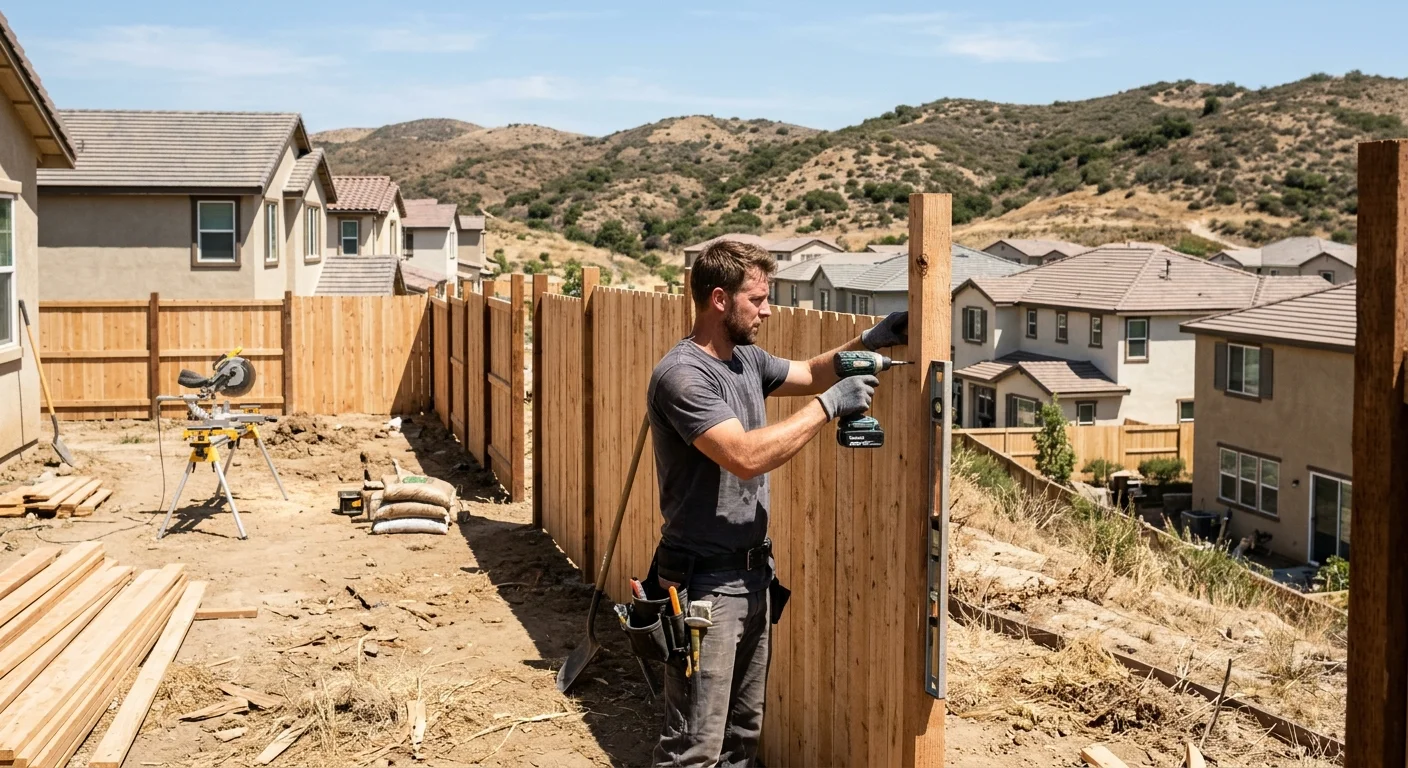
Vista sits inland of Oceanside and west of San Marcos and Escondido. State Route 78 is the spine. South of the freeway you get planned streets, HOA palettes, and fences that have to look like the rest of the block. Closer to downtown Vista, Civic Center Drive, and the older blocks off North Santa Fe Avenue, the stock is mixed. Some runs are original wood. Some are patched with newer boards. Some sit against planters and mow strips that throw dirt every time the sprinklers run.
That mix is the Vista staining problem. It is not a beach-salt problem, and it is not Escondido valley heat with a city name swapped in. Escondido fence staining is a hotter inland-valley job. Boards there cook in a bowl of heat, and a south face can fail in a more even, all-day way. Vista still gets strong afternoon sun, especially on west and south faces that look toward open pavement along Melrose Drive or the 78. The pattern on the lot is different. You often get one hot street face, one shady HOA interior, and a gate that lives in a breezeway. Treating the whole run like an Escondido heat job misses half the fence.
Coastal stain work in Oceanside, Carlsbad, and Encinitas fights marine air and a cooler morning layer. Vista is drier. Salt is not the main story here. Irrigation overspray, dust from inland roads, and uneven UV on tract fences are. A north-facing panel under a neighbor’s tree can still be damp in the morning while the street face is already hot. Independent staining contractors time the work to each face, not to a countywide calendar.
The housing stock pushes the same split. Shadowridge and the later tracts along Sycamore Avenue tend to have HOA sight lines, matching gates, and neighbors who notice a color miss. Older lots toward Buena Creek and the village core tend to have mixed woods, repaired sections, and soil packed against the bottom of the boards. If you want a Vista-specific starting point for who handles fence work in this city, read the fence company in Vista guide, then keep the stain scope separate from a new build.
Fence Pros San Diego is a referral service. It matches you with licensed, independent fence professionals. Those contractors walk the lot. They do not stain from a photo of a different North County city.
What a staining pro inspects on wood, hardware, and soil splash
A staining pro walks the fence before anyone opens a can. On Vista wood, that walk is about three things: the boards, the hardware, and the dirt line.
On the wood, the pro is looking at remaining coating, gray weathered faces, cupping, checks, and soft bottoms. Replaced pickets next to original boards drink stain at different rates. A semi-transparent product will show that mismatch. A more opaque stain can hide it. That choice belongs in writing, on a sample board from your fence, not in a catalog photo. Our guide to fence stain types in San Diego walks through transparent, semi-transparent, and solid looks. The contractor still has to test your actual wood, because a patched run off South Santa Fe will not read like a newer tract fence in Shadowridge.
Hardware is the second pass. Hinges, latches, drop rods, and gate frames tell you whether the moving parts will take a coat or need work first. Rusted screws and a sagging gate are not stain problems. Stain on a dragging gate just coats a mechanical failure. If the gate rubs the walk, the pro should say so before the wash. Ask whether hinges get masked, removed, or coated, and whether both faces of the gate are in the scope.
Soil splash is the Vista detail a lot of generic stain pages skip. Tract yards along Sycamore and in Shadowridge backyards often throw mud, lawn fertilizer, and irrigation stain onto the lowest boards. If planters sit against the fence, that contact line needs to be called out. Packed soil holds moisture against the board bottoms. A wash that never reaches that line leaves a dirty band that the new color will not hide. Dog paths, slope, and a neighbor’s overspray matter as much as the top rail.
Access belongs on the same walk. Both sides, a dog run, a slope, and an HOA street face you cannot reach without the neighbor all change the job. Shared lines need a conversation before anyone washes. For the coating work itself, fence staining and sealing is the service path. Repair is a different path, and it should show up in the notes if the wood is past coating.
When prep, board replacement, and staining deserve separate quotes
Prep, board swaps, and stain are three jobs. One line that says “stain the fence” hides that, and it is how Vista homeowners end up comparing two numbers that are not the same work.
Prep is the wash, the dry wait, knocking down fuzzy grain, and dealing with a failing old coating. If the wood is still wet, stain sits on top. If last year’s sealer is peeling, a light wash will not open the surface. The contractor should say whether they are washing only, sanding, or stripping, and which faces need which step. A hot west face along the 78 and a shady interior face on the same lot often need different prep, even when they are the same fence.
Replacement is the next split. Split, rotten, or missing boards will not hold a clean finish. Posts that move will not either. That is fence repair, not a stain add-on you discover on the last day. Ask for a board count, a post count, and whether replacement wood will be stained with the rest of the run or billed as it is found. Mixed new and old wood is common on older Vista lots. If those boards are not called out, the finished color will telegraph every patch.
Stain is the third line: product, opacity, number of coats, both sides, and gates. Ask whether the quote includes the street face, the neighbor face, and the gate, or only the side you can see from the patio. HOA lots get this wrong when the association cares about the street and the homeowner cares about the yard.
Keep those lines separate in the written scope. Then confirm the contractor’s license on the CSLB license check. A C-13 fencing contractor license in California authorizes work to construct, erect, alter, or repair fences, gates, and related work, and it excludes masonry walls. You hire and pay that independent pro directly. Fence Pros San Diego does not set the price, own the equipment, or perform the work.
How to compare two Vista staining proposals
Two written proposals with the same linear footage are not the same job. Compare the scope, not the shortest number.
Start with what gets cleaned, how, and how the wood is left to dry before stain goes down. Then look at sanding, stripping, and whether failing coating is in the price or listed as extra. Next, board replacement: a counted allowance, a per-board line, or “as needed” with no cap. “As needed” with no count is not a comparable bid.
Then the finish. Named product, opacity, number of coats, and whether both sides and the gate are included. Ask for a sample on your actual fence, in the sun, on a board that matches the rest of the run. A sample on a shady north face will not tell you what the west face along Melrose will look like at 3 p.m. If the HOA has a color list, that sample is also the document you send to the association.
Access and protection belong in the same comparison. Who moves furniture, who masks plants, who needs the neighbor’s gate open, and how change orders get written. A Shadowridge interior lot with tight side yards is a different access job than a deeper older lot near the village. If one proposal assumes both sides and the other assumes the yard side only, they are not competing.
Shared fences add a legal step that is not optional. Under California Civil Code section 841, adjoining landowners are presumed to share equally in the reasonable costs of construction, maintenance, or necessary replacement of a dividing fence, unless they have a written agreement that says otherwise. Before incurring those costs, a landowner must give 30 days’ advance written notice. The notice has to describe the problem, the proposed solution, estimated costs, the proposed cost-sharing, and the timeline. The presumption can be overcome with evidence that equal sharing would be unjust. The statute applies to private landowners, not government entities. If the run on your Vista lot is a neighbor line, get that notice in motion before the contractor schedules the wash.
Pick the proposal that names the wood, the prep, the faces, the gate, and the HOA sample. A thinner page with a round number is not a better deal. It is an incomplete scope.
Which finish or HOA questions need confirmation for that address
HOA color is an address question, not a neighborhood guess. Call the association for that lot. Ask about approved colors, opacity, sheen, whether the street face and the yard face have to match, and whether the gate is included in the review. Do not copy the neighbor’s stain and assume it is still on the list. Shadowridge and other Vista tracts change packets, and a faded sample on the next cul-de-sac is not an approval. If you need a wider county walkthrough of association fence rules, use the HOA fence approval page, then still confirm with your own board.
The City of Vista is the other authority when the work is more than a coat. If you are only recoating in place, ask the city whether that coating work needs anything from them. If you are also changing height, moving the line, or replacing enough structure that the job looks like a rebuild, ask before the contractor starts. A Vista-specific staining permit rule could not be confirmed in the approved claims ledger for this site. Unresolved permit questions go to the City of Vista, not to a blog post.
Finish choice sits on the wood you have. Stain that soaks in will show grain and will also show mismatched patches. Solid stain hides more of that, and it reads closer to paint. Once a fence is painted, going back to a clear or semi-transparent look usually means stripping. Ask the contractor which product fits this wood’s condition, and to show you a sample on the actual fence before you commit. Do not pick from a screen.
How long a finish lasts is not a number this page can publish. Sun, irrigation, and wood condition drive it, and there is no verified interval in the claims ledger. Use how often to stain a San Diego fence for the county-level questions, then let the pro on your lot speak to this run. A west face on the 78 and a shaded HOA interior on the same property will not age together.
If the fence is a neighbor line, keep Civil Code 841 in the folder with the HOA email. If it is an HOA street face, keep the association’s written color note with the sample. The contractor can stain only what you have permission and access to stain.
When to call us
Call when the wood is gray, the coating is failing, boards are splitting, or the HOA wants a color match you cannot guess from the street. The independent, licensed fence contractors in the network inspect the run, separate prep and repairs from the stain, and quote you directly. Call us at (858) 400-4906 and we’ll connect you with a licensed fence contractor.