A pool fence inspection before closing should document the barrier, test normal gate movement, and identify questions needing expert review. Don’t declare an existing fence compliant from appearance alone. Current requirements depend on the property and its governing authority.
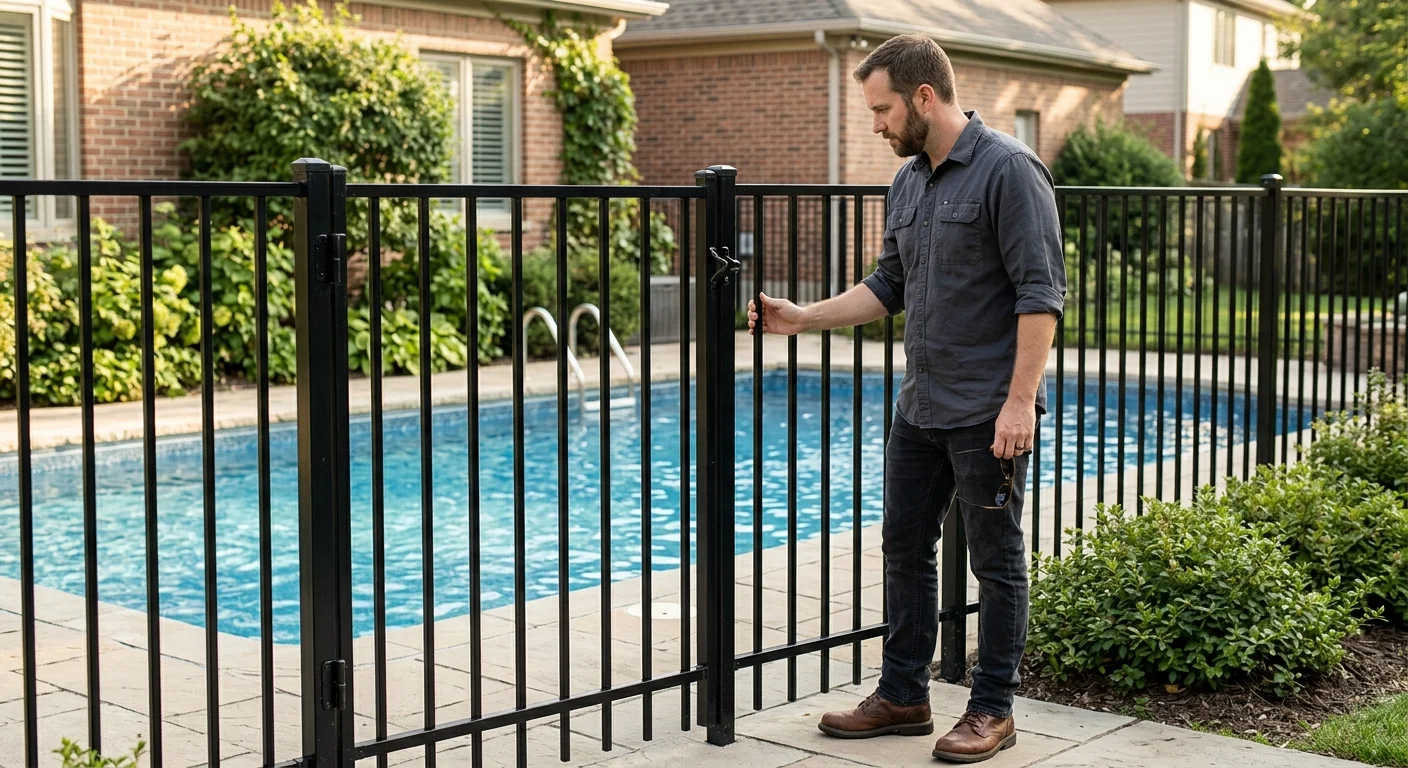
How to document the existing barrier without changing it
Start with a slow walk around every accessible side of the pool barrier. Take wide photos that show how each section connects. Then photograph posts, panels, gates, hinges, latches, and attachment points.
Create a simple folder for the inspection. Label photos by location, such as driveway side, house side, or rear boundary. This makes later conversations easier. It also helps a fence contractor understand the layout before discussing options.
Record what you can see without taking anything apart:
- Every gate and visible access point
- Changes between fence materials or panel styles
- Sections connected to buildings, walls, or other structures
- Loose, leaning, bent, cracked, rusted, or deteriorated areas
- Soil gaps, raised paving, slopes, and changes in ground level
- Planters, furniture, equipment, or landscaping beside the barrier
- Repairs that don’t match the surrounding installation
Don’t loosen hardware, adjust hinges, or move posts during a showing. Avoid pushing hard against questionable sections. The goal is to preserve the existing condition while creating a useful record.
San Diego properties vary sharply by setting. Note whether the home is near the coast, on a hillside, beside a canyon, or on a compact city lot. Don’t assume those conditions create a violation. They simply give the contractor and local authority better context.
Save the listing photos too. Compare them with what you see in person. If a gate, panel, or access point changed, ask the seller when and why it changed. A careful photo record gives your pool fence inspection a reliable starting point.
What gate operation and visible damage need closer review
Operate each gate only as intended. Don’t slam it, pull it sideways, or force a sticking latch. Watch the entire movement from the open position through closure.
If the seller describes a gate as self-closing, document whether it closes during normal use. Try several ordinary starting positions when you have permission. Note whether the gate drags, stops, rebounds, or reaches the latch without help. One successful closing attempt doesn’t settle the question.
Look closely at the working parts. Loose hinges, shifting posts, bent frames, worn fasteners, and misaligned latches deserve professional review. So do temporary ties, added blocks, improvised springs, or other visible modifications.
Surface damage also provides useful clues. Photograph corrosion, peeling material, split wood, cracked panels, broken mesh, and open joints. Check where posts meet soil, concrete, or paving. Record movement you can observe without applying heavy force.
An existing pool gate that won’t self-close needs closer assessment. That behavior doesn’t prove why the problem exists. The cause could involve the gate, hardware, post alignment, surrounding surface, or several connected parts.
Do not use a blog chart to announce that the property passes or fails. California Health and Safety Code section 115923 is the sourced enclosure list (gate swing away from the pool, self-close, self-latch, latch no lower than 60 inches, 60-inch height, 2-inch ground clearance, 4-inch sphere, climbable-face rule for a child below age five). Photograph against that list. The governing building official still decides the address. Section 115922’s two-feature rule applies when a building permit is issued for a new or remodeled private single-family pool or spa, not as a DIY closing stamp.
Keep children outside the inspection area while gates are being operated. Once testing ends, return each gate to the position in which you found it. Give your photos and notes to the home inspector, seller, and any fence contractor asked to review the barrier.
Which records and approvals to request from the seller
Ask the seller for documents tied to the pool barrier and its gates. Missing paperwork doesn’t prove the fence is unacceptable. Existing records can still clarify what was installed, changed, or reviewed.
Request copies of any available:
- Permits or approval records
- Inspection reports
- Contractor invoices and written scopes
- Product information
- Manufacturer instructions
- Repair or replacement records
- HOA approvals, if the property has an HOA
- Written agreements involving a shared boundary
Ask when the barrier was installed and whether it was later modified. A replaced gate, added panel, shifted post, or changed access point may have separate records. Keep original documents instead of relying on a verbal summary.
An invoice shows that someone billed for work. It doesn’t establish current compliance or confirm official approval. Likewise, an old inspection record describes a past review. It doesn’t answer every question about later damage or alterations.
If a contractor’s name or license information appears, check it through the California Contractors State License Board license search. Match the record to the business named on the paperwork. Save the result with your purchase documents.
Give these records to the professional conducting your home inspection. If concerns remain, ask your real estate agent how to document them during the purchase process. The goal is a written trail showing what’s known, what couldn’t be confirmed, and what still needs review.
Our California pool fence code overview can help organize questions. Don’t treat a blog article as property-specific approval. Current answers must come from the governing authority.
Who can confirm current pool barrier requirements
HSC 115923 and 115922 are the statewide texts used on this job. They do not replace the building official for the parcel, local amendments, or whether 115922 is even in play for this sale.
First, identify the jurisdiction for the exact property address. A San Diego mailing address does not replace a jurisdiction check. Determine whether the parcel falls within the City of San Diego, another incorporated city, or an unincorporated county area. City Table 142-03A and County PDS 070 are fence-construction notes, not a closing inspection form.
For a City of San Diego property, contact the City’s Development Services Department. For an address in another city, contact that city’s building or development office. For an unincorporated property, contact the applicable San Diego County building authority.
Provide the property address and describe the existing barrier. Ask direct questions:
- Which current rules apply to this address?
- Are permits or inspection records available?
- Does the existing pool barrier have a recorded approval?
- Do later repairs or alterations appear in the record?
- Would the planned work require review or a permit?
- Which office makes the final determination?
Mention unusual access conditions. These might include doors opening toward the pool area, barriers tied into buildings, shared boundary sections, multiple gates, slopes, or recent additions. Let the authority decide which details matter.
Write down the office, date, and guidance received. Save any email response or record number supplied by the agency. If officials need drawings, photos, or an on-site review, follow their requested process.
A seller, buyer, home inspector, and fence contractor can each provide useful information. None should substitute an appearance-based opinion for the authority’s decision. This keeps the purchase discussion focused on documented conditions and confirmed requirements.
When a fence pro should assess repair or replacement options
Bring in a fence professional when the barrier has movement, visible damage, unreliable gate operation, or unclear alterations. Professional input also helps when several sections connect differently or the seller’s records don’t explain the existing work.
Share your photos, measurements, records, and authority notes. Ask the contractor to separate observed condition from code interpretation. If the contractor identifies a requirement, ask which current official source supports it.
The assessment should distinguish between isolated repairs and wider replacement work. A loose hinge may call for a different scope than a shifting gate post. Repeated damage across connected sections may change the available options. The contractor should explain those differences for this property, not apply a generic answer.
Request a written scope that identifies:
- Sections proposed for repair or replacement
- Gate, hinge, latch, and post work
- Connections to walls or other structures
- Ground or paving conditions affecting the work
- Materials included in the proposal
- Questions that still require agency confirmation
Don’t accept a repair as suitable only because it’s smaller. Don’t assume full replacement is necessary because the fence looks old. Material age alone doesn’t establish condition, and no verified lifespan figure is available for this page.
A licensed contractor can discuss pool fence and safety barrier options after reviewing the property. If the barrier is generally intact, fence repair and restoration may also be worth assessing.
Fence Pros San Diego is a referral service. We connect homeowners with licensed, independent local fence contractors. The homeowner contracts with and pays the matched professional directly.
When to call us
Call when visible damage, shifting posts, or inconsistent gate operation needs a licensed fence pro’s assessment. Call us at (858) 400-4906 and we’ll connect you with a licensed fence contractor.