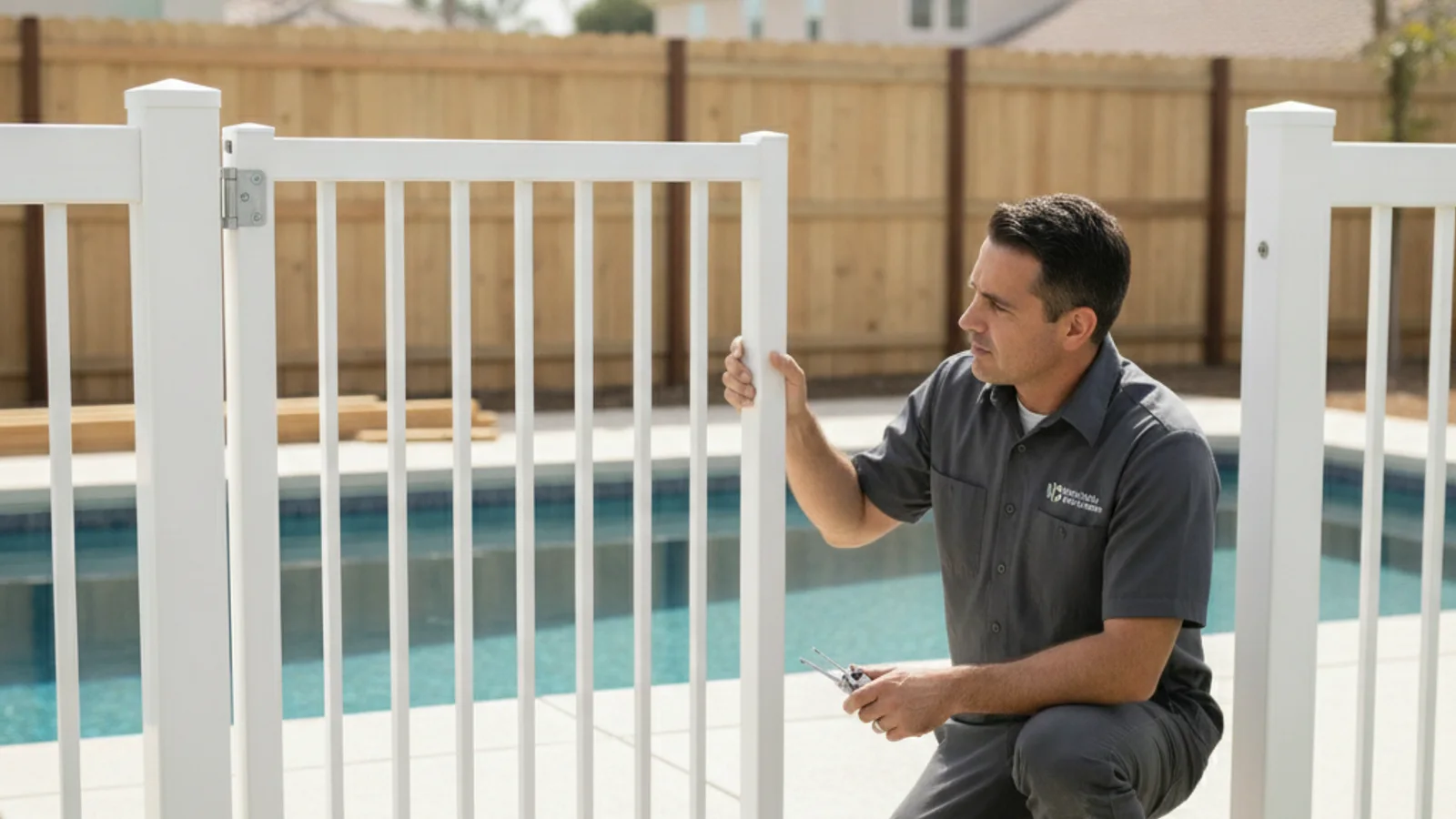
A pool gate that used to swing shut and now hangs open, or closes but misses the latch, has a mechanical problem in the hinge, closer, latch, or frame. Finding which part failed is the first step. Restoring the self-closing and self-latching function is the finish.
This is a safety barrier, not a decorative gate. California Health and Safety Code section 115923 sets enclosure characteristics when that statute applies, including gates that open away from the pool and a self-closing, self-latching device placed no lower than 60 inches above the ground. Confirm with the building desk for the address whether your gate is an enclosure gate, a 115922 safety feature, or both.
Fence Pros San Diego is a referral service. We match you with a licensed independent fence professional. We do not repair gates, certify barriers, or hold a C-13 license.
Why a self-closing pool gate stops closing
A gate that is built to swing shut relies on spring hinges or a separate closer doing the same work every cycle. When it stops, look at these mechanical causes first.
Spring tension has weakened. Self-closing hinges use a coiled spring that loses force after years of cycling. Salt air on a coastal lot can speed wear on moving metal. A hinge that used to push the gate home and now barely nudges it is a spring at the end of its useful tension.
The gate frame is out of plumb. If the hinge-side post has shifted, or the frame has racked, gravity fights the close instead of helping it. A gate that hangs even slightly low on the latch side will stop short of the strike.
Debris or growth is in the swing path. Leaves, dirt at the base, a plant in the arc, or a sprinkler head that crept into the path can stop the last few inches. Rule this out before anyone orders hardware.
The hinge is binding. Corrosion, a bent pin, or grit in the barrel adds friction the spring can no longer overcome. A hinge that feels stiff by hand will be worse under spring load alone.
What you can check without changing the safety setup
A few checks are safe and do not reconfigure the closer or latch.
Clear the swing path. Walk the full arc. Remove plant growth, debris, or a fixture catching the bottom or side.
Look at ground clearance. Note dragging, a shifted paver, or dirt piled at the base. Do not raise or lower the gate yourself. Describe what you see to the contractor.
Feel the hinge. With the gate held open, ease it toward closed. Note grinding, binding, or a spring with almost no pushback.
Look at the latch strike. If the leaf reaches the closed position but does not catch, check whether the strike still lines up with the latch. A post that has moved even slightly will miss every time.
Do not loosen, remove, or bypass the self-closing mechanism to make daily use easier. That device exists so the gate closes and latches without anyone remembering to do it.
If the gate cannot close and latch, treat the pool area as an open barrier until a licensed professional restores it. Supervise the water. Do not prop the leaf open as a workaround.
When a licensed fence contractor should repair or replace the gate
Some hardware swaps look simple. A pool gate is still the wrong place to guess.
A worn spring hinge needs a hinge rated for the leaf weight and for outdoor exposure. A generic interior closer is not a substitute.
A racked frame or shifted post needs the structure fixed first. Turning up spring tension on a crooked leaf hides the cause.
A latch that misses the strike sometimes needs only a strike move. If the post moved, the fix is resetting the post, not chasing the latch with shims.
California’s C-13 fencing classification covers constructing, erecting, altering, or repairing fences and gates. It excludes masonry walls. If the gate hangs from a masonry column, the proposal should name who holds the masonry scope.
If the gate is part of an isolation enclosure, Health and Safety Code section 115923 also requires a minimum enclosure height of 60 inches, a maximum two-inch clearance from the ground to the bottom of the enclosure, no gap that lets a four-inch sphere pass, and an outside face without footholds that a child under five could use to climb. City Table 142-03A and County PDS 070 are fence-construction notes. They do not replace the pool statute. Confirm both tracks with the desk for the parcel.
Our pool fence page explains how referrals work. The California pool fence code guide covers 115922 and 115923. If the setup is a removable mesh system rather than a fixed panel, see removable mesh pool fence.
Frequently asked questions
Why did my pool gate suddenly stop closing on its own?
Common mechanical causes are a weakened spring hinge, a post or frame out of plumb, debris in the swing path, or a binding hinge. Clearing the path is the fastest check.
Can I tighten or replace the spring myself?
A hinge swap can be reasonable if the frame is square and plumb and you are competent with the hardware. If the gate has been dragging, sagging, or missing the latch, a new spring alone will not fix the structure.
Is it safe to prop my pool gate open while I wait for repair?
No. Treat an out-of-service pool gate as an open barrier. Keep the water supervised and restore self-closing and self-latching as soon as a licensed contractor can do the work.
What legal requirements apply to a pool gate in San Diego?
When section 115923 applies, gates must open away from the pool and use a self-closing, self-latching device no lower than 60 inches above the ground. Local building review can add checks. Confirm with the city or County desk for the address. Do not treat Title 24 as the source of these numbers on this page.
When to call us
A pool-gate repair that does not restore self-closing and self-latching is not finished. Call (858) 400-4906 and we will connect you with a licensed independent fence contractor. You contract with that professional directly.