Removable mesh pool fencing is one drowning-prevention option for a San Diego backyard pool. It is not automatically “the code fence,” and it is not the same thing as a 115923 isolation enclosure. This page explains the statute split, how mesh differs from a permanent barrier, and what belongs in a written proposal.
Fence Pros San Diego is a referral service. We connect you with licensed independent professionals. We do not install mesh, certify barriers, or set prices.
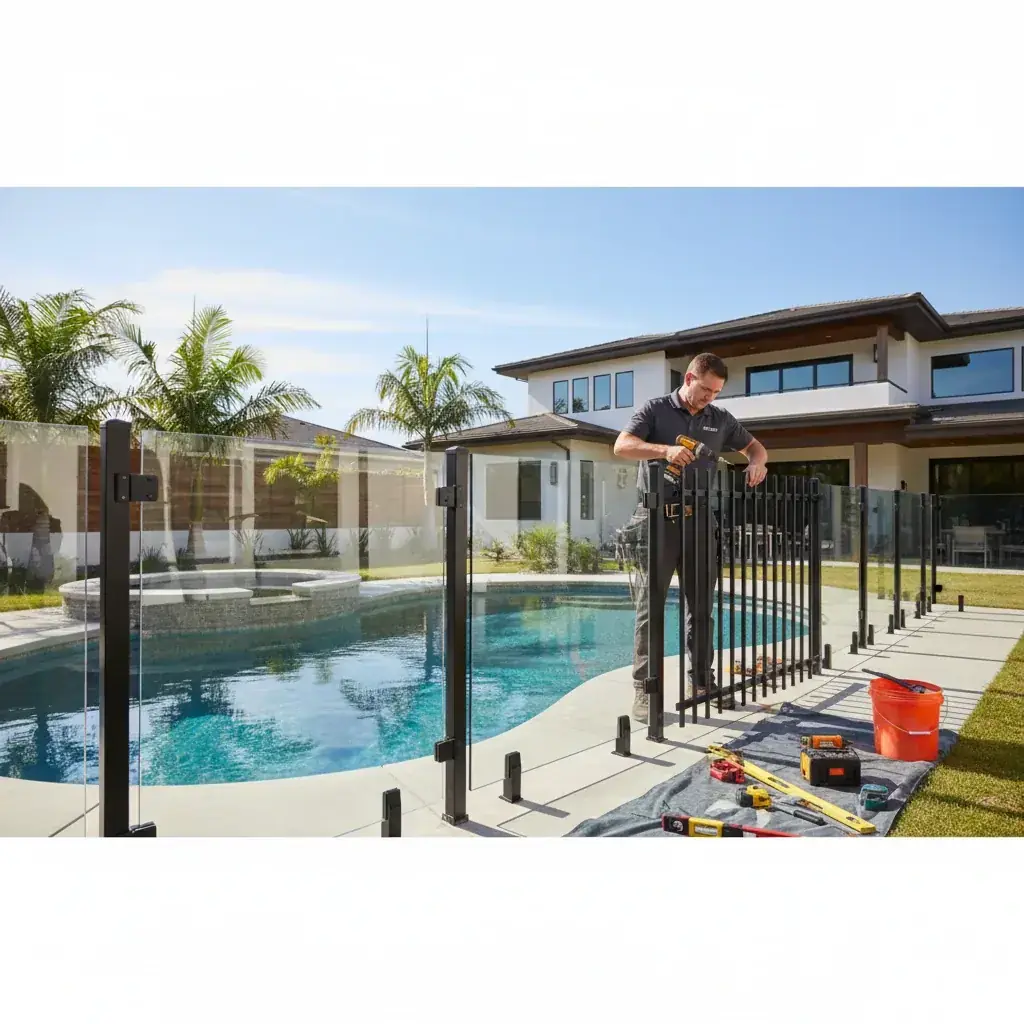
What a removable mesh pool fence is
A removable mesh fence uses taut mesh panels on poles that drop into sleeves in the deck. The poles come out so the panels can be stored. Caps on the sleeves are supposed to sit flush when the fence is down. Ask the proposal to name the mesh product, pole size, sleeve hardware, and how those caps are finished.
Panel width, height, and brand vary. Do not assume a stock kit matches the height your permit or inspector requires. Read the product sheet and the local checklist together.
This is different from a permanent pool barrier that is bolted or cored to stay. Mesh is built to come off. That flexibility is the point during the years you want a close-in child barrier. It also means the barrier only works when it is actually installed and latched.
How it fits California pool statutes
Do not cite Title 24 as the home of these rules on this page. The job file has Health and Safety Code sections 115922 and 115923.
Section 115922 applies when a building permit is issued for construction of a new swimming pool or spa, or remodeling of an existing one, at a private single-family home (with the statute’s stated exceptions). The pool or spa must then have at least two of seven listed drowning-prevention features.
One of those seven is “removable mesh fencing that meets the ASTM International F2286 standard in conjunction with a gate that is self-closing and self-latching and can accommodate a key lockable device” (115922(a)(2)). Another is an enclosure that meets 115923 and isolates the pool from the house (115922(a)(1)). Mesh as feature (2) is not the same legal object as a 115923 enclosure. Some feature pairs do not count; see 115922(b).
Section 115923 lists enclosure characteristics when that section applies: gates open away from the pool; self-closing with a self-latching device no lower than 60 inches above the ground; minimum height 60 inches; maximum two-inch clearance from ground to the bottom of the enclosure; no gap that lets a four-inch sphere pass; outside face without footholds a child under five could use to climb.
Local building desks can add inspection checklists. City Table 142-03A and County PDS 070 are fence-construction notes. They do not replace the Swimming Pool Safety Act. Confirm which path applies to this permit with the city or County serving the address.
The California pool fence code guide walks through the two-feature rule in more detail.
Mesh versus glass versus aluminum
All three can be part of a legal setup when the installed product matches the statute and the local inspection. They do different jobs.
Mesh is a close-in child barrier with no horizontal rail to stand on when the mesh is tight. It is visible as a safety layer. Cheap or loose mesh can sag. It comes down when an adult removes it, which is also the failure mode if it stays down.
Glass keeps a view of the water from the house. It is a permanent landscape feature. Coastal hardware needs a named alloy or coating. It is not a cheaper substitute for mesh, and this site does not publish a price ratio.
Aluminum is a common permanent picket barrier. Climbability depends on rail height and spacing. Specify the gate closer and latch. Permanent.
If you want a toddler-stage barrier you can store later, mesh is the reversible option. If you want a finished yard edge that stays, look at aluminum or glass. Style notes: pool fence ideas.
What belongs in the installer proposal
Fence Pros San Diego does not publish per-foot or per-pool totals. Compare written scopes.
Ask each bidder to state:
- Product name and whether it is specified as ASTM F2286 mesh (if you are using 115922(a)(2))
- Panel height as installed, not as a catalog nickname
- Gate count, swing direction (away from the pool if it is an enclosure gate), closer, latch height, and whether the latch can take a key lockable device
- Sleeve layout, deck material, and how caps sit when the fence is down
- How mesh is tensioned and how joints between panels are closed
- Who pulls any required permit and who meets the inspector
- Exclusions: electrical, masonry, glass, or operators that are not in this bid
California’s C-13 fencing classification covers fences and gates and excludes masonry walls. Core-drilling a masonry deck edge or adding a block stem is a separate license question.
Verify the contractor on the CSLB license check. We do not “vet a network” as a published quality claim. We make a referral. You contract with the professional directly.
Frequently asked questions
Is a removable mesh pool fence required in San Diego?
A drowning-prevention setup can be required when 115922’s permit trigger is met. Mesh is one listed feature, not a mandated material. The city or County can still require an inspection of whatever you install.
How much does a removable mesh pool fence cost?
This site does not publish installed ranges. Ask for an itemized proposal: linear feet, panel height, gates, deck drilling, and permit handling.
Can I remove it for a gathering?
That is the design. The barrier only protects when it is up and latched. Do not leave the water unwatched with the mesh stored.
Does mesh meet California pool code by itself?
It can satisfy 115922(a)(2) when the product meets ASTM F2286 and the gate is self-closing, self-latching, and able to take a key lockable device, and when it is paired with a second qualifying feature. It meets 115923 only if the installed enclosure actually has those characteristics. A short kit with a weak latch will not get there.
When to call us
If you need a licensed contractor to measure the deck, name a mesh product, and write the gate spec, call (858) 400-4906. We will connect you with an independent professional. You hire that contractor directly. We do not mark up the install or line up competing quotes as a paid service.