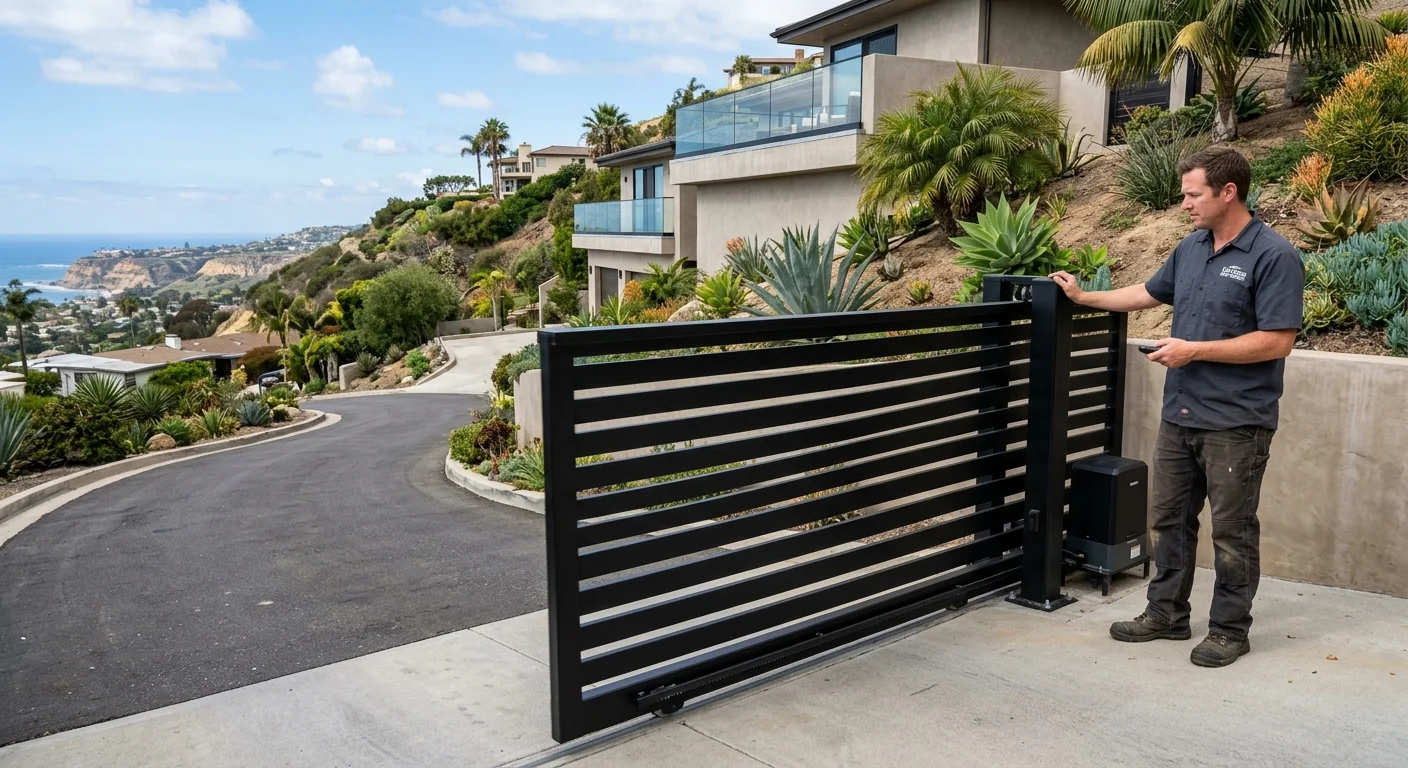
A sliding gate beats a swing gate in two common San Diego situations: a driveway that pitches, and a tight lot where a swing leaf would hit a car, a wall, or the slope. The leaf moves along the fence line instead of through an arc. Installed price is a site quote. Fence Pros San Diego does not publish 2026 gate packages. We match you with an independent contractor who measures the opening, the runback, and the power path.
For swing vs slide cost drivers across styles, see driveway gate cost in San Diego. That page is the cost URL. This page is the geometry URL.
Why a sliding gate works better for sloped driveways
A swing gate needs a level sweep. If the drive rises toward the house, an inward swing hits pavement. If the drive falls away, an outward swing scrapes. You can cheat a slight slope by hanging the leaf out of plumb. That leaves a triangular gap at the bottom and still fails on a real hillside.
A sliding leaf travels parallel to the fence. The driveway slope under the cars is not the path the gate has to clear, as long as the fence-line grade for the track or the cantilever rollers is built correctly. That is why hillside streets in East County canyons and coastal bluff lots show up with slides more than swings.
A slide still needs a clear pocket beside the opening. If that pocket is full of meters, a mature ficus, or a retaining wall, you do not have a sliding-gate lot until that conflict is designed out.
Cantilever vs track sliding gates
Track sliding gates
Wheels roll on a metal track set across the driveway. Upper rollers keep the leaf upright.
Fits when: you want the simpler, usually cheaper hardware package, the opening is wide, and someone will keep debris out of the track.
Watch for: dirt, ice plant, and pea gravel in the channel; a bump at the pavement; wheel and track wear if the track sits full of grit. San Diego does not have a snow problem. It has a sand-and-leaf problem.
Cantilever sliding gates
The leaf hangs on rollers mounted on posts beside the opening. A tail behind the opening counterbalances the span. Nothing sits on the driveway.
Fits when: you want a clean pavement, the track would clog, or you do not want a ridge in the concrete.
Watch for: runback. The tail is a large fraction of the opening width. Tight side yards cannot hide it. Balance and roller spec are the install. A sagging cantilever is an alignment problem, not a “tighten the opener” problem.
What belongs in a sliding-gate quote
Do not shop a single number. Ask the bid to name:
- Leaf type (track vs cantilever) and material (aluminum, steel, wood, vinyl)
- Opening width, leaf height, and, for cantilever, the tail length
- Posts and footings for the hangers or the track
- Operator model, voltage, and backup
- Safety devices the manufacturer requires for that operator (photo eyes, edges, loops), listed as products, not as “sensors included”
- Electrical path: existing circuit vs new conduit. Solar is a design choice, not a promise that you skip trenching, batteries, or shade problems
- Site work: grade along the fence line, concrete, demo
Steel is heavy and custom. Aluminum is the common coastal slide because it does not rust like bare steel. Wood needs finish cycles. Vinyl and composite show up on privacy slides. Automation, access control, and a video keypad are separate money from the leaf.
A reputable installer puts materials, labor, and site work in writing. Gate installation is the service page for that scope.
Motor and automation questions to ask
A slide operator is not a swing operator. It is built to pull a leaf on a rack or chain.
Power. AC on a dedicated circuit is the usual choice for a heavy, high-cycle commercial-style leaf. Solar plus battery shows up on lots where a trench is ugly or long. Solar still needs a panel in real sun, a battery sized for your daily cycles, and a plan for marine layer weeks. It does not automatically beat trenching. It trades trench cost for electrical design. Ask the contractor to size both options against your cycle count. Do not take a blog’s word that solar “makes the most sense.”
Access. Remotes, keypads, intercoms, and phone apps are adders. Write them on the bid.
Safety. Automated gates are their own product family. Manufacturer instructions and the operator listing (commonly discussed as UL 325 for the operator and ASTM F2200 for the gate construction) are not the same as a garage-door opener, and they are not “one photo eye and you are done.” Ask the installer to list the entrapment devices that pair with that exact operator. Manual release during a power cut should be demonstrated before you sign off.
If an existing operator misbehaves, use troubleshooting automatic gate problems and then get the contractor, not a DIY spring release.
Frequently asked questions
How much does a sliding gate cost to install in San Diego?
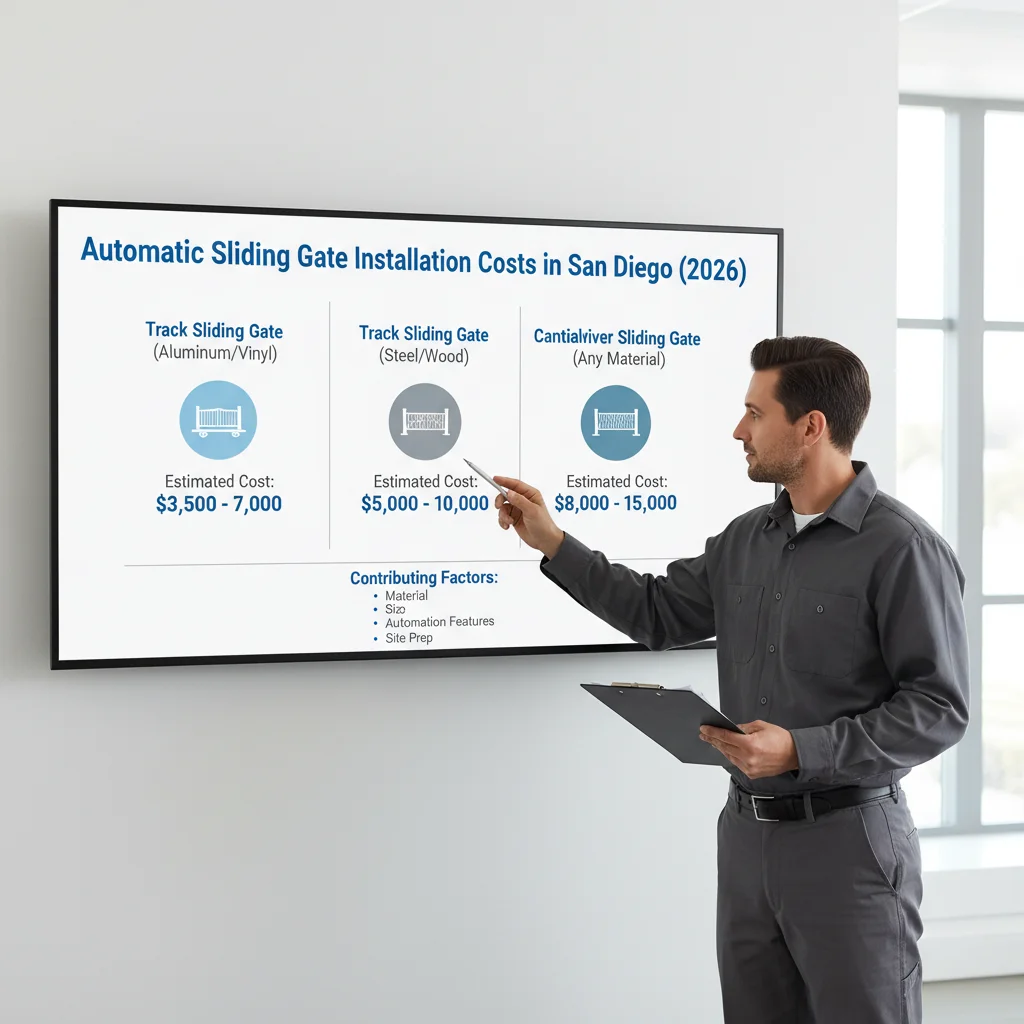
Track vs cantilever, aluminum vs steel, opening width, and whether you are adding an operator all change the number. Site concrete and power are often the sleeper lines. Get an itemized estimate on your opening. We will not invent a package price here.
When should I choose a sliding gate over a swing gate?
Choose a slide when the drive slopes through the swing arc, when cars or walls sit inside that arc, or when you want the leaf stacked along the fence. Choose a swing when the pad is flat, the sweep is clear, and you do not have runback room for a slide.
What is the difference between a cantilever and a track sliding gate?
A track gate rolls on a ground rail. It is usually the simpler hardware. The rail collects grit. A cantilever hangs on rollers and a tail. Pavement stays clear. You pay in space and in alignment.
Do sliding gates in San Diego need a permit?
Electrical work and fence-line changes often do. Rules vary by city. The contractor who pulls the permit should name the department. Verify the contractor’s license at cslb.ca.gov. Fence Pros San Diego is not the licensee.
How long does a sliding gate last in coastal San Diego conditions?
Bare steel near salt air is the short life. Powder-coated aluminum and stainless or well-coated hardware last longer if you wash salt off the rollers and the operator. There is no 20-year promise on this page. Maintenance is track or roller cleaning plus the operator’s listed service.
Can a sliding gate be solar-powered?
Yes, when the panel sees sun and the battery matches the leaf weight and daily cycles. Heavy cantilever leaves with constant use often stay on AC with battery backup. Shade, marine layer, and accessory loads (locks, cameras, heaters) all belong in the sizing, not in a slogan.
Installing a sliding gate with an operator is alignment, electrical, and listed safety devices. Fence Pros San Diego matches you with an independent gate installation contractor. Call (858) 400-4906.