A job site or event enclosure comes down to two real setups: freestanding panels on weighted feet, or posts driven into the ground. The right one depends on the surface you’re working on, how long the fence needs to stand, and how much wind and foot traffic it needs to hold up against. This isn’t a question with one universal answer, and a site manager who picks the wrong setup usually finds out during the first Santa Ana wind event or the first week of heavy pedestrian traffic near a sidewalk.
How panel systems and driven posts differ
Freestanding panels are self-supporting fence sections that sit on weighted or clamped feet rather than being anchored into the ground. They go up fast, come down fast, and don’t require digging or drilling into the surface underneath them. That makes them the default choice for paved lots, sidewalks, and any site where the ground can’t or shouldn’t be disturbed.
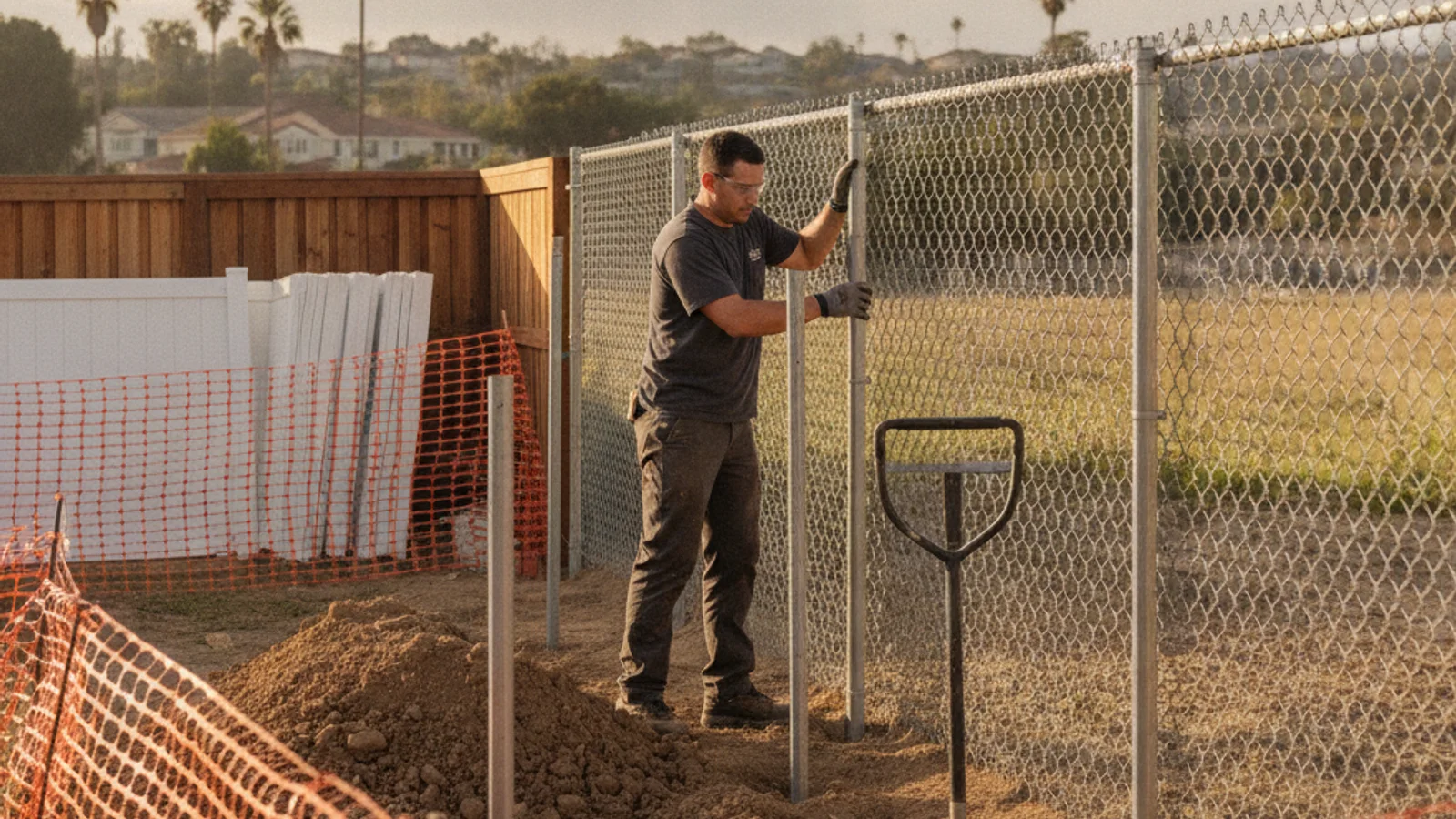
Driven-post setups, typically chain link fabric on posts pounded or drilled into the ground, are more stable over time and hold up better against sustained wind and repeated contact, but they require a surface that can actually be driven into. They also take longer to install and remove, and reinstating the ground afterward is its own line item.
Neither setup is inherently better. A panel system on an unpaved, sloped lot can walk and shift over weeks of wind. A driven-post fence on a paved lot means drilling into pavement you may not have permission, or reason, to disturb. Longer-term perimeter needs on a permanent commercial property are a different question entirely, and the pros we connect you with through our general fence installation service handle that side of the work.
Surface type: the first decision
Asphalt and concrete favor freestanding panels, since driving a post into pavement means coring or drilling and then patching later, an added cost and an added restoration obligation most site managers don’t want for a fence that’s coming down in a few months anyway.
Bare dirt and graded soil can support either system, but loose or sandy soil sometimes doesn’t hold a driven post as firmly as expected, especially after rain softens the ground. Decomposed granite, common on graded pads across San Diego County’s inland construction sites, sits in between: firm enough for driven posts in most conditions, but worth testing rather than assuming.
Sloped or uneven ground is where panel systems tend to struggle, since each panel needs its own footing to sit level, and a slope forces awkward stepping between sections. Driven posts follow the grade more naturally because each post is set independently at the height the terrain requires.
Duration, stability, and wind exposure
How long the enclosure needs to stand matters more than people plan for at the outset. A one-week event enclosure has very different requirements than a six-month construction perimeter that has to survive multiple wind events and constant foot traffic along a public sidewalk. Longer jobs favor driven posts, and short-duration jobs on hard surfaces favor panels, precisely because panel feet need periodic checking and re-weighting over time in a way a driven post generally doesn’t.
Wind is the variable that catches people off guard. San Diego’s Santa Ana events bring sustained gusts that can walk lightweight panels across a lot if they aren’t weighted, staked, or braced correctly, particularly on open sites with no windbreak. Screening fabric, covered next, makes this worse by turning each panel into a sail if it isn’t specified and installed correctly for wind loading.
Gates, vehicle access, screening, and dust control
Both systems need a real answer for vehicle access, not an afterthought. Panel systems usually use a wider, separately braced gate section. Driven-post fences need a swing or slide gate built into the post layout from the start, since retrofitting a gate into an already-set post line is a bigger job than planning for it up front.
Screening fabric, mesh or solid, controls dust and blocks the view into an active site, which matters for public perception on visible sites and for basic dust control compliance on graded lots. Screening adds real wind load to whatever system it’s attached to, so a fence spec’d without screening in mind can fail once fabric goes up, even if the bare fence was stable.
Who handles right-of-way permits
If any part of the enclosure sits in or near the public right-of-way, a sidewalk, a curb lane, or a street-facing setback, that’s a permit question for the relevant public authority, not something a fence contractor decides on their own. The correct authority for unincorporated property could not be confirmed in the approved research. The permit process, timeline, and any associated fee vary by jurisdiction and by exactly what the enclosure encroaches on, so confirm directly with the public agency that governs the property before the fence goes up rather than after an inspector flags it.
Our temporary fence rental guide covers rental logistics in more depth, and the commercial fence page for San Diego business properties is a good next read if this is a longer-term commercial perimeter rather than a short job-site enclosure.
Changing work zones and phased sites
Not every site stays static for the full job. A project that regrades in phases, or an event that reconfigures its footprint between setup days, needs a fence system that can move without a full teardown and rebuild each time. Freestanding panels have a real advantage here, since a section can be picked up and relocated in minutes without disturbing the ground underneath it. A driven-post fence, once set, is much more of a commitment. Moving it means pulling posts, patching the holes, and resetting elsewhere, which is a bigger task than most phased schedules can absorb without real delay.
This is worth raising directly with whoever is managing the schedule before the fence contract gets written, since a site that will change shape more than once over its lifespan is usually better served by a panel system even if a driven-post fence would otherwise be the sturdier long-term choice for that surface and duration.
Inspection and maintenance while the fence is up
Whichever system goes up, someone needs to walk the perimeter periodically, especially after a wind event. Panel feet can shift or lose their weighting over time, particularly with screening attached, and a panel that’s walked out of alignment creates both a gap and a tripping hazard along a public-facing edge. Driven posts hold their position better but can still loosen at the base if the ground softens after rain, so a post that rocks when pushed is worth resetting before it becomes a bigger problem. Building a simple walk-and-check routine into the site’s regular safety inspection, rather than treating the fence as something installed once and forgotten, catches most of these issues before they become a liability or a permit compliance problem.
What a site manager should confirm before requesting a quote
Before calling for a quote, have the surface type, the expected duration, and the total linear footage ready. Know whether any part of the run touches a public sidewalk or right-of-way, since that changes both the permit conversation and the layout. Decide whether screening is required for dust control or visual privacy, since that changes the wind-loading math for whichever system you pick. A commercial fence quote built around these specifics will be far more accurate than one based on linear feet alone.
Frequently asked questions
Which is better for a construction site, panels or driven posts?
It depends on the surface and duration. Paved lots and short-term jobs generally favor freestanding panels. Long-duration jobs on dirt or decomposed granite generally favor driven posts, which hold up better against sustained wind and repeated contact.
Do I need a permit for temporary construction fencing in San Diego?
The current permit rule for temporary construction fencing could not be confirmed in the approved research. Before installation, ask the public agency that governs the property whether the location or layout requires approval.
Does screening fabric affect fence stability?
Yes. Screening adds wind load to the fence system, so a layout that’s stable bare can become unstable with mesh or solid screening attached unless it was planned for that load from the start.
Can freestanding panels be used on a sloped construction site?
They can, but each panel needs independent leveling and the slope forces stepping between sections, which creates more gaps and weak points than a driven-post fence that follows the grade continuously.
When to call us
If you’re planning a job-site or event enclosure and aren’t sure which system fits your surface, duration, and wind exposure, that’s worth working through with a contractor before you commit. Call (858) 400-4906 with your site address, surface type, and expected timeline ready, and we’ll connect you with a licensed and insured local fence contractor.