A walkthrough gate is the smaller cousin of the driveway gate: the one set into a side-yard or backyard fence line for foot traffic, trash cans, garden equipment, or the dog. It gets opened more often than any other part of the fence, which is exactly why it’s usually the first thing to fail. It falls under the same gate installation scope as a driveway gate, just with a different set of design questions.
Because it’s a smaller, simpler build than a driveway gate, homeowners often treat it as an afterthought during a fence project. That’s the mistake. A walkthrough gate sized or hinged wrong can sag, bind, or stop latching, regardless of how well the rest of the fence was built.
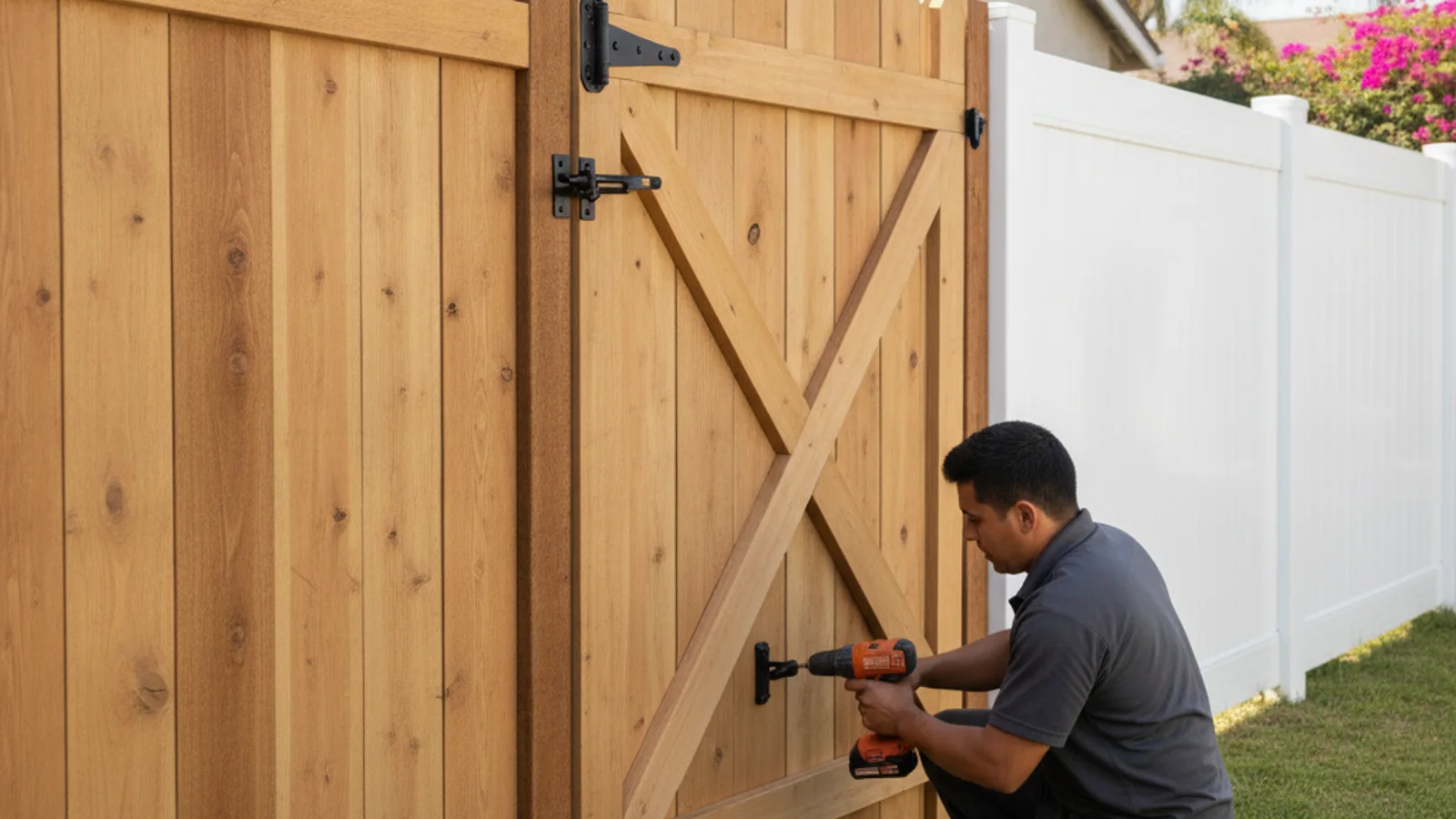
Sizing the opening for what actually needs to pass through
A walkthrough gate opening gets sized for what regularly needs to fit through it, so the right width is a measurement, not a standard.
If the gate is just for people, a narrower opening in that range works fine and keeps the gate itself lighter, which matters for hinge life. If a trash and recycling bin, a wheelbarrow, a mower, or a wheelchair needs to pass through regularly, size the opening for the widest of those items plus clearance on both sides, not for the average case.
Side-yard gates that serve as the main path from the front yard to a backyard pool, patio, or ADU tend to see the heaviest daily traffic, and that traffic adds up over years of use. If you’re weighing whether a side-yard gate near a pool needs to meet pool-barrier rules, that’s a separate and more specific question than sizing, and it’s worth confirming with your city or county building department before you finalize anything for that particular gate.
Matching the gate frame to your existing fence
The gate should be built from the same material as the fence it interrupts, both for looks and for structural consistency, but the frame underneath needs its own reinforcement regardless of what the panels are made of.
Wood fence lines get a gate built on a full mortise-and-tenon or metal-bracketed frame with a diagonal brace, not just butted boards. Without that internal bracing, a wood gate frame can rack out of square during regular use, which is one of the most common walkthrough gate failures on an older wood fence line.
Vinyl fence lines need a gate frame reinforced with an internal aluminum or steel channel. Vinyl on its own doesn’t have the rigidity to carry a swinging gate’s weight without that internal support, and a vinyl gate without it will sag at the latch corner. Our vinyl fence gate guide goes deeper on that hardware.
Chain link fence lines use a welded steel gate frame, sized to the same height as the fence, with the mesh stretched and fastened to the frame rather than left loose. A chain link gate built this way holds its shape far longer than a frame that relies on the mesh itself for rigidity.
Hinges, latches, and the hardware that actually matters
The hardware on a walkthrough gate takes more cycles per year than any other hinge or latch on the property, so it’s worth spending a little more here than the fence budget might suggest.
Hinges should be sized to the gate’s actual weight, not the smallest hinge that physically fits. An undersized hinge on a heavier wood or vinyl gate can loosen and let the gate drop at the latch side. Self-closing spring hinges are common on side-yard gates where a homeowner wants the gate to swing shut on its own, for a dog or a small child, though a spring hinge alone is not the same thing as a certified pool safety gate and shouldn’t be treated as one.
Latches range from a simple gravity latch to a keyed locking latch for gates that also serve as a security point. A gravity latch is fine for a casual side gate; anything facing the street or serving as a secondary entry point does better with a latch that locks.
Hardware material deserves a closer look on coastal properties. The approved claims ledger doesn’t provide a verified distance-based corrosion zone or timeline for any finish. Check the selected hinge and latch manufacturer’s exposure guidance, then ask the installer which listed product matches the site.
Common problems and what causes them
Most walkthrough gate complaints trace back to one of a small handful of causes, and diagnosing which one you have determines the fix.
A gate that drags on the ground or won’t latch without lifting the handle is almost always a hinge-post problem: the post has shifted, or the frame has racked. Our gate won’t latch guide walks through how to tell the two apart.
A gate that swings open on its own in the wind usually means the latch mechanism has worn or the gate was never quite plumb to begin with. A gate that’s stiff or hard to open, on the other hand, often points to a hinge that’s binding from corrosion or from the post settling slightly out of alignment.
If replacing hardware doesn’t stop the problem, it’s worth having a fence pro look at the installation rather than repeating the same repair. Recurring hardware failure can be a sign that the frame or post wasn’t built to carry the gate’s actual weight.
Adding a keypad or app-controlled latch to a side gate
Some homeowners want more than a latch on a walkthrough gate, especially one that serves as a secondary entry for a rental unit, an ADU, or a pool service crew who needs access when no one’s home.
A keypad or app-controlled latch retrofit works on most existing wood, vinyl, or aluminum gates as long as the frame is solid enough to carry the added hardware weight and the strike plate can seat properly. Battery-powered units skip the wiring question entirely and are the more common retrofit choice for a side gate that isn’t near an existing power run.
The tradeoff with any electronic latch on an exterior gate is exposure. A unit mounted where it gets direct sun or salt spray needs a housing rated for outdoor use, and battery life drops faster in a hot, exposed location than a shaded one. If the gate already needs new hardware anyway, it’s a reasonable time to have that conversation with whoever’s doing the work.
Frequently asked questions
How wide should a walkthrough gate be?
Size the opening for what regularly passes through it: people, trash bins, a mower, or a wheelchair. Measure the widest regular item, add clearance, and give the installer that number rather than a guess.
Do I need a self-closing gate for a side yard with a pool?
That depends on your city or county’s specific pool barrier rules, which govern more than just the gate. Confirm the current requirements with your local building department before treating any side-yard gate as pool-code compliant.
Why does my wood gate sag faster than the rest of the fence?
A walkthrough gate gets opened far more often than any static fence section, and without internal frame bracing, that repeated motion racks the frame out of square over time. The fix is a properly braced frame, not just tighter hinges.
What hardware should I use near the coast?
A single material recommendation for every coastal property couldn’t be confirmed from the approved claims ledger. Check the hinge and latch manufacturer’s exposure guidance, then have the installer match a listed product to the site.
When to call us
If your walkthrough gate is sagging, binding, or won’t latch, or you’re planning a new one and want the frame and hardware sized correctly the first time, call us at (858) 400-4906 and we’ll connect you with a licensed fence contractor.