Searching WPC fence in San Diego usually means you have two sample photos open and you cannot tell whether wood-plastic composite is a real third material or just another name for vinyl. It is a real third material. The mix, the posts, and how the run lives in Encinitas salt or El Cajon heat belong in the proposal, not only in the showroom.
What WPC fencing is and how the name differs from composite and vinyl
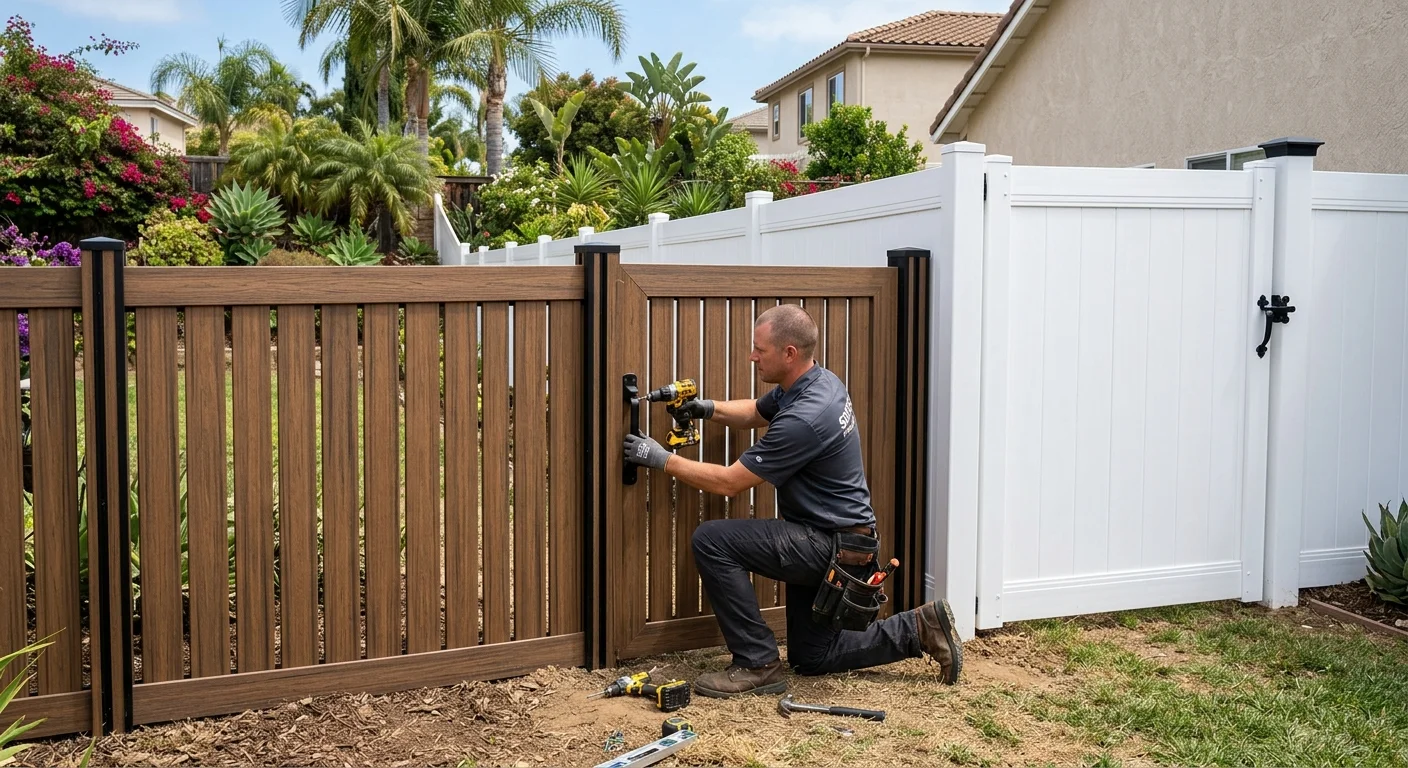
WPC stands for wood plastic composite. Manufacturers blend wood fiber, or wood flour, with a plastic binder, then form that mix into fence boards, infill slats, or full panels. The face is built to read as timber: grain, brown and gray tones, a flatter modern board. That look is manufactured. It is not a stained cedar plank waiting for a second coat.
Composite is the larger family. WPC fencing is one recipe inside that family. Other composite systems use different fibers, different plastics, a co-extruded cap over a core, or aluminum frames with composite infill. If a bid says “composite” and you typed WPC fence, ask which recipe is on the truck. Our composite fence guide for San Diego covers that wider family. This page stays on the WPC name and how it sits next to vinyl.
Vinyl is a different stack. Most residential vinyl fencing is extruded PVC. Panels are often hollow, with ribs inside. Color usually runs through the plastic. Styles include full privacy, semi-privacy, picket, and ranch rail. There is no wood fiber in that profile. For the vinyl privacy path, start with vinyl privacy fence in San Diego and the vinyl fence service page.
Three mix-ups to kill before anyone orders material. WPC is not a board you stain like redwood. WPC is not vinyl with a printed grain film. And WPC is not a masonry wall. A C-13 fencing contractor in California is authorized to construct, erect, alter, or repair fences, corrals, runs, railings, cribs, game court enclosures, guard rails, barriers, playground equipment, backstops, posts, flagpoles, and gates. Masonry walls sit outside that classification. A block wall is a different trade.
Ask the matched contractor to name the exact system: manufacturer, series, board size, whether the face is capped, and what the posts are made of. Fade, expansion, water, insect, and cleaning claims are manufacturer claims. Get them in writing from the maker and from the contractor. This page will not invent a year count, a fade rating, or a warranty term. Those numbers change by SKU, and they were not verified for publication here.
A composite fence, in plain words, is a manufactured board that is not solid lumber and not hollow vinyl. Wood plastic composite is the wood-plus-plastic version of that idea. If the paperwork only says “composite,” you still do not know what you are buying.
How inland heat and coastal exposure change the comparison questions
San Diego County is not one climate. A WPC fence vs vinyl choice on an Imperial Beach alley is a different set of questions than the same choice on a Ramona pasture line.
Coastal north county and the South Bay sit in salt air and marine layer. Encinitas, Carlsbad, La Jolla, Coronado, and Imperial Beach all throw salt at hardware, post bases, and gate latches. Ask how the system handles fasteners, and whether the posts are aluminum, steel, vinyl sleeves, or composite. Salt eats cheap steel. It does not care whether the infill looks like teak or like white privacy vinyl.
Inland heat is the other half. El Cajon, Santee, Lakeside, Escondido, and Ramona run hotter and drier. East County also takes Santa Ana winds. Hollow vinyl can rack and pop if posts are under-set. WPC boards can move as temperature swings. Neither sentence is a lifespan claim. It is a reason to ask, on the record, how the manufacturer wants gaps, clips, and rail channels detailed for heat. If the install sheet is silent, that silence belongs in your notes.
Windbreak is a separate job from privacy. A solid panel blocks the view and also catches wind. Shopping “the strongest fence panel” is the wrong unit. Strength lives in the whole run: post size, hole depth, concrete, rail count, and how the infill locks in. Manufacturer wind charts, if they exist for that SKU, belong in the packet. We do not publish wind ratings here. They are product-specific, and no verified figure sits in the claims ledger. Ask for the chart that matches the exact board and post.
Height rules also change which material even makes sense. In the City of San Diego, Table 142-03A in Chapter 14, Article 2, Division 3 treats fences below 7 feet as no permit under that division, and 7 feet or greater as a Building Permit, Process One. That exemption is not the same thing as zoning compliance. Required side and rear yards can go up to 9 feet, with the portion above 6 feet required to be open. A solid fence at the front or street-side line is generally 3 feet, with setback-based provisions and exceptions. Coastal overlay rules can add another layer. Confirm the current sheet with Development Services for your parcel.
Unincorporated county lots follow a different handout. County PDS070, revised 2023-01-01, lists a permit exemption for fences and walls no higher than 6 feet if the work is zoning compliant. The zoning summary on that sheet is 42 inches at front and exterior side, and 72 inches at rear and interior side. That sheet applies to unincorporated jurisdiction only. A Spring Valley or Lakeside address still needs a current check with County PDS.
If you are still weighing lumber against vinyl as a third fork, that comparison lives in wood fence vs vinyl fence. Keep WPC on its own line so the bids do not collapse into one generic “composite or vinyl” number.
Which posts, rails, gates, and finish details belong in a proposal
A WPC fence bid that lists only “panels” is incomplete. The infill is what you see from the patio. The posts and rails are what keep it standing through a Santa Ana and a wet February.
Name the posts. Aluminum, steel, vinyl, wood, or composite. Name the size. Name whether they set in concrete, in sleeves, or on brackets. Attaching fence panels to concrete posts is a real method on some systems. It is not universal. If the design uses concrete or masonry posts, the contractor should specify the channel, clip, or rail the manufacturer lists for that post. A wood-fence bracket on a WPC board is a guess, not a spec.
Count the rails. Note whether they are aluminum, vinyl, or composite. Tongue-and-groove and channel systems need the matching rail. Mixing a WPC board into a vinyl rail that was never designed for it is how gaps and rattles start. Post spacing has to match the board length. Measure on-center, in inches, on the proposal.
Gates are their own line. A walk gate and a driveway leaf are different loads. Ask for the same infill on the gate as the run, or a stated mismatch you can live with. Hardware belongs in writing: hinges, latch, drop rod, and a closer if the gate is pool-adjacent. Pool enclosure rules are a separate path under California Health and Safety Code for covered private single-family pools and spas. Do not treat a decorative WPC screen as a pool barrier unless the matched contractor is designing to that enclosure standard and your building department agrees.
Finish details decide whether both neighbors accept the face. Color, grain, capstock, and which side is public all belong on the page. Some WPC boards are finished both sides. Vinyl often is too. If this is a boundary fence, California Civil Code 841 presumes adjoining landowners share equal benefit from a dividing fence and, unless they have a written agreement otherwise, equal responsibility for reasonable costs of construction, maintenance, or necessary replacement. Before you incur those shared costs, the statute requires 30 days’ written notice. The notice has to describe the problem, the proposed work, estimated costs, the sharing approach, and the timeline. Government entities are excluded from that landowner definition.
Also put in the proposal: line length, height, stepping or racking on slope, removal of the old fence, haul-away, and whether the work is new fence installation or a mixed repair. Ask for the manufacturer install sheet. A verbal “this is how we always do it” is not a substitute.
When repair, panel replacement, and a full new run deserve separate quotes
Not every failing run needs a full tear-out. Not every cracked board is a one-panel swap. Those three jobs should not share one vague number.
Repair belongs on its own quote when posts are plumb, rails are sound, and a short section of infill or a latch has failed. Vinyl and WPC both depend on matching SKUs. A discontinued color can turn a “simple board swap” into a visible patch down the line. Get the product name and color code before anyone orders one replacement piece.
Panel replacement is the middle path. Several bays are tired. Posts can stay. This only works if the new panels match the post spacing and the rail system. A WPC system at one width will not drop into a vinyl bay built to another. Measure the bays. Photograph the rail ends. Put both on the quote request.
A full new run deserves its own quote when posts are spinning in the soil, the line is out of plumb, the height no longer matches what you want, or you are changing material entirely, WPC to vinyl or the reverse. Mixing leftover wood posts with new WPC infill is a common shortcut. It is also how you inherit the weakest part of the old fence. If the posts are the failure, replacing only the pretty boards buys you a short delay.
Shared property-line work can split the decision further. You may replace your face of a good-neighbor design while the neighbor keeps theirs. Put that split in writing, with the Civil Code 841 notice if you intend to share cost.
Separate scopes also keep the C-13 fencing contractor’s work description clear. Check the license on the CSLB license lookup before you sign. Look at classification, status, and the business name on the contract.
If the job looks tiny, California Business and Professions Code 7048 exempts work from contractor licensing when the aggregate contract price for labor, materials, and all other items is less than $1,000, the work is casual, minor, or inconsequential, and it does not require a building permit. The exemption does not apply when the work is part of a larger operation, when contracts are divided to evade the threshold, when the person advertises as a contractor, or when the person employs others to do the work. A full fence run in this county is rarely that small. Do not treat a backyard privacy line as a casual $1,000 errand.
What to compare before choosing a WPC or vinyl contractor
Compare systems, not adjectives. “Low maintenance” and “wood look” are not specifications.
Named product first. Manufacturer, series, board size, color. WPC and vinyl are categories. A category cannot be warrantied, cleaned, or color-matched in five years.
Post and footing spec next, for your soil and wind exposure. An Encinitas bluff and a flat El Cajon lot are not the same hole. Ask how panels attach: clips, channels, through-fasteners, or a manufacturer rail on concrete or metal posts. If two bidders describe two different attachments, you are not comparing the same fence.
Written manufacturer care sheet. Cleaning method, pressure-washer limits, and what voids the maker’s coverage. We do not restate warranty years here. Get the current document for the SKU on the bid.
Gate schedule that matches the run, including hardware metal. Salt air on a coastal lot makes that line earn its space.
Permit path for your jurisdiction. City of San Diego Table 142-03A is the city table. Unincorporated parcels follow County PDS070, not the city table. HOA design rules, if you have them, sit on top of both.
License. C-13 is the fencing classification. Confirm it is current and in standing on the CSLB site. Every fence contractor in the network is licensed and insured. You still verify the name on your contract.
Who you contract with. Fence Pros San Diego is a referral service. We match you with licensed, independent local fence professionals. You contract and pay the contractor directly. The brand does not install, own trucks, or hold a trade license.
Ask the same questions of a vinyl bidder and a WPC bidder so the answers line up. If one bid is a product name and the other is a paragraph of marketing, the named product is the one you can actually check.
When to call us
If you are choosing a WPC fence or vinyl for a San Diego County yard, and you want a licensed C-13 fencing contractor to price a named system with posts, rails, and gates spelled out, we can match you. Call us at (858) 400-4906 and we’ll connect you with a licensed fence contractor. Leave a message with the city, the material you are comparing, and whether this is a repair, a panel swap, or a new run.