A side yard in Normal Heights that still needs light, a back line in Encinitas that should carry bougainvillea, a patio in El Cajon that a solid wall would bake: those are the usual reasons a trellis fence comes up in San Diego County. It is the fence itself. Posts, open lattice panels, and a matching gate sit on the line. That is a different job from a nursery kit leaned on the house, and from fabric clipped to chain link.
How a trellis fence differs from a solid privacy run
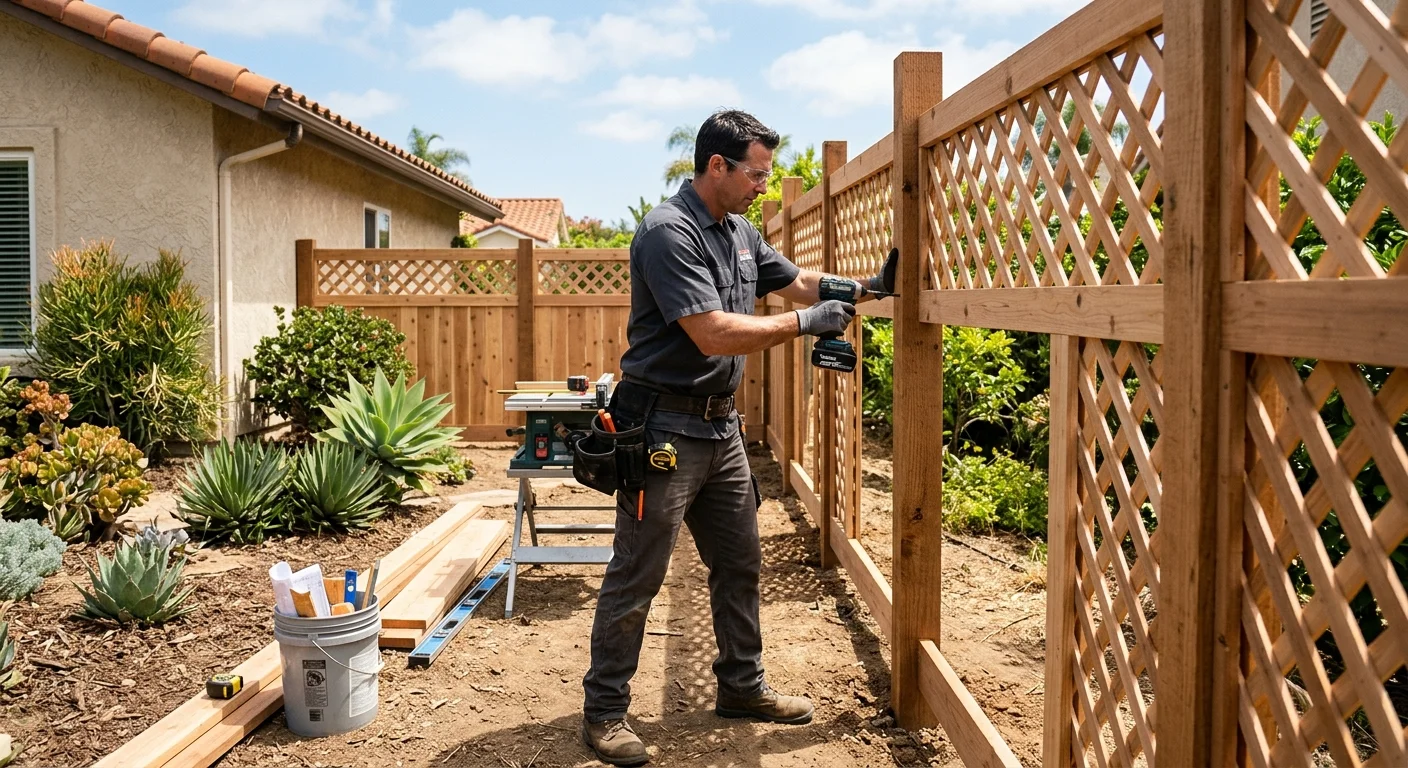
A trellis fence is a post-and-panel boundary with an open lattice, grid, or diamond field from the bottom rail to the top. You can see through it on day one. Wind moves through. Light hits the planting strip. A solid privacy fence is a different run: boards or slats stacked to block the view from the street, the alley, or the next house.
That gap is the whole decision. People type “trellis privacy fence” hoping jasmine will hide a bedroom window. Vines help in spring. They thin in a San Diego dry stretch, and they never close like a board-on-board face. If you need the block from the first week, in North Park, City Heights, or a tight lot in Pacific Beach, specify a solid style. Our privacy fence ideas piece covers those board, vinyl, and mixed runs.
A trellis fence is a different product from a privacy screen on chain link. Screens, slats, and faux ivy sit on a fence that already exists. They are add-ons. A garden trellis fence is the line in the ground, with footings and a latch a neighbor will live with.
It is also a different product from an interior garden panel. Garden fence ideas inside a bed can come from a nursery. A property-line trellis fence has to stand as a boundary.
Choose a trellis fence when you want a filtered view, climbing plants, and air. Choose a solid run when you need a visual block, a dog barrier with no footholds, or a pool enclosure. Lattice openings and horizontal members are the wrong geometry for a child-safety barrier. For covered private single-family pools and spas, California Health and Safety Code section 115923 sets enclosure rules that include a 60-inch minimum height, a ground gap no larger than 2 inches, no opening a 4-inch sphere can pass, and gates that swing away from the pool and self-close and self-latch, with the latch at least 60 inches high. A typical trellis panel fails the opening and climb tests. Confirm pool rules for that property before you mix a garden look with a pool lot.
Where San Diego sun, wind, and vine load change the plan
San Diego County is not one climate. A trellis fence in Mission Beach sees salt and onshore wind. The same drawing in Ramona or Alpine sees hotter days, colder nights, and Santa Ana events. Once vines leaf out, the lattice can act like a sail. A west lot in Point Loma takes different salt than a run in Santee. Tell the contractor the street, not only the city.
The open field sheds more wind than a solid board run. Wet vines, full bougainvillea, and a heavy top rail change that. No published wind rating for a residential trellis fence is in our verified claims, so do not treat a catalog garden panel as engineered for an East County ridgeline. The licensed contractor should size posts, footings, and fasteners for that lot. Put the exposure in the scope.
Sun is the other local load. South and west faces in Chula Vista and El Cajon cook wood faster than a shaded side yard in La Jolla. Metal holds shape in heat. Wood moves. There is no government lifespan figure for either material, so skip the round-number life talk. Ask what species or finish the contractor is proposing, and how the post line sits next to irrigation. Spray on the posts is a common failure in this county.
Vine load is real, and it is not rated in public code. Star jasmine, grapes, passionflower, and bougainvillea are common on San Diego fences. They add weight when wet. They tug in wind. They hide hardware until something lets go. Tell the contractor which plants you want. A garden trellis fence built for peas is a lighter job than a property-line run meant to carry mature bougainvillea.
Coastal hardware rusts. Inland hardware bakes. Name the metal, the coating, and whether posts are wood or steel. That is local work, not a generic lattice kit from a garden aisle.
What posts, panels, gates, and spacing belong in writing
If it is not on paper, it is not the fence. A trellis fence quote should name posts, panels, gates, and spacing the same way a solid fence installation quote does.
Posts: material, size, spacing, footing method, and how they meet grade on a slope. Plenty of San Diego lots step, from Encinitas canyons to East County pads. A trellis that racks or floats looks unfinished. The contractor should say whether panels step or rack, and how the bottom rail meets soil or a mow strip.
Panels: material, pattern, and opening size. Lattice is not a spec. Diamond cedar, rectangular steel, hog-wire in a wood frame, and vinyl lattice take salt and sun differently. Opening size changes privacy, vine grip, and whether the run still reads as open for height rules.
Gates: a trellis leaf sags if the frame is light. Latch type, hinge side, swing direction, and whether the gate matches the panel pattern belong in the writing. Walk hardware is a different build from a driveway leaf.
Spacing: post centers, bottom gap, and the line relative to the survey. California Civil Code section 841 treats a fence on the boundary as a shared benefit unless a written agreement says otherwise. Before anyone spends money on a shared line, the statute requires 30 days’ written notice covering the problem, the proposed work, estimated costs, cost sharing, and a timeline.
Buying a trellis and building a fence are different jobs. Garden centers sell lean-to panels and obelisks. Those pieces support plants. They are not a property-line fence. Independent C-13 fencing contractors construct, erect, alter, or repair fences, including this run. Masonry walls sit outside that classification. A block stem with trellis above may need a different license mix. Check the contractor on the CSLB site before you sign.
When a trellis, a screen, or a solid fence deserves its own quote
Ask for separate quotes when the property needs more than one system. A trellis fence, a screen on existing chain link, and a solid privacy run use different posts, different panels, and different outcomes.
Quote a trellis fence when the run is the boundary you want to look at: open, planted, and still a real fence. Side yards between bungalows in South Park, a garden edge in Vista, a view corridor toward a canyon in Tierrasanta: those are the usual fits.
Quote a screen when the fence is already there and you only need to cut the view.
Quote a solid privacy fence when the need is block, not filter. Bedroom windows. A rental that cannot wait for vines. A dog that will climb lattice. A street-facing lot with headlights and foot traffic. You can mix styles on one property. Specify each run on its own so the contractor is not guessing which face is the trellis one.
A lattice cap on an existing six-foot board fence is a separate job. Searchers ask if they can put a trellis on top of a six-foot fence. In the City of San Diego, required side and rear yards allow height up to 9 feet when the portion above 6 feet is open, per Municipal Code section 142.0310 as published in July 2026. That open-above-six pattern is why a trellis topper comes up. Confirm it for the address. Solid fences at the front or street-side line are generally limited to 3 feet, with setback-based provisions. Coastal overlay rules can still apply. Confirm the address with the city or, in unincorporated county, with the County of San Diego.
Which HOA or permit questions need confirmation for that address
HOA design rules live in the association papers, and they are not the same in Rancho Bernardo, 4S Ranch, and a coastal complex in Oceanside. Ask the association for the current fence standard: height, color, and whether lattice is allowed as the field or only as a topper. If the CC&Rs are quiet, get the answer in writing from the architectural committee. A neighbor’s trellis is not your approval.
City of San Diego fence rules live in Municipal Code Chapter 14, Article 2, Division 3. Table 142-03A, in the July 2026 publication, lists fences below 7 feet as not needing a building permit under that division, and 7 feet or greater as Building Permit, Process One. An exemption from that table is not zoning compliance. Front and street-side solid fences are generally 3 feet at the line. Side and rear yards can go to 9 feet with the portion above 6 feet open. Confirm with Development Services for that parcel, especially in the coastal overlay.
Unincorporated county is a different map. County PDS070, revised January 1, 2023, lists a permit exemption for fences and walls no higher than 6 feet if the run is zoning compliant. The zoning summary on that handout is 42 inches at the front and exterior side, 72 inches at the rear and interior side. Confirm current applicability with Planning & Development Services. That handout is not a permit for your lot.
If the property sits in Chula Vista, Encinitas, El Cajon, or another city, those municipal codes were not verified for this page. Call that city’s building counter and ask how they treat an open trellis fence versus a solid privacy fence, and whether a topper counts in the height.
Shared lines still need the Civil Code 841 notice. Pool lots still need Health and Safety Code 115922 and 115923 features, which a lattice run usually cannot provide. When a rule cannot be confirmed for the address, put that in the file and point the contractor at the city, the County of San Diego, or the HOA that actually sets it.
When to call us
A trellis fence on a property line is licensed fence work, not a weekend nursery kit. When you need posts set, panels hung, and a gate that will take San Diego wind and vines, that is a C-13 contractor job. Call us at (858) 400-4906 and we’ll connect you with a licensed fence contractor.