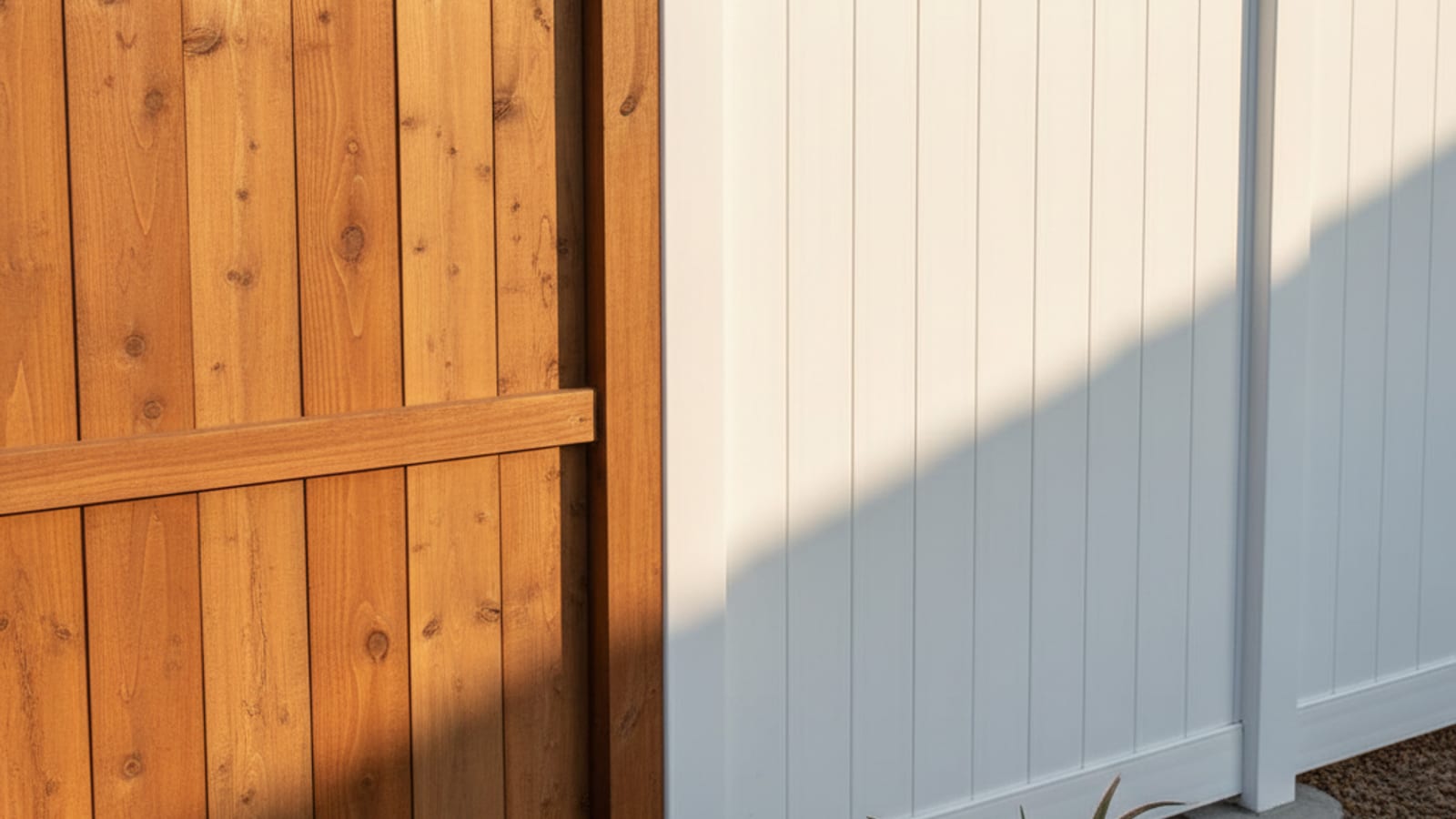
The best wood for a fence in San Diego is western red cedar for most yards and heart redwood for coastal lots close to the ocean. Pressure-treated pine costs less on day one but cups and warps faster in inland heat. Fence Pros San Diego is a referral service. We do not publish installed per-foot rates, a lifespan warranty, or a cost-per-year table. Compare species on rot, movement, stain, and hardware, then get written quotes on the same spec.
TL;DR
- Western red cedar is the usual San Diego pick: stable, takes stain, and works countywide when sealed.
- Heart redwood is the premium coastal choice: more rot resistance in fog and salt air.
- Pressure-treated pine is the budget option and a poor inland bet east of I-5.
- Pine with only a clear sealer is a weak inland plan. Ask the contractor to explain the finish, not a year count.
- All three need stainless or hot-dip galvanized hardware in coastal zones.
Best wood for a fence: species comparison table
| Species | Quote class | Sealed vs unsealed | Maintenance | Best zone |
|---|---|---|---|---|
| Western red cedar | Mid | Sealed boards last longer than bare boards | Oil stain on a regular cycle | All SD County |
| Heart redwood | Premium | Better rot resistance in wetter lots | Oil stain, often a longer cycle than cedar | Coastal, premium residential |
| Pressure-treated pine | Budget | Inland heat shortens board life faster than coastal | Frequent sealing if you keep it | Coastal mild zones only |
We are not printing cost-per-year math. Cedar often bids above pine and then needs less board replacement inland. Pine can still fit a tight coastal budget if the quote names grade, hardware, and finish. Get both species on the same linear footage before you decide.
Western red cedar
The default for most San Diego wood fence installs. Why it works here:
Natural oil content resists rot and insects without pressure treatment. Cedar has thujaplicin in its heartwood, which is toxic to most wood-destroying fungi.
Dimensional stability. Cedar moves less with humidity changes than most softwoods. Your fence stays straight.
Takes stain beautifully. Cedar absorbs penetrating oil stains evenly, no blotching, no patchy color.
Lightweight. Easier to handle on long runs than denser species.
Gentle on hardware. Cedar’s tannins are less acidic than redwood, so hardware corrosion is slightly slower.
Cost: Midrange among the three woods on this page. Clear grades bid higher than knotty common grade. We do not publish a per-foot installed rate.
Lifespan: No year warranty here. Oil stain on a regular cycle stretches service life versus leaving boards bare. Ask the contractor what recast interval they expect for your exposure.
Picket options: Dog-ear, flat-top, gothic, french gothic, scalloped. Boards commonly 1x6 or 1x8, 6 ft or 8 ft tall.
Best for: Most San Diego backyards. Coastal, inland, mountain, cedar is adaptable. For a deeper look at cedar specifically, see our guide to cedar fence pros and cons in San Diego.
Weak spots:
- Cedar posts can rot at grade if not treated with a ground-contact end-sealer. Pressure-treated 4x4 posts are often used with cedar picket fence.
- Not as rot-resistant as heart redwood in wet conditions (coastal fog, low-drainage yards).
- Grade variation matters, knotty common-grade is common and fine for most fences; clear grade is premium and cleaner.
Heart redwood
The premium option. Why you pay for it:
Better rot resistance than cedar. Redwood’s heartwood (the dark red interior portion of the log) has even better rot and insect resistance than cedar. Coastal fences in heart redwood often outlast cedar in wet fog, but that is a site outcome, not a year guarantee.
Darker, richer color. Redwood tones are warmer, deep reddish brown that weathers to a lighter silver-gray if unsealed. Many homeowners prefer the aesthetic.
More structural strength. Heart redwood has higher bending strength than cedar, which matters for taller fences (7–8 ft) or tall posts.
Available in longer dimensional lumber. Heart redwood 1x8 and 2x4 in 12-ft lengths is easier to source than equivalent cedar.
Cost: Premium versus cedar. Heart grade (old-growth) is more expensive than common redwood, and “construction heart” is the typical residential grade. Confirm the grade on the quote.
Lifespan: No year warranty here. Sealing still matters. Unsealed redwood weathers faster.
Weak spots:
- Sapwood (outer lighter portion) rots faster than heart. Cheap redwood fences often have mixed sapwood/heartwood boards that fail unevenly.
- More expensive than cedar. Ask for both species on the same spec if you want a real delta.
- Limited supply. West Coast redwood is harvested under current forestry rules, and some grades are harder to source.
Best for: Coastal San Diego (Encinitas, Carlsbad, La Jolla, Oceanside, Coronado), premium residential work, property-line fences visible from the street, taller fences (7–8 ft).
Pressure-treated pine
The budget option. Here’s the honest case:
Much cheaper on day one. Pine usually bids below cedar and redwood on the same footage. The gap belongs on the quote, not in a published savings figure.
Pressure-treated. Infused with copper-based preservatives (usually ACQ, MCA, or CA) that resist rot. A PT pine post buried in soil resists decay.
Easy to find. Every lumber yard and Home Depot stocks PT pine in every standard dimension.
Lifespan: No year warranty here. Coastal mild lots treat pine better than East County heat. Inland and East County boards cup, crack, and split at the end grain sooner if they stay unsealed.
Where pine works:
- Coastal properties with a milder climate.
- Utility fences (dog runs, backyard that you don’t see from the street).
- Short-term ownership where maintenance effort matters less than upfront cost.
Where pine fails fast:
- East County (El Cajon, Santee, Lakeside, Spring Valley). UV and heat punish PT pine boards.
- Inland North County (San Marcos, Escondido). Similar heat profile to East County.
- Any sun-exposed fence without regular sealing.
Weak spots:
- Treatment chemicals bleach out over time. Boards turn gray, splits open, cups appear.
- Pine cups more than cedar or redwood. Even sealed boards flex under seasonal humidity.
- Treatment chemicals are corrosive to some hardware. Stainless or hot-dip galvanized required, NEVER use electroplated zinc hardware with PT pine.
- End grain untreated after cuts. Cut pine 2x4 rails need end-sealer brushed on the cut end or they rot from the exposed grain inward.
What wood is best for a fence in each San Diego microclimate
The same wood performs very differently across San Diego County. Choosing the best wood for your fence depends as much on where you live as on your budget.
Coastal (Encinitas, Carlsbad, La Jolla, Oceanside, Coronado):
- Best: Heart redwood.
- Good: Cedar.
- Acceptable: Pine with annual sealing.
- Key: stainless hardware, penetrating oil stain, footings sized for the soil (name depth on the quote).
North County Inland (San Marcos, Escondido, Vista, Poway):
- Best: Cedar.
- Good: Heart redwood (expensive but durable).
- Not recommended: Pine (warps in dry heat).
- Key: oil stain after the wood has dried per the product and installer, then recast when water stops beading.
East County (El Cajon, Santee, Lakeside):
- Best: Cedar.
- Good: Heart redwood.
- Don’t use: Pine. Period.
- Key: premium material grade, oil stain, consider board-on-board construction to hide any movement.
Mountain (Julian, Alpine, Ramona, Pine Valley):
- Best: Cedar or redwood.
- Acceptable: Pine in coastal-mountain zones (Alpine, Descanso). Avoid in high-heat mountain (east).
- Key: handle freeze-thaw with vertical-grain boards over flat-grain.
South Bay (Chula Vista, National City):
- Best: Cedar (matches HOA specs in most communities).
- Good: Redwood where CC&Rs allow.
- Key: HOA typically specifies a stain color; verify before quoting.
If you’re deciding between wood and another material entirely, our wood fence vs vinyl fence comparison covers the full tradeoff on cost, lifespan, and maintenance.
The grade question
Within each species there are grades:
- Clear grade (highest), few knots, uniform color, straight grain. Premium price. Used for visible residential work where appearance matters.
- Select tight knot (STK), small tight knots allowed, but mostly clean. Most common cedar fence grade in San Diego.
- Common grade, more knots, some color variation. Budget-friendly but fine for utility fences.
- Construction grade, structural lumber, not typically used for fence pickets.
For most residential fence, select tight knot is the right call. Clear is worth it on highly visible runs or horizontal fence designs where every board is a design element.
Stain is not optional
Whatever wood you pick, professional fence staining after the boards have dried is part of getting the service life the species can actually deliver. It is not a lifespan multiplier we can warrant.
Why oil penetrating stain over water-based stain or paint:
- Oil stains soak into the wood. Water stains sit on top and peel.
- Paint creates a film that cracks as wood moves. No film = no peeling.
- Oil stains let moisture escape. Paint traps it and accelerates rot.
Brands contractors often specify:
- Ready Seal (California favorite, self-leveling, no back-brushing needed)
- Defy Extreme (Colorado-made, marketed for UV)
- TWP 1500-series (Total Wood Preservative, a common California-sun spec)
Ask the independent contractor which product they will use. Recast when water no longer beads. Inland sun usually needs attention sooner than a shaded coastal run. We do not publish a 2-year or 4-year warranty interval.
Frequently asked questions
What is the best wood for a fence in San Diego?
Western red cedar is the best wood for a fence in San Diego for most homeowners: it balances cost class, durability, and appearance better than pine inland and usually bids below heart redwood. Heart redwood is the better coastal choice where fog and salt keep wood wetter. Pressure-treated pine works mainly in milder coastal climates and falls apart faster in East County heat. Confirm species, grade, and hardware on the quote.
How long does a cedar fence last in San Diego?
A cedar fence lasts longer with oil staining on a regular cycle than if it is left unsealed. There is no 15-to-20-year warranty on this page. Coastal cedar may need more frequent sealing because of salt air and moisture cycling. East County and inland North County cedar still needs UV protection. Ask the independent contractor for a maintenance plan, not a year count.
Is redwood worth the extra cost for a San Diego fence?
Heart redwood bids above cedar. The premium is easier to justify near the coast, where extra rot resistance matters. For inland yards in Poway, Escondido, or East County, cedar often performs well enough that redwood is a color and grade choice, not a required upgrade. Get both species quoted on the same spec.
How much does a wood fence cost per foot in San Diego?
Fence Pros San Diego does not publish installed rates. Pine, cedar, and heart redwood land in different quote classes. A useful bid names posts, rails, pickets, footings, hardware, gates, and tear-out for the same footage.
What is the best wood for a fence post in San Diego?
Pressure-treated pine is the standard choice for fence posts set in the ground, even on cedar or redwood fences. PT pine posts resist ground-contact rot better than untreated cedar or redwood at the grade line, and the post is mostly buried so aesthetics don’t matter. The key is using stainless or hot-dip galvanized hardware with any PT post to avoid chemical corrosion.
Do wood fences need staining in San Diego?
Yes. Staining after the wood has dried is not optional if you want the fence to reach a long service life. A penetrating oil stain protects cedar and redwood from UV, moisture cycling, and coastal salt better than leaving wood bare. Professional fence staining is a separate quote from installation. We do not claim it doubles lifespan.
Does coastal salt air affect wood species choice?
It does. Close to the ocean, heart redwood often outperforms cedar because its heartwood handles the higher moisture load from coastal fog. All coastal fences also need stainless steel or hot-dip galvanized hardware, since standard electroplated zinc hardware corrodes in salt air. Cedar still works in coastal zones; it just needs more frequent sealing than redwood. Do not treat “one to two years” as a hardware warranty.
Summary
- Most San Diego homes: western red cedar. Best balance of cost, appearance, durability, and ease of maintenance.
- Coastal or premium homes: heart redwood. Better salt-air and wet-fog performance when the grade is actually heartwood.
- Tight budget in coastal-only: pressure-treated pine. Works, but shorter lifespan and more maintenance.
- Never: pressure-treated pine in East County or inland North County. The climate eats it.
We’re a lead-gen referral service, not a licensed contractor. Whoever you hire, verify their CSLB license at cslb.ca.gov before you sign anything. If you want cedar and redwood compared on the same spec, we can connect you with independent installers. They set their own prices, schedules, and product warranties. Call (858) 400-4906.