TL;DR
- Design around how your dog actually escapes: over, under, through gaps, or through weak panels.
- Height is a site and dog question. Front-yard zoning is often too short for containment.
- Digging needs a buried apron, a mow strip, or another ground closure named on the bid.
- Solid privacy can cut reactivity. Horizontal rails on the inside can become a ladder.
- Invisible (buried-wire) fence is a different trade. Fence Pros San Diego does not install it and does not quote it.
- No per-foot or 150-foot package prices. Those old bands had no invoice set behind them.
If you are building primarily to contain a dog, the job is not a generic privacy fence. Fence Pros San Diego is a referral service. We match you with an independent fence professional. We do not walk the yard, we do not spec your dog, and we do not offer free estimates.
The four containment problems
Dogs leave a yard for one of four reasons:
- Over. Athletic dogs clear a short fence. Height and climbable rails both matter.
- Under. Diggers use any gap at the soil. A 2-inch ground clearance is an invitation.
- Through gaps. Small dogs go through openings. Standard 2-inch chain-link mesh is a squeeze and a stuck-head risk for tiny dogs.
- Through the panel. Large dogs find the weak bay, the rotten board, or the loose tension bar.
Ask the contractor to design for the failure you have already seen, not a breed cartoon. Breed notes below are starting questions, not guarantees.
Material and height questions by dog type
Use these as bid questions. They are not a promise that 4 ft or 6 ft will hold a given animal.
Small dogs (under about 25 lb). Solid panel or small mesh. Ask that no opening pass a 4-inch sphere if the dog is a squeezer. Four feet is often enough height if the dog does not climb.
Medium dogs. Five feet is a common discussion height if there is no jump history. Dig resistance still belongs on the bid for hounds.
Large dogs. Six feet is the usual conversation, plus structure: no rotten bays, no loose mesh. Climbers may need an anti-climb top or no inside horizontal footholds.
Known escape artists (husky-type, some herding mixes). Plan for both jump and dig. Inside rails on a privacy fence are footholds. Tell the contractor if the dog has already cleared 6 feet.
San Diego mix notes (questions, not data): husky mixes show up here and often need both height and a dig apron. Strong bully-type dogs more often fail panels than Olympic jumps. Beagles dig and bark at sightlines. Small terriers squeeze.
Height versus zoning
A rule of thumb you can use at home: watch the standing jump and the hind-leg reach, then add margin. Downhill fences lose effective height. Decks, dog houses, and AC pads next to the fence are launch pads.
Do not copy a single “San Diego County allows 6 ft backyard, 7-8 ft with a permit, 42-inch front yard” sentence as every city’s rule.
- Unincorporated County (PDS 070): building permit except fences not exceeding 6 feet that also meet zoning. Zoning excerpt: 42 inches in front or exterior side yard, 72 inches in rear or interior side yard. An 8-foot dog fence is not the barbed-wire security exception.
- City of San Diego: Table 142-03A, fence less than 7 feet, no building permit required by that division; 7 feet or greater needs a building permit. Yard height in Chapter 14 is a separate zoning question.
Front-yard height caps are why street-facing dog containment often fails even when the backyard is tall enough. Confirm the address.
Dig-resistance features (as bid lines, not adders with fake dollars)
If the dog digs, ask the bid to name one or more of:
- Buried L-footer or apron (mesh turned out below grade)
- Concrete mow strip along the base
- Hardware-cloth apron for small squeezers
- Rock at the base (weaker, cheaper class)
There is no verified $3-$6 or $8-$15 per-foot adder. Ask for the detail as a line item.
Fence types compared for dogs (no installed rates)
Chain link (galvanized or vinyl-coated). Dogs can see out. Mesh size matters for small dogs. Fence-fighting with a neighbor dog is a real behavior issue. Vinyl-coated black reads more residential than raw galvanized.
Cedar privacy. Sight barrier can cut barking. Inside rails can be climbed. Some dogs chew wood.
Vinyl privacy. Smooth face, fewer footholds. Still needs a ground closure for diggers. Posts and gates are the containment, not the brand name “Class-A.”
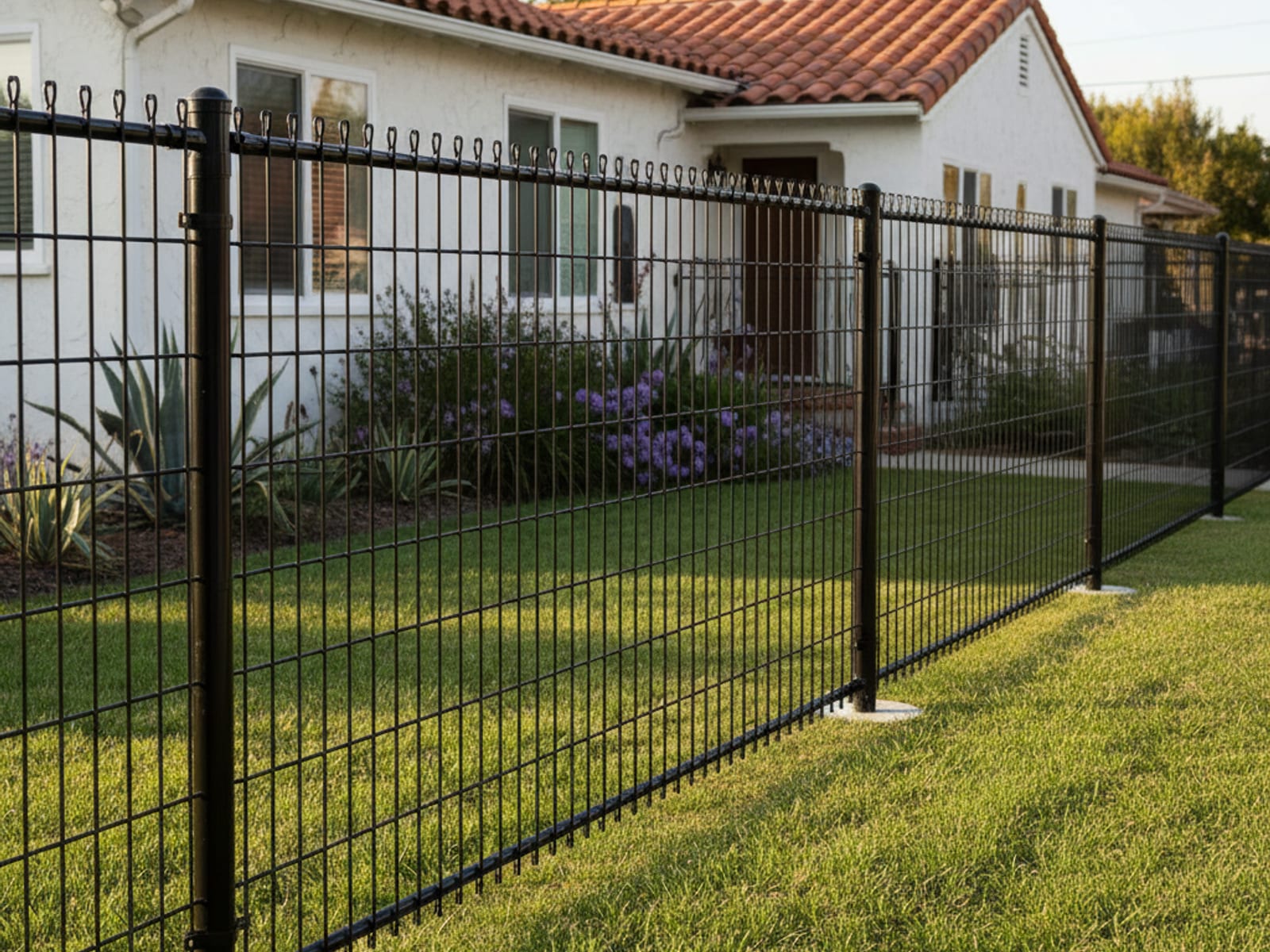
Ornamental metal. Visibility. Picket spacing has to be tight enough for the dog. Ask about bottom gap.
Split rail with woven wire. Rural look. Wire can stretch. Weak for a small urban yard.
Invisible (underground wire) fence
A buried boundary wire and a collar is a training product, not a physical fence. It does not keep coyotes, other dogs, or children out. Some dogs blow through the stim if a cat runs past. It needs training and collar upkeep. Fence Pros San Diego does not match invisible-fence vendors as a core service, and the independent fence contractors we refer typically do not install that system. If you want it, search a specialist. Do not treat it as a substitute for a physical fence on a busy street.
Gate considerations
- Self-closing hinges
- Latches a dog cannot nose open (height and type named on the bid)
- Latch placement away from child reach if that is a household issue
- Gate width that is a people opening, not a dog-sized hole
Pool-barrier gates, if the yard is also a pool enclosure, follow Health and Safety Code section 115923 (self-closing, self-latching, latch height, swing direction). That is a different spec than a backyard dog gate.
Frequently asked questions
How tall should a dog fence be in San Diego?
Tall enough for the dog you have, and legal for the yard you are in. Medium dogs are often discussed at 5 feet, large or athletic dogs at 6 feet, plus anti-climb if they use rails. Confirm height with the city or County. There is no one countywide dog-height code.
How much does a dog fence cost in San Diego?
There is no published Fence Pros rate and no verified 150-foot package total. A bid should separate fence, height, mesh or panel, ground closure, and self-closing gate. See fence installation.
What is the best fence material for dogs?
The one that matches the escape mode. Chain link is practical for many dogs that need to see out. Privacy helps reactive barkers. Neither is “best” without the ground detail.
Do I need a dig guard for my dog fence?
If the dog already digs, yes, name it on the bid. There is no verified extra-per-foot price.
Does San Diego require a permit for a dog fence?
Height, front versus rear, and jurisdiction decide. City of San Diego Table 142-03A uses 7 feet for that division’s building-permit split. County PDS 070 uses 6 feet for its common exception. Front-yard 42-inch zoning on unincorporated lots is too short for most dog containment. Confirm before you dig.
Is a privacy fence better than chain link for dogs?
Privacy can reduce sightline barking. Chain link is often harder to climb if there is no inside rail. Pick based on the dog.
What to put on the request, not a fake package
Tell the independent professional the dog’s escape history, weight, and whether you need a sight barrier. Ask them to write height, mesh or panel, ground closure, and gate hardware. Do not shop three round numbers from an old blog table.
Call (858) 400-4906 for a referral. Verify C-13 yourself. Estimates, if offered, come from the contractor, not as a free Fence Pros product.