TL;DR
- There is no honest single 2026 per-foot rate for San Diego County on this site. Chain link, cedar privacy, and vinyl are different quote classes.
- Gates, slope, rock, tear-out, coastal hardware, and HOA specs move the number more than a national calculator.
- HOA approval and permits, when required, should appear in the contractor’s scope, not as a surprise.
- The cheapest lump sum is often a shallower post or a thinner material grade.
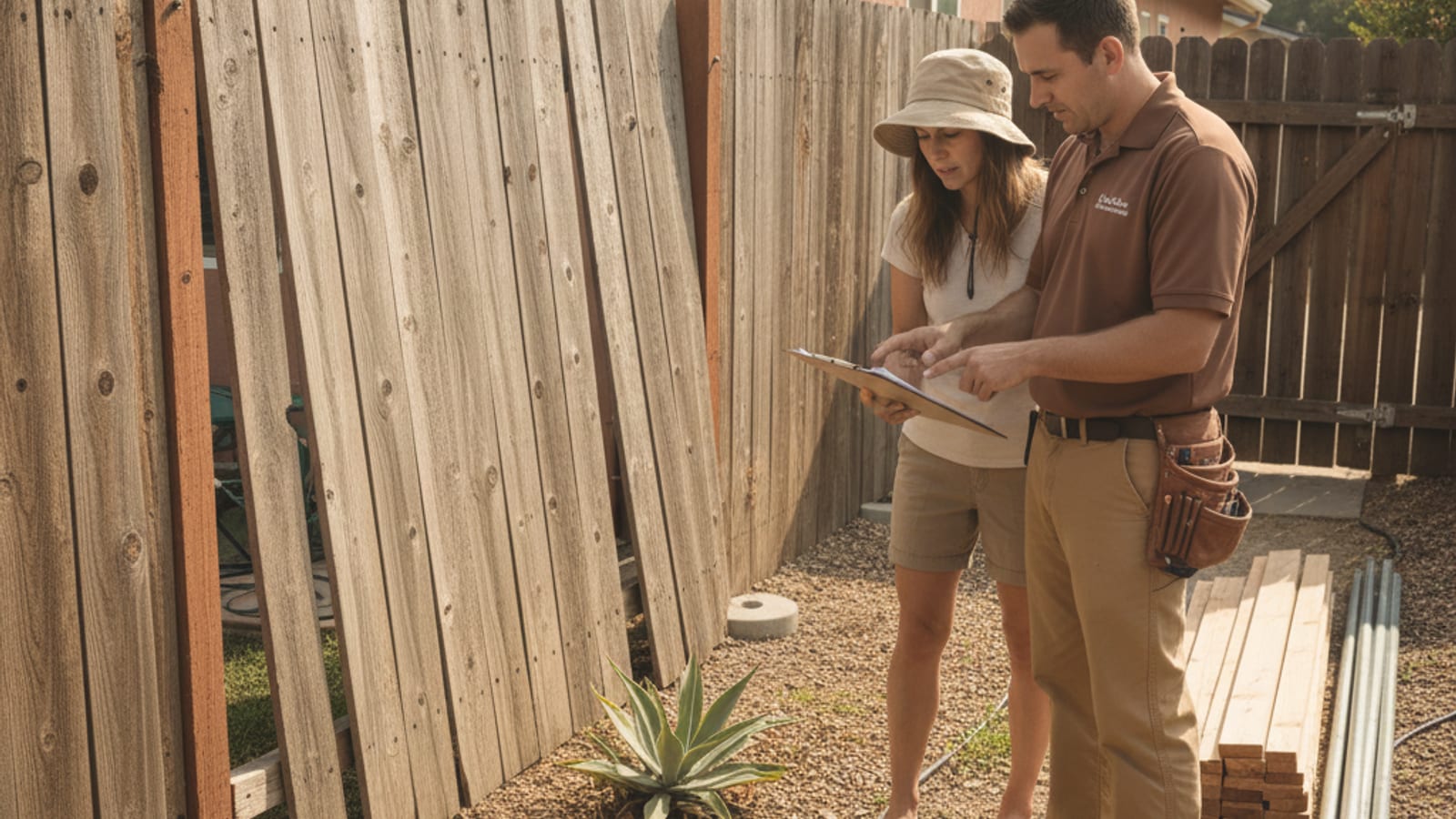
A new fence in San Diego is priced after someone measures the line. Fence Pros San Diego is a referral service. We do not sell panels and we do not publish market rates. What follows is how to read a bid so two contractors are quoting the same job.
National “fence cost 2026” articles paste another metro onto this county. Labor, salt, and inland UV are not that market.
Fence cost by material (classes, not dollars)
Most residential jobs land in three classes: chain link, wood (cedar or redwood), and vinyl. Ornamental aluminum or steel is a fourth class for pools and front yards.
| Material | Typical job | What to lock in the bid |
|---|---|---|
| Chain link | Pets, perimeters, side yards, budget | Gauge, coating (galvanized vs vinyl-coated), height, terminal posts |
| Pressure-treated pine | Lowest-cost wood privacy | Expect more movement inland; name it if it is not cedar |
| Cedar privacy | Classic backyard screen | Grade, style, fastener spec, post size and depth |
| Vinyl privacy | Low stain work, many HOA streets | Virgin vs recycled, wall thickness, inserts, color |
| Ornamental aluminum/steel | Pool barriers, open front yards | Grade, powder coat, racking, gate closers |
A 150-foot backyard is a common conversation length, not a price. The same footage with a drive gate, a hillside, or a full tear-out is a different invoice. Vinyl usually bids above a comparable cedar privacy run and then skips stain cycles. Chain link usually bids below both and does not give privacy unless you add slats. For vinyl line items see vinyl fence cost. For privacy zoning see best privacy fence.
Those comparisons assume a standard 6-foot backyard height, ordinary access, and a named product. Change any of that and the class ranking can flip.
What changes the price
Contractors who quote in line items are easier to compare than a single number on a card.
Fence height. A 4-foot open fence is not a 6-foot privacy wall. An 8-foot wall is more panel, deeper posts, and, in many desks, a permit. If the line is a pool enclosure, Health and Safety Code 115923 sets 60 inches as the minimum enclosure height. See pool fence.
Gate count and type. A walk gate is a framed opening. A double-swing drive gate is a different structure. Automation is its own project. Do not let gates hide inside a per-foot fence number.
Terrain. Flat yards match the brochure. Hillsides, rock, roots, and stair-stepped grade add time.
Demo of the old fence. Concrete-set posts take longer to pull than dry-set junk. Haul-off should be a line.
Permits and HOA. Fees belong on the quote or in a city handout, not as an invented band here. City of San Diego Table 142-03A: building permit at 7 feet and up. County PDS 070: permit except qualifying fences not over 6 feet. Most 6-foot interior privacy fences still need HOA paper in planned communities. Permit guide. HOA paperwork is not automatically “free” unless the contract says so.
Material grade. Unnamed “vinyl” and unnamed “cedar” are not comparable. Heartwood-heavy redwood is not common-grade cedar. Thin-wall vinyl is not Class-A.
Coastal vs inland. Within a mile or two of the water (Encinitas, La Jolla, Coronado, Imperial Beach), salt eats zinc-plated hardware. Stainless or hot-dip galvanized should be written in. Inland (El Cajon, Santee, Ramona), heat and slope do more of the damage. Coastal jobs cost more in hardware; inland jobs often cost more in terrain and in not using pine.
Fence cost by project size
Think in total scope, not a copied per-foot. Longer runs add footage, corners, and often extra gates. A corner lot is not “the 150-foot price times two.”
Ask each bid to restate measured linear feet, height, number of walk gates, whether a drive gate is included, and whether tear-out is included. Then compare. Swapping chain link for cedar, or cedar for vinyl, changes class. It does not scale by a published percent on this page.
Labor vs materials
On many San Diego fence jobs, materials and labor are both large shares. Vinyl and aluminum carry more of the check in product. Wood can lean more toward hand-set labor. We will not invent a 45/55 split or a “$9,000 cedar fence” example.
A quote that will not break out materials, labor, footings, and gates is hard to audit. A quote that is almost all labor or almost all materials needs a second look at grade and hours.
What a written quote should include
At minimum:
- Material cost (posts, rails, pickets or panels, hardware), with grade named
- Labor
- Concrete for post footings (listed separately is fine)
- Demo and haul-away of the old fence
- Utility locate (Dig Alert 811 is free; it should still be in the scope)
- Permit pull if required
- HOA submission if applicable
Common extras, billed only if they apply:
- Rock or hardpan
- Grading
- Removing a concrete mow strip
- Moving irrigation or low-voltage lines
- Post-install staining (wood)
We are not publishing sanitized “Encinitas $X / El Cajon $Y” examples. Those were not invoices in the job file.
Is the cheapest fence quote really the cheapest?
Often not. Look for:
Shallow post depth. Ask for inches. County PDS 070’s wood-post notes recommend at least 24 inches into undisturbed ground or compacted fill in a 12-inch-diameter concrete footing, over gravel, with the wood post through to the gravel. That is a County recommendation, not a promise that 18 inches will fail on a timetable.
Zinc-plated hardware on the coast. Stainless and hot-dip cost more than generic zinc. In Encinitas, La Jolla, Coronado, and Imperial Beach, cheap hardware rusts.
Thin-wall vinyl. Ask for wall thickness and the product line. Unnamed “white vinyl” is how warping shows up in East County sun.
Pine labeled as a cedar price. Pressure-treated pine is a different product inland.
Total cost of ownership favors a middle bid with named grade, not the lowest lump sum, when the cheap bid omitted posts or fasteners. We will not turn that into a dollars-per-year formula.
How to get an apples-to-apples comparison
Match quotes line by line:
- Post depth, inches
- Post material, size, wood vs steel
- Hardware, stainless or hot-dip vs zinc
- Picket or panel grade, wood grade or vinyl class
- Warranty, manufacturer materials plus the contractor’s labor term in the contract (read it; do not trust a blog)
- Permit and HOA, included or extra
- Gate hardware, hinges, latch, anti-sag
If a contractor will not write post depth or hardware, that is the answer.
What Fence Pros San Diego does
Independent contractors in this county write line-item estimates after they walk the yard. We match you with a pro. We do not pull CC&Rs for every community, we do not prioritize storm calls as a dispatch desk, and we are not the licensee. Verify the CSLB number yourself.
If you want a number for your yard, that is a phone call and a site visit. Call (858) 400-4906.
Frequently asked questions
How much does a fence cost per foot in San Diego in 2026?
There is no single per-foot rate we can stand behind. Chain link, cedar, vinyl, and ornamental metal are different classes. Height, gates, footings, access, and tear-out set the bid.
How much does it cost to fence a typical San Diego backyard?
A 150-foot conversation is common. The invoice depends on material class and the extras above. A national 150-foot total will not match your lot.
What’s the cheapest fence to install in San Diego?
Galvanized chain link is usually the lowest install class. Pressure-treated pine is usually the lowest wood privacy class and is a poor inland heat choice. Neither is “cheap” if you have to rebuild it.
How much of a fence quote is labor vs. materials?
Both are large. Vinyl and aluminum skew toward product. Wood can skew toward labor. Ask for a breakout instead of a percentage from a blog.
Do I need a permit for a fence in San Diego?
City: building permit at 7 feet and up (Table 142-03A), plus front-yard, visibility, coastal, pool, and retaining-wall rules. County unincorporated: permit except qualifying fences not over 6 feet. HOA approval is separate. Permit guide.
Does a coastal fence cost more than an inland one in San Diego?
Often, because the spec should include corrosion-rated hardware and, on sand, different footings. Inland jobs add heat, clay, and slope. Same drawing, different drivers.