Fallbrook fence work starts on the lot, not in a catalog. Inland heat, long private drives off Mission Road, and County of San Diego rules shape the hire before a post hole is marked. A coastal backyard in Encinitas does not teach anyone how to bid a De Luz hillside or an East Mission grove edge.
How Fallbrook lots along the I-15 corridor differ from coastal yards
Fallbrook sits in inland north San Diego County, east of Camp Pendleton and west of the Palomar foothills. Most addresses here are unincorporated. The mail may say Fallbrook. The planning desk is still County of San Diego Planning & Development Services, not a city fence counter.
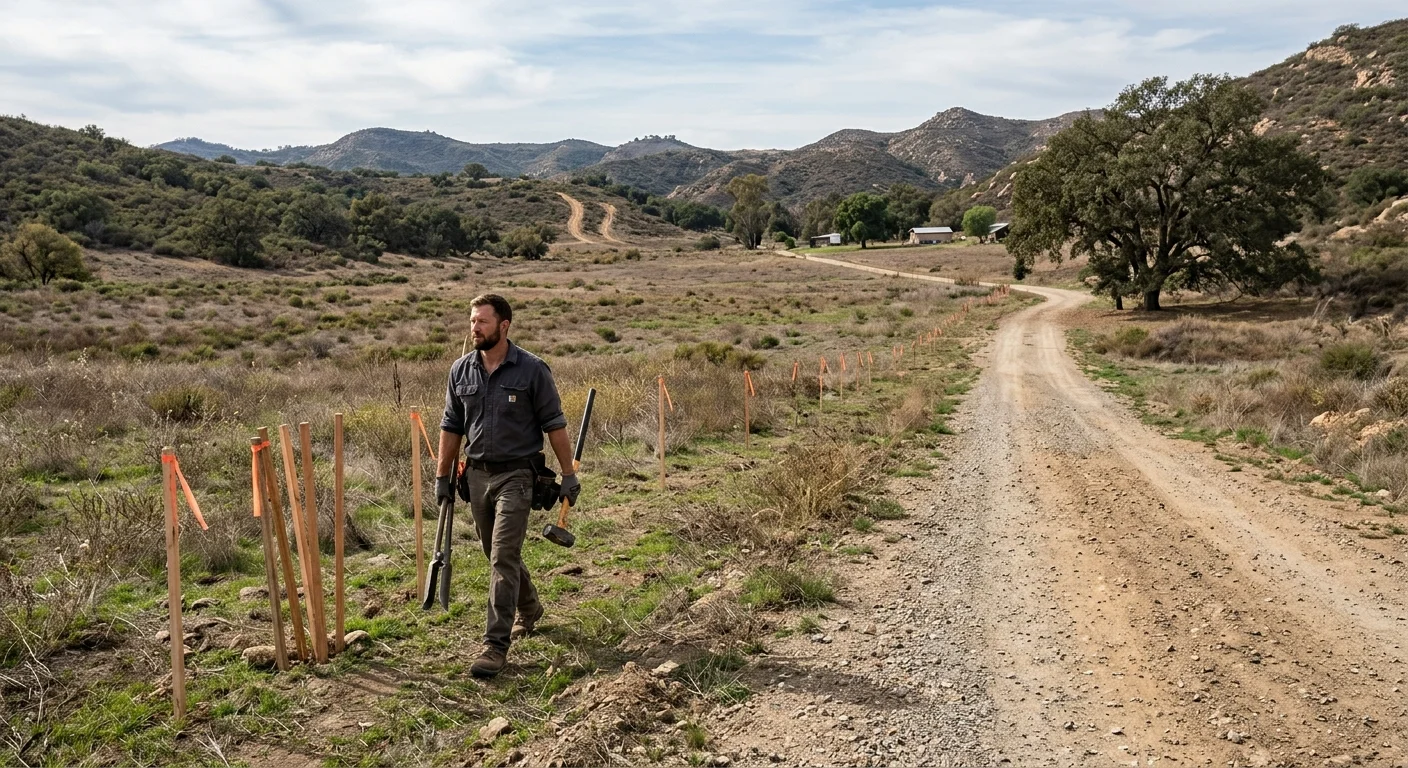
The I-15 corridor, Mission Road, Reche Road, Gird Road, and De Luz Road cut through avocado groves, citrus, pasture, and rural residential acreage. Lots run longer than a coastal fifty-foot backyard. Frontage can sit far from the house. A fence line may follow a grove road, a seasonal wash, or a neighbor’s tree row instead of a tidy side-yard setback. Live Oak Park neighborhood lots and Main Avenue parcels are tighter. De Luz and Rainbow-adjacent land is not.
Climate is the other split. Coastal North County gets marine layer, salt air, and milder nights. Fallbrook gets hotter afternoons, drier wood, and Santa Ana wind through canyons. Hardware that looks fine in Carlsbad still has to handle inland heat and dust. Wood next to grove irrigation behaves differently than wood on a salt-facing Oceanside lot.
Soil shows up on the walk. Decomposed granite, cobble, and hardpan are common on inland cuts. A coastal sandy yard and a Fallbrook slope are not the same post-hole job. The fence contractor you hire should talk about grade, rock, and drainage in plain words, not a generic site line.
This is also not a swap-in for other inland towns. Ramona’s fence-company pattern sits farther east, higher, and on a different housing mix. Fallbrook’s avocado belt, Pala Mesa-adjacent parcels, and river-drainage slopes need their own walk. If a proposal reads like it was written for Encinitas with the city name changed, it is not a Fallbrook proposal.
What long driveways, slope, and livestock access change in the site review
Many Fallbrook homes sit well off the public road. The driveway is part of the fence problem. You need a clear opening for trucks, trailers, and grove equipment, plus room for a gate to swing or slide without clipping a bank. Sight lines at the apron matter when Mission Road or a private lane carries fast local traffic.
A licensed fence contractor should walk the drive, not only the house yard. Mark where the public right-of-way ends. Mark where a turnout already exists. Note irrigation, well heads, and power along the lane. A house-yard plan that ignores the drive leaves you with a closed-in ranch you cannot actually use.
Slope is the next filter. Fallbrook lots step toward the Santa Margarita River drainage or climb toward De Luz. A fence can step in even panels or rack with the grade. Those two methods look different, hold different post lengths, and fail in different ways if someone guesses. Ask which method is on the drawing for each run, and why.
Livestock access changes the walk again. A house-yard privacy run and a pasture run are not one product. Gates people use daily should not be the same opening a trailer has to thread. If horses or other stock use the land, read a dedicated horse-property fence brief before you lock a mixed quote. For crop edges, grove roads, and working paddocks, the farm fence notes cover layout questions this hiring page should not repeat.
Water is local. Irrigation on avocado and citrus rows can saturate post holes on one side of a line while the other side stays dry. Ask how the contractor keeps posts out of drip lines, and how they treat a run that crosses a swale. None of that shows up on a coastal 6,000-square-foot lot.
How to compare wood, wire, pipe, and mixed-material proposals
Fallbrook quotes often mix four languages on one property. Wood or a privacy run around the house. Wire on a pasture or grove edge. Pipe or rail where stock leans. A driveway opening in steel or wood. Compare the proposals as a set of runs, not as one mystery number.
Start with the drawing. Each run should list material, height, post spacing, post type, and footing method. If one bidder writes “fence the property” and another itemizes house yard, pasture, and drive separately, the second bid is the one you can actually compare.
Wood is still the common house-yard ask. It gives privacy from a close neighbor on a smaller Reche Road lot. It also sits in inland sun and next to irrigation. Ask species, grade, post material, and how the contractor treats the bottom of the boards. Do not accept lifespan numbers. There is no verified government figure for how long cedar or vinyl lasts, and this page will not invent one.
Wire belongs on longer working lines. It lets air and view through a grove. It also fails at the hardware: braces, gates, and corners. A fence installation proposal should show corner assemblies, not only a roll of mesh.
Pipe and rail show up where animals lean. That is a different conversation than a backyard dog-ear fence. If a bidder stretches house-yard wood across a paddock, you are not looking at a Fallbrook-aware quote.
Mixed-material jobs go wrong at the joints. Ask who owns the transition from wood to wire, how a gate post is spec’d when it carries a heavy leaf, and whether masonry is even on the table. A California C-13 fencing contractor may construct, erect, alter, or repair fences, corrals, runs, railings, gates, and similar work. That classification excludes masonry walls. A block wall is a different license conversation.
Line up three things on paper: the same linear footage broken into the same runs, the same gate count, and the same exclusions. Utility locates, survey, haul-off, and permit filing should be yes or no on each bid. If those sit in a fog, you cannot compare the work.
Who confirms permits for a Fallbrook address
There is no City of Fallbrook municipal fence code to quote here. Fallbrook is largely unincorporated. For an unincorporated address, County of San Diego Planning & Development Services is the desk that confirms whether a fence needs a permit.
Start with the county handout PDS070, revised 2023-01-01. It lists a permit exemption for fences and walls no higher than 6 feet when the work is zoning compliant. The same public zoning summary lists 42 inches at the front and exterior side, and 72 inches at the rear and interior side. That handout is for unincorporated jurisdiction only. Confirm current applicability for your APN. Do not treat it as a city ordinance, and do not treat it as a substitute for a planner’s answer on your lot.
Height, setback, overlay, and wildland-interface questions that are not in that handout could not be confirmed for this page. If a contractor recites a “Fallbrook city” height number, ask where it is written. Send the question to County PDS for that address. If your parcel sits in a different jurisdiction than you think, only the county or city counter for that APN can say so.
Shared lines follow state law, not a Fallbrook custom. California Civil Code section 841 presumes adjoining landowners share equally in the reasonable costs of a boundary fence unless a written agreement says otherwise. Before you spend on a shared fence, the statute requires 30 days’ written notice covering the problem, the proposed work, estimated costs, a cost-sharing approach, and a timeline. Government entities are excluded from that landowner definition. A written agreement can override the equal-cost presumption.
Licensing is statewide. California Business and Professions Code section 7048 exempts some casual, minor work under a $1,000 aggregate contract price, with limits: no advertising as a contractor, no splitting jobs to dodge the threshold, and no hiring others to do the work. Most full yard or ranch fences sit above that line. Check the person you hire on the CSLB license lookup. Look for an active C-13 fencing classification when the work is fence work.
What to compare before choosing a fence contractor
A Fallbrook fence company, in the sense searchers mean it, is a licensed independent contractor who will walk your lot and contract with you directly. Fence Pros San Diego is a referral service. We match you with licensed local pros. We do not build the fence, own the trucks, or hold the trade license. You pay the contractor.
Pull the license first. Active C-13 for fence work. An insurance certificate if your lender asks for it. No ratings theater. The CSLB record and the written scope are the documents that matter.
Then compare the walk. Did the contractor measure the long drive, the slope, and the livestock openings, or only the house. Did they ask for a survey when monuments are missing. Inland north-county lines get fuzzy under groves. Guessing a line is how you buy a dispute.
Read the exclusions. Rock, haul-off, irrigation conflicts, and gate hardware should be written. Mixed wood-and-wire jobs should not hide the expensive corners inside a lump sum you cannot unpack.
Ask who files with County PDS when a permit is required. The contractor should say so in the contract. If the work is claimed as exempt under PDS070, that claim should cite the current handout and still leave room for the planner to disagree.
Neighbors and HOAs, where they exist on smaller Fallbrook tracts, are your paperwork. Civil Code 841 notice is yours to send. An HOA packet is yours to submit. The contractor can give you drawings. They cannot invent a city code that does not exist.
If two proposals disagree on height at the street, stop and call PDS. Do not average the two numbers. Unincorporated zoning is not a vibe.
When to call us
Call when the lot is inland, the drive is long, and you need a licensed C-13 contractor to walk Fallbrook grade instead of a coastal catalog. Call us at (858) 400-4906 and we’ll connect you with a licensed fence contractor. You contract with that pro directly.