For most San Diego County farm and ranch properties, woven wire field fence is the right starting point: it costs $2 to $4 per linear foot installed, contains cattle, goats, and sheep without the injury risk of barbed wire, and holds up to the heat and dry summers in inland areas like Ramona, Fallbrook, and Valley Center. Barbed wire drops that cost to $1 to $2 per linear foot but works best only as a cattle perimeter, not for smaller livestock. Knowing which material matches your animals and acreage is the key decision, and this guide walks through each option.

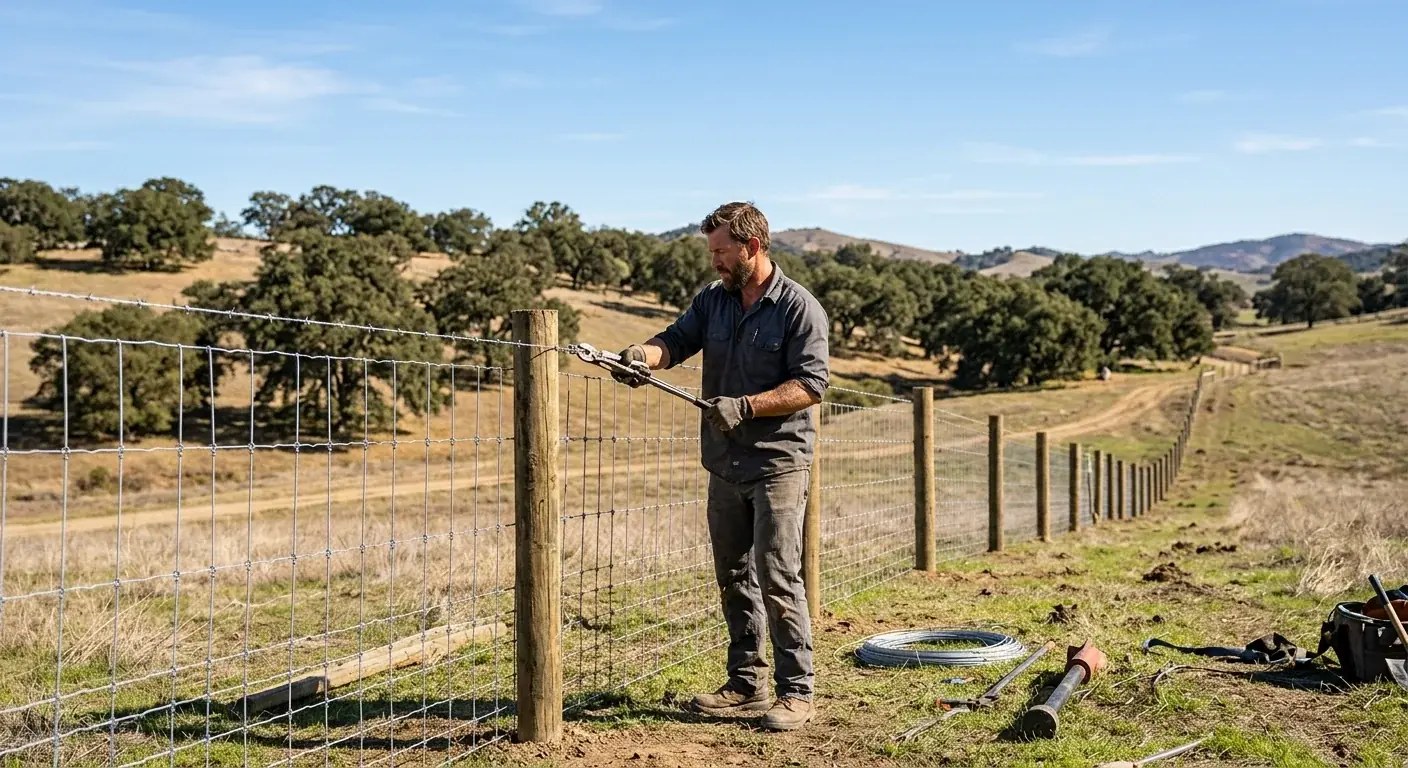
A long stretch of woven wire farm fence on a rural San Diego County property, with rolling hills and oak trees in the background under a clear sky.

Fencing for livestock: cattle, goats, and more

When it comes to keeping your animals safe and contained, not all fences are created equal. The ideal livestock fence depends heavily on the type of animals you’re managing and their specific behaviors. For instance, cattle require a much different approach than goats or smaller animals. In San Diego County, where properties can range from sprawling pastures to rugged hillsides, selecting the right material and design is critical for effective animal management.

For cattle, a fence needs to be sturdy and tall enough to discourage jumping and strong enough to withstand pushing. High-tensile woven wire fences are often a top choice because they offer excellent strength and longevity. These fences are designed to absorb impact without breaking, making them suitable for larger, more powerful animals. We often recommend adding a strand or two of barbed wire along the top or bottom for extra deterrence, especially in areas where cattle might rub against the fence. Post spacing is also important; closer posts provide more rigidity and prevent sagging over long runs.

Goats, on the other hand, are notorious for their climbing abilities and their knack for finding weaknesses in any enclosure. For these agile creatures, a tightly woven wire mesh is usually the best solution. Look for “no-climb” or “field fence” options with small openings that prevent them from getting their heads stuck or climbing through. The fence height should also be substantial, often 48 to 60 inches, and it’s wise to consider an outward-facing hot wire at the top or bottom for added security against determined escape artists. Smooth wire can be used as electric fencing, providing a psychological barrier without causing injury.

For smaller livestock like sheep, pigs, or even poultry, you’ll need a fence that prevents them from digging under or squeezing through tight spaces. Hog wire, a type of woven wire with graduated spacing (smaller at the bottom, wider at the top), works well for pigs. For poultry, a finer mesh chicken wire or welded wire is necessary to keep them in and predators out. When planning your livestock fencing, always consider the unique challenges of your animals and the local environment. We’re experts in designing custom solutions to keep your herds and flocks secure, complementing any existing horse property fence or split rail fence you might have.

Cost-effective perimeter fencing for large properties

Securing a large property in San Diego County doesn’t have to break the bank. When you’re dealing with extensive acreage in areas like Valley Center or Ramona, cost-effectiveness becomes a major factor alongside durability and security. The goal is to establish clear boundaries and provide general containment without incurring exorbitant material or labor costs.

One of the most popular and budget-friendly choices for large property perimeters is a field fence, often made from woven wire. This type of fence is designed for long stretches and can be installed relatively quickly compared to more decorative or complex fencing styles. Its construction allows for wider post spacing, which reduces the number of posts needed, saving on both material and installation costs. Field fence comes in various heights and wire gauges, allowing you to choose the appropriate strength for your specific needs, whether it’s simply marking a property line or containing larger wildlife.

Another cost-effective option, particularly for defining boundaries on very large, remote properties where animal containment isn’t the primary concern, is a multi-strand smooth wire or barbed wire fence. While not always suitable for all livestock, this can be extremely economical per linear foot. For smooth wire, adding an electric current greatly enhances its effectiveness as a deterrent. Barbed wire, though less animal-friendly, offers a strong visual and physical barrier at a low cost. Remember, the key to cost-effectiveness isn’t just the upfront material price, but also the longevity and minimal maintenance requirements.

Installation efficiency also plays a significant role in overall cost. Long runs of fence benefit from professional installation that uses specialized equipment for digging post holes, setting posts, and stretching wire properly. This ensures a tight, secure fence that will last for decades, minimizing future repair costs. At Fence Pros San Diego, our team has the experience and equipment to handle large-scale fence installation projects efficiently, ensuring your investment is sound and sustainable for years to come on your expansive San Diego County property.

Woven wire vs. barbed wire: pros, cons, and uses

Choosing between woven wire and barbed wire is a fundamental decision for many farm and ranch owners in San Diego County. Both types offer distinct advantages and disadvantages, making them suitable for different applications depending on your property’s specific needs, livestock, and budget. Understanding these differences is key to making an informed choice.

Woven wire fence, often referred to as field fence or no-climb fence, consists of horizontal and vertical wires woven together to form a mesh. The openings in the mesh can vary significantly in size and shape, from large rectangles to small, graduated squares.

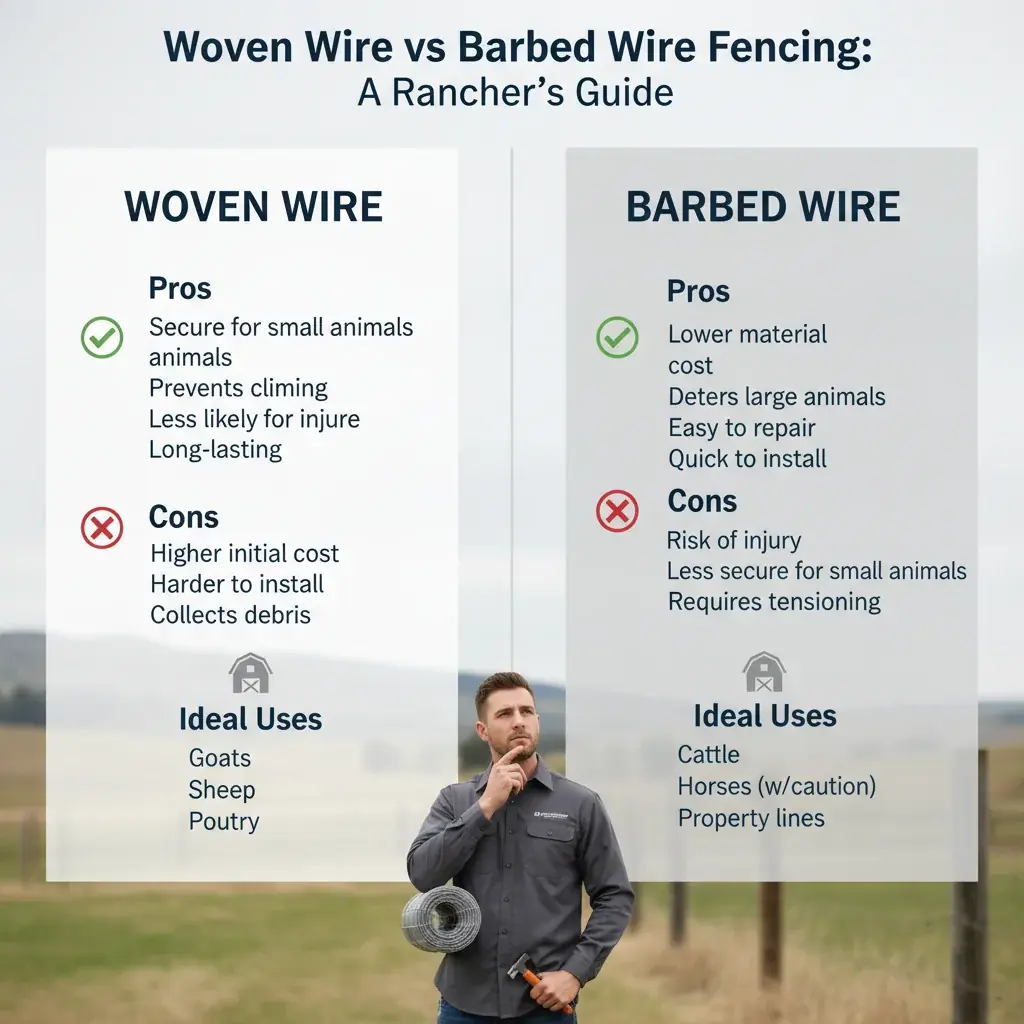
Pros of woven wire:

  • Excellent containment: The mesh design prevents animals from pushing through or climbing over, making it ideal for a wide range of livestock, including goats, sheep, pigs, and even horses (with appropriate no-climb variations).
  • Safer for animals: Without sharp barbs, woven wire significantly reduces the risk of injury to animals that might rub against or get caught in the fence.
  • Versatile: Available in various heights and mesh patterns, it can be tailored to specific animal types and containment needs.
  • Durable: When properly installed and tensioned, modern woven wire fences can last for many years, resisting sagging and weathering.

Cons of woven wire:

  • Higher initial cost: Generally more expensive per linear foot than barbed wire due to the increased material and more complex manufacturing process.
  • More labor-intensive installation: Requires precise stretching and securing to ensure proper tension and effectiveness.
  • Can be damaged by heavy impact: While durable, a very determined animal or significant impact can still deform the mesh.

Barbed wire fence features sharp barbs spaced along strands of wire. It’s often used in multiple strands to create a barrier.

Pros of barbed wire:

  • Very cost-effective: Typically the least expensive fencing option per linear foot, making it suitable for very large properties or remote boundaries where cost is a primary concern.
  • Strong deterrent: The barbs provide a strong psychological and physical deterrent against animals trying to push through or climb over.
  • Relatively easy to install: Can be installed quickly over long distances, often with wider post spacing than woven wire.

Cons of barbed wire:

  • Risk of injury: The sharp barbs can cause cuts and injuries to livestock, wildlife, and even people. This is a significant concern for animal welfare.
  • Less effective for smaller animals: Small animals can sometimes slip between strands, and it doesn’t provide the same secure containment as a mesh fence.
  • Not suitable for all livestock: Generally not recommended for horses or animals prone to panicking and running into fences, due to the injury risk.
  • Maintenance: Can sag over time and require re-tensioning.
A comparison infographic showing pros, cons, and ideal uses for woven wire and barbed wire farm fencing types, with examples of livestock.

When deciding, consider the types of animals you have, the level of containment required, your budget, and safety concerns. For active livestock like goats or horses, woven wire (especially no-climb) is generally preferred. For extensive perimeters with cattle or as a cost-effective deterrent, barbed wire might be considered, often in conjunction with other fencing types or with careful animal management practices. Our experts can help you weigh these factors and choose the best solution for your San Diego County ranch.

Durable gate options for ranch entrances and pastures

A fence is only as good as its gate, especially on a busy farm or ranch in San Diego County. Gates aren’t just points of access; they’re critical components for security, livestock management, and overall property functionality. When you’re planning for ranch entrances or pasture access points in areas like Ramona or Fallbrook, you need gates that are built to last, easy to operate, and strong enough to handle daily wear and tear from vehicles, equipment, and animals.

For primary ranch entrances, durability and security are paramount. Heavy-duty steel gates are a popular choice. These gates are typically constructed from galvanized steel tubing, offering superior strength and resistance to rust and corrosion, even in varying San Diego weather conditions. They can be designed as single swing gates for smaller openings or double swing gates for wider access, ideal for large farm machinery or livestock trailers. For added security, you can opt for automated gate systems, complete with keypads, remote controls, or even solar power, providing convenient and controlled access to your property. We specialize in sturdy gate installation that integrates perfectly with your existing or new fencing.

Within pastures and fields, the requirements might be slightly different. Here, ease of operation and reliable containment are key. Utility gates, often made from lighter but still sturdy steel or aluminum, are common. These gates are designed for frequent use, allowing easy movement of animals and smaller vehicles between different sections of your property. Look for features like heavy-duty hinges and latches that can withstand repeated use and the occasional bump from livestock.

Another excellent option for pasture gates is a well-constructed wooden gate. While requiring more maintenance than steel, a well-built pressure-treated wood gate, especially one reinforced with steel bracing, can offer a classic aesthetic that complements the natural landscape of San Diego County. Wooden gates are particularly effective when integrated into a traditional split rail fence system. The key is proper installation, ensuring the posts are deeply set and adequately braced to support the gate’s weight and prevent sagging over time.

Regardless of the material, proper installation is non-negotiable for gate longevity. Gate posts must be set deep and firm, often with concrete, and adequately braced to prevent movement. The right hardware, heavy-duty hinges, sturdy latches, and durable drop rods, makes all the difference in a gate that operates smoothly for years versus one that constantly sags or sticks. Investing in quality gates and professional installation ensures your ranch entrances and pasture access points are secure and functional, day in and day out.

Frequently asked questions

How much does farm fence installation cost in San Diego County?

Woven wire field fence typically runs $2 to $4 per linear foot installed in San Diego County, depending on wire gauge, post spacing, and terrain. Barbed wire perimeter fence is cheaper at $1 to $2 per linear foot, while premium no-climb horse fence or heavily gated entrances push costs higher. Getting a firm quote based on your acreage and animal type is the most reliable way to budget.

What is the best farm fence for goats in San Diego?

No-climb woven wire, sometimes called field fence, with openings no larger than 4 by 4 inches is the standard choice for goats. A height of 48 to 60 inches is recommended, and adding a single electric strand at the top discourages climbing. Goats are skilled at finding gaps, so tight mesh and well-set corner posts matter more than the wire type alone.

Do I need a permit for a farm fence in San Diego County?

Agricultural fencing on rural parcels in unincorporated San Diego County generally does not require a building permit, but boundary-line fences near roads or easements may have setback rules. Properties inside city limits follow that city’s fence ordinance. It’s worth confirming with the county’s Planning and Development Services department before you dig posts on shared property lines.

How long does woven wire fence last in San Diego’s climate?

Galvanized woven wire fence typically lasts 20 to 30 years in San Diego County’s inland valleys when installed with proper tension and treated wood or steel posts. The dry heat in areas like Ramona and Valley Center is gentler on wire than coastal salt air, so rural properties tend to see the longer end of that range. Re-tensioning every few years and keeping vegetation from pushing on the wire extends the life further.

Can I use a privacy fence on my ranch property for wind or visual screening?

A solid privacy fence can work for windbreaks near structures, outdoor seating areas, or arena perimeters, but it’s rarely practical for large livestock runs because of cost and wind-load stress on posts. Most ranch owners combine a woven wire perimeter for pastures with a shorter privacy or wood section near the barn or home for screening. Our fence installation team can help you map out which fence type belongs where on a mixed-use rural property.

What size gate do I need for a cattle ranch entrance in San Diego?

A 16-foot double-swing gate is the most common size for ranch driveways in San Diego County because it accommodates livestock trailers and farm equipment side by side. Single-swing gates at 10 to 12 feet work for pedestrian and ATV access between pastures. Gate posts should be set at least 4 feet deep in concrete, since the hinge-side post carries most of the load and will rack over time without a solid footing.

When to call us

Fencing large rural and agricultural properties in San Diego County is a specialized job that requires expertise in animal behavior, material science, and local conditions. When you need a durable, cost-effective, and professionally installed farm or ranch fence that stands the test of time, it pays to work with an experienced crew. We’re here to help you navigate your options and get the install done right. Call us at (858) 925-5546 for a same-day estimate.