A useful La Mesa fence repair quote starts with the damaged parts, not one vague total. It should identify the posts, panels, rails, gates, materials, and access conditions included in the proposed work.
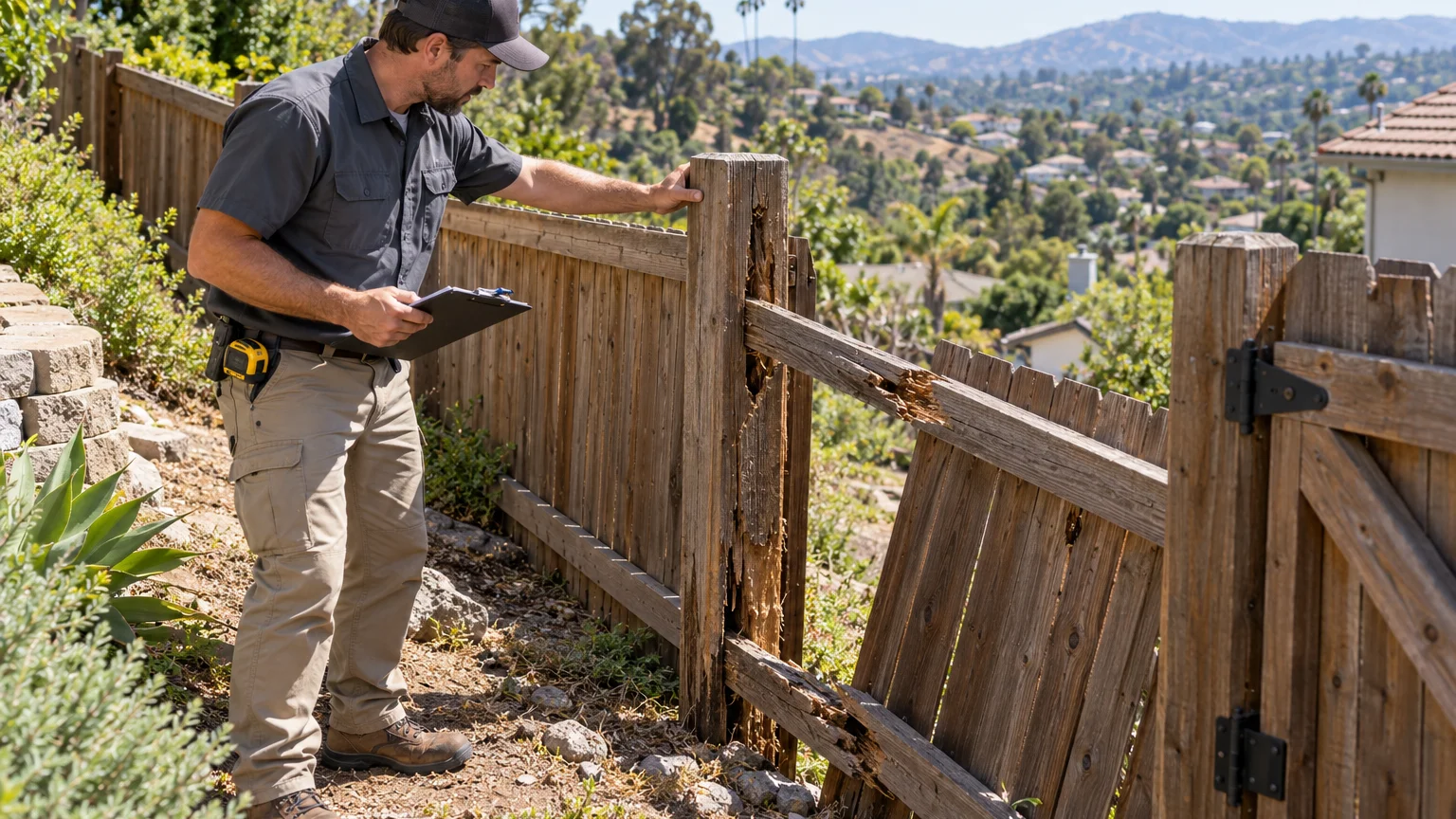
How to document posts, panels, and gates before requesting quotes
Start by walking both sides of the fence where access permits. Take one wide photo of each run, then photograph every damaged area closely. Include an object for scale when a crack, gap, or lean isn’t clear in the image.
Give each fence run a simple name. “Driveway side,” “rear boundary,” and “east side yard” are easier to follow than a folder of unlabeled photos. Note where each run starts and ends. If you know the approximate length, include it, but tell the contractor that it needs field verification.
Document the parts separately:
- Posts that lean, move, split, or show damage near grade
- Rails that have pulled away, cracked, or lost fasteners
- Boards, pickets, or panels that are loose, missing, warped, or broken
- Chain link fabric that sags, separates, or has damaged ties
- Gates that drag, bind, swing poorly, or fail to latch
- Hinges, latches, brackets, caps, and other visible hardware
- Areas where plants, stored items, or structures limit access
For gate repair in La Mesa, photograph the gate closed and partly open. Include the hinge side, latch side, posts, and ground clearance. Describe when the problem appears. A gate that binds only near the end of its swing may require a different review than one hanging loose at the hinges.
Don’t diagnose hidden damage from photos alone. Your notes help a contractor prepare, but they don’t replace an on-site assessment. Our fence repair and restoration service can connect you with an independent, licensed contractor who can inspect the full run.
How La Mesa hills, older lots, and side-yard access shape the site review
A hillside fence needs more than a count of broken boards. The contractor should view the fence from uphill and downhill sides. Changes in grade can affect panel alignment, gate clearance, post exposure, and access to each damaged section.
Ask the quote to identify whether the repair follows the existing slope or uses stepped sections. It should also state how transitions between elevations are handled. Avoid assuming that a level-looking panel means the supporting posts remain sound.
Older lots may have repairs from different periods. One run can contain mixed post sizes, unmatched boards, added brackets, or several hardware types. The contractor should identify which existing components will remain. The quote should also explain how new materials will meet those older sections. An exact visual match may depend on what’s currently available, so that point belongs in writing.
Side-yard access deserves its own line in the site notes. Record narrow passages, stairs, tight corners, locked gates, overhead obstructions, and areas where materials can’t be carried directly to the fence. Mention irrigation components, paving, planters, and nearby structures without guessing what lies underground.
La Mesa’s city limits also matter. Don’t apply City of San Diego or unincorporated county fence rules to a La Mesa address. If you need broader local planning context before comparing contractors, see our La Mesa fence company guide. The repair quote itself should remain tied to the actual property, fence line, and access route.
What fence pros inspect on wood, vinyl, and chain link runs
The inspection should follow the fence as a connected system. One damaged panel may be visible, while movement at a neighboring post or gate creates the underlying problem. Ask the contractor to distinguish observed damage from conditions that can’t be confirmed until components are removed.
For wood fence repair in La Mesa, the review should cover posts, footings, rails, boards, fasteners, and gates. A quote should name which pieces will be removed and which will stay. If a post is involved, ask whether the footing will be exposed, removed, reused, or replaced. Our guide to repairing fence post footings explains why that detail needs a separate scope.
A vinyl fence review should cover posts, rails, panels, caps, brackets, and gate hardware. The contractor should check whether pieces have separated, cracked, shifted, or lost support. The quote should identify any parts that must match an existing profile or color. It should also explain what happens if a matching component can’t be sourced.
For chain link, the contractor should inspect the terminal posts, line posts, top rail, fabric, tension components, ties, and gate frame. Sagging fabric may not tell the whole story. The written scope should state whether the proposal addresses the fabric alone or includes supporting components.
Every material review should cover gates separately. Gate trouble can involve the leaf, frame, hinges, latch, posts, or surrounding fence. Ask for those items to be named instead of accepting “adjust gate” without further detail.
The quote should also separate labor, materials, removal, disposal, access preparation, and optional work. For background on common repair categories, read our San Diego fence repair cost guide. Confirm all current amounts directly with the contractor before signing.
When repair and replacement deserve separate scopes
Repair and replacement answer different questions. Repair asks which existing components can remain. Replacement asks what should be removed and rebuilt. When both approaches appear reasonable, request separate written scopes instead of one blended proposal.
The repair scope should identify every post, rail, panel, board, hardware item, and gate component included. It should state what remains untouched. It should also describe any assumptions about concealed conditions. If removing a board or footing may expose added damage, the quote should explain how a revised scope would be approved.
The replacement scope should define the start and end points of the proposed run. It should name the material and general configuration, plus any gates or transitions included. Removal and disposal should appear clearly when they’re part of the proposal.
Separate scopes make exclusions easier to see. They also prevent a partial repair from being compared directly with a larger rebuild as if both contractors priced identical work. Our wood fence repair versus replacement guide offers another way to organize that decision.
Price alone doesn’t settle the choice. Compare what remains, what changes, and what hasn’t been confirmed. A low total may cover fewer components. A larger scope may include work another proposal excluded. Ask each contractor to mark optional items and explain dependencies between them.
Shared boundary fences need extra care. California Civil Code Section 841 presumes adjoining landowners share equal benefit and reasonable costs unless a written agreement says otherwise. It also requires advance written notice containing specified information before costs are incurred. Discuss the proposed scope with the adjoining owner and seek legal advice when responsibility is disputed.
Who can confirm current permit questions for that La Mesa address
The approved claims ledger doesn’t contain a verified City of La Mesa fence permit or setback rule. That means no specific La Mesa height, setback, or permit threshold can be stated here. Confirm the current requirement with the City of La Mesa building or planning source for the exact address before authorizing work.
Give city staff enough detail to answer accurately. Be ready to provide:
- The property address
- The fence location on the lot
- Existing and proposed heights
- Whether the project repairs or replaces the fence
- Whether posts or footings will be disturbed
- The fence and gate materials
- Any nearby street, sidewalk, driveway, pool, or retaining wall
- Whether the location is within an easement or shared boundary
Ask for the answer in writing or request a link to the current city source. Keep that information with the contractor’s quote. A permit exemption, if one applies, shouldn’t be treated as approval of every design or location issue.
California’s C-13 fencing classification covers constructing, erecting, altering, and repairing fences and gates, but excludes masonry walls. You can verify a contractor’s current license record through the Contractors State License Board license check.
California’s minor-work licensing exemption is narrow. Business and Professions Code Section 7048 addresses qualifying work below an aggregate contract price of $1,000, with added conditions and exclusions. Don’t split a project to avoid licensing requirements. When the scope involves licensed fence work, confirm the contractor’s status before contracting directly with that professional.
When to call us
Call when damaged posts, connected panels, a gate, or uncertain footing conditions need an on-site review by a licensed fence pro. Call us at (858) 400-4906 and we’ll connect you with a licensed fence contractor.