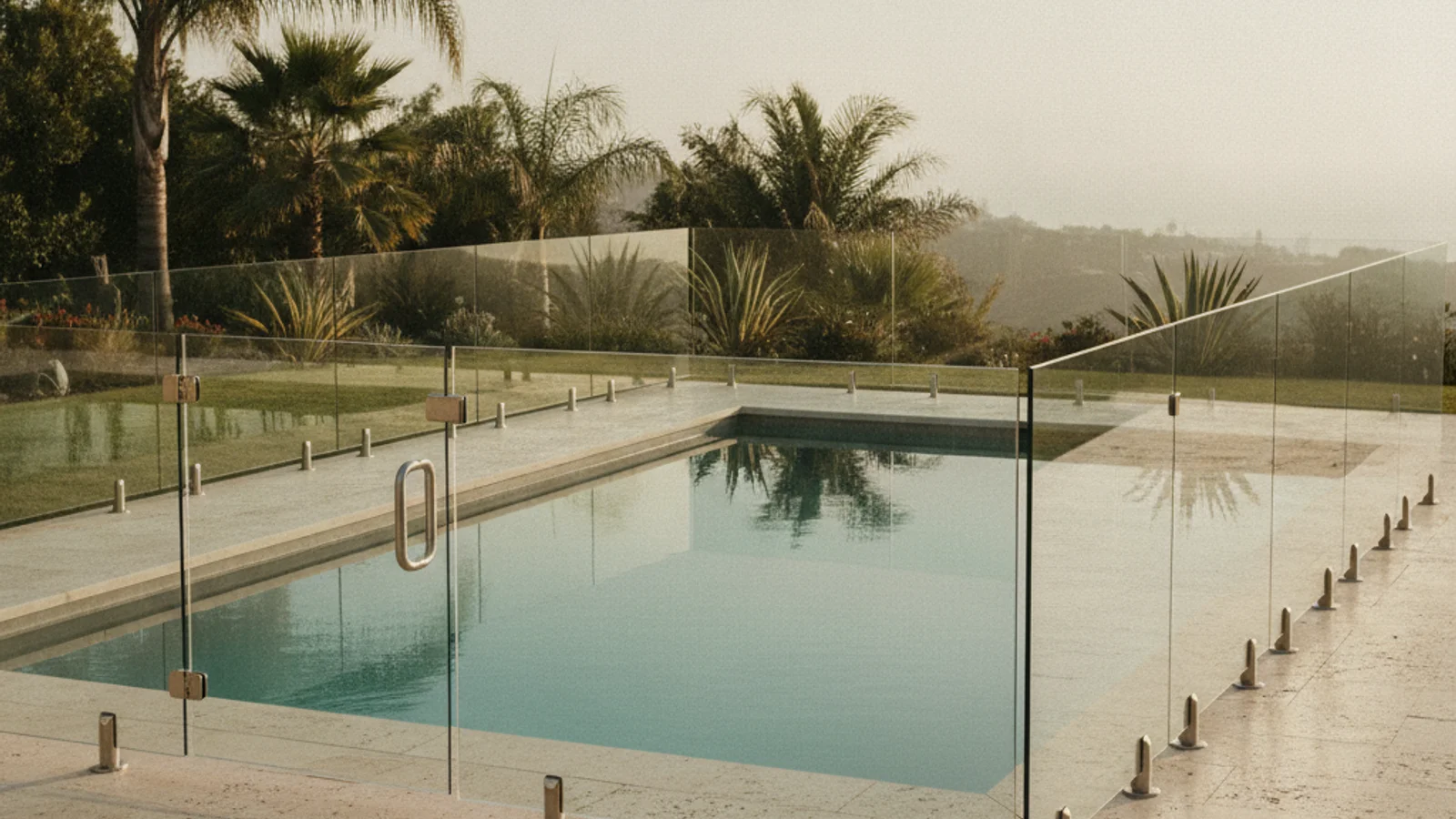
A frameless glass pool fence is thick tempered safety glass held on stainless spigots instead of a picket frame. Homeowners in La Jolla, Del Mar, Coronado, and Rancho Santa Fe use it when the pool sits in front of an ocean, canyon, or golf-course view. Cost is a measured quote, not a published per-foot rate. Code is not “Title 24 in three bullets.” If the glass is the isolation enclosure, it has to meet California Health and Safety Code section 115923. New pools and pool remodels that take a building permit also have to satisfy section 115922’s two-feature rule. Details live in our California pool fence code guide.
Fence Pros San Diego is a referral service. We match you with an independent pool fence contractor. We do not install glass, inspect barriers, or mark up the contractor’s contract.
What a glass pool fence actually is
Two builds cover most San Diego jobs.
Frameless. Individual panels sit in stainless spigots core-drilled into the deck. The gap between panes is small and sealed. The view is as open as a barrier gets.
Semi-frameless. Same glass, slim posts at the joints. You lose a little transparency. You gain an easier repair path if one pane is damaged, because you are not rebuilding a fully frameless run.
From the patio, glass reads as architecture. From the statute, it is still an enclosure: it has to keep a child from walking or climbing into the water. Mesh and aluminum can do that job for less money when the view is not the point.
How glass meets the Swimming Pool Safety Act enclosure rules
Section 115923 is the enclosure checklist. A glass barrier used as that enclosure needs all of the following characteristics, in the statute’s own terms:
- Access gates open away from the pool, and are self-closing with a self-latching device placed no lower than 60 inches above the ground.
- Minimum height of 60 inches.
- Maximum vertical clearance from the ground to the bottom of the enclosure of two inches.
- Gaps or voids do not allow passage of a sphere equal to or greater than four inches in diameter.
- An outside surface free of protrusions, cavities, or other physical characteristics that would serve as handholds or footholds that could enable a child below the age of five years to climb over.
Standard 60-inch or 72-inch glass panels can meet the height rule. The 4-inch sphere rule is why panel spacing and gate gaps have to be tight. The 2-inch bottom clearance is why an uneven deck edge fails even when the glass looks tall enough. Flat glass has no horizontal rail to stand on, which helps on climbability, but spigots, base shoes, and adjacent planters can still create footholds. The inspector looks at the built line, not the catalog photo.
Do not mix this with the house-door rule. Section 115922(a)(5) puts a self-latching release no lower than 54 inches on doors of the home that open to the pool. That 54-inch figure is not the enclosure-gate latch. Glass pool gates follow the 60-inch enclosure latch in 115923(a).
When a building permit is issued for a new private single-family pool or spa, or for a remodel of one, section 115922 requires at least two of seven drowning-prevention features. An enclosure that meets 115923 and isolates the pool from the home is one of those seven. A glass fence does not, by itself, finish the two-feature count. Pairing rules in 115922(b) also disqualify some combinations (for example a cover plus an in-pool alarm). The building official inspects the required features before final approval.
Local departments also enforce the building code they have adopted. This page does not reprint Title 24 numbers that are not in the saved Health and Safety Code text. Confirm the current local checklist with the city that will inspect.
What a glass pool fence costs in San Diego
Glass is the premium pool barrier. Price tracks glass thickness (12mm is a common spec, not a code number), frameless vs semi-frameless, how the deck is cored (pavers and stone take longer than a clean concrete bond beam), gate count, and hardware grade. We do not have a current invoice set, so we will not print per-foot bands or project totals.
Compare bids on the same scope:
- Tempered safety glass thickness and panel size
- Spigot or shoe system, stainless grade named (304 vs 316)
- Gate hinges and latch, including the 60-inch release
- Core drilling, waterproofing, and deck repair
- Permit and inspection, if the contractor is carrying them
Mesh is usually the lowest-cost reversible barrier. Powder-coated aluminum sits in the middle on look and maintenance. Glass is the view product. For mesh, see removable mesh pool safety fence. For style tradeoffs, see pool fence ideas for San Diego backyards.
Coastal salt air and glass fence hardware
The glass does not corrode. The hardware does.
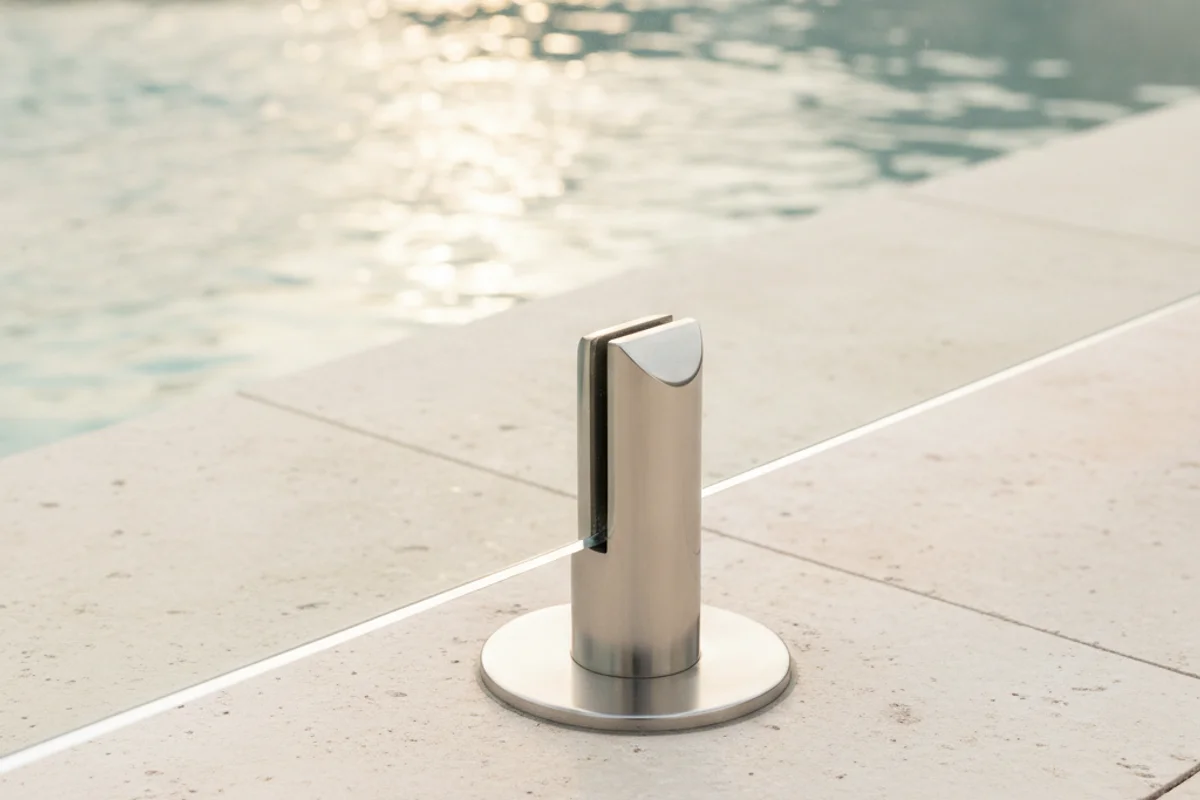
304 stainless shows up in cheaper kits and can be enough well inland. Near the ocean, chloride pits 304. 316 stainless (with molybdenum) is the grade coastal contractors should name for spigots, hinges, and latches. If a spigot rusts at the deck, the panel loses support. That is a safety failure, not a stain.
Get the grade in writing. For hardware across fence types, see the coastal salt-air fence hardware guide.
Glass vs mesh vs aluminum: when glass is worth it
Glass is worth specifying when the view behind the pool is the reason you built the pool there, and when the deck is part of the living space. It is a weak pick when you want a barrier you can take down after the toddler years (that is mesh) or when there is no view to protect (aluminum meets the same enclosure tests for less glass handling).
Both glass and mesh can satisfy the enclosure rules when they are built to 115923. Mesh’s extra feature under 115922 is a separate product: removable mesh that meets ASTM F2286, with a self-closing, self-latching, key-lockable gate. Do not treat a pretty glass pane as that mesh feature.
Frequently asked questions
Is a glass pool fence up to code in San Diego?
It can be, if the built enclosure matches section 115923: 60-inch minimum height, 2-inch maximum bottom clearance, no 4-inch-sphere gaps, gates that swing away from the pool and self-close, latch release no lower than 60 inches, and an outside face a child under five cannot climb. New or remodeled pools still need the second 115922 feature. Your city may add adopted building-code checks.
How much does a glass pool fence cost in San Diego?
Enough that you should not buy it from a blog table. Thickness, hardware grade, deck material, and gates dominate. Ask for those as line items. Mesh is the budget reversible option. Aluminum is the mid look. Glass is the view.
Does frameless glass hold up to coastal salt air?
The tempered glass is fine in salt air. 304 spigots and hinges are not a coastal spec. Name 316 on the quote.
Glass vs mesh pool fence, which is safer?
Installed to the same enclosure rules, both keep a toddler out of the water. Mesh can be removed later. Glass keeps a sightline from the house. Wearable child alarms are not a qualifying 115922 feature.
Do glass pool fences need permits in San Diego?
A new pool or a pool remodel that takes a building permit triggers 115922 and an inspection of the drowning-prevention features before final approval. Whether a barrier-only retrofit needs its own permit is a city question. Do not assume the contractor skipped it. Confirm with the department that will inspect.
When to call us
Glass is a measured install: height, gaps, latch, and stainless grade all get checked. Call (858) 400-4906 with pool size, deck material, and frameless vs semi-frameless. We will connect you with an independent contractor for a written quote.