Fence stain isn’t one product. It’s a category with real technical differences between opacity levels and formula types, and picking the wrong one for San Diego’s mix of coastal marine layer and inland heat is a common reason a stain job disappoints within a year or two.
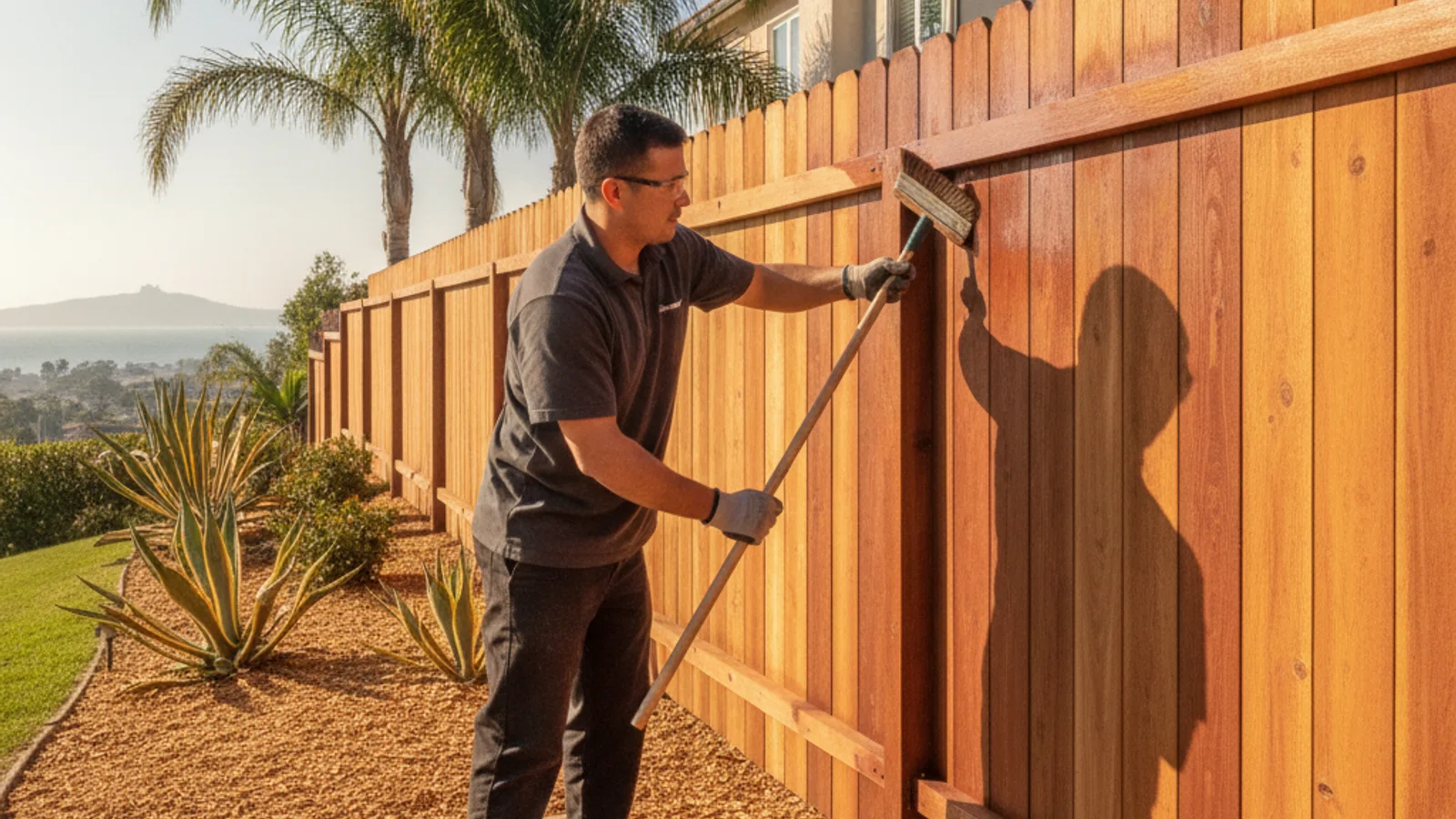
This is a foundational look at the types themselves, not a color guide or a maintenance schedule. If you already know your fence needs restaining and just want timing or color guidance, our staining frequency guide and color guide cover those questions directly. This post is for the step before that: understanding what you’re actually choosing between.
Opacity: transparent, semi-transparent, semi-solid, and solid
Opacity is the first and most consequential choice, because it determines how much of the wood grain shows through and how much UV protection the finish provides.
Transparent stain carries the least pigment and lets the wood grain show through almost fully. It gives the most natural look but also the least UV protection, since pigment is what blocks UV light from breaking down the wood surface. Transparent stain typically needs the most frequent reapplication of the four types.
Semi-transparent stain adds enough pigment to tint the wood while still showing grain clearly. This is the most common choice for a standard residential privacy fence because it balances a natural look against meaningfully better UV resistance than a transparent product.
Semi-solid stain carries enough pigment that grain becomes a subtle texture rather than a clear pattern. It hides more of the wood’s natural variation, which is useful on an older fence with uneven weathering or repaired sections that don’t match in color, and it holds its pigment longer under UV exposure than semi-transparent.
Solid stain behaves close to paint in appearance, fully covering the wood grain with color, but it remains a stain in that it typically doesn’t form as thick or as brittle a film as true paint. It offers the most UV protection of the four and the most complete coverage of imperfections, at the cost of the natural wood look most homeowners choose stain over paint to get in the first place.
Oil-based versus water-based: how they behave, not just how they smell
The opacity choice and the oil-versus-water choice are separate decisions, and both matter.
Oil-based stains penetrate deeper into the wood fiber before curing, which many contractors consider an advantage for weathered or slightly porous older wood. They tend to have a longer working time during application, which helps on a hot day when a water-based product might start setting up before you’ve finished a section. Oil-based products also generally have a longer manufacturer-specified dry and cure window than water-based equivalents.
Water-based stains dry faster, clean up with water rather than solvent, and many current formulations use resins designed to flex with the wood as it expands and contracts with humidity, which can reduce cracking and peeling over time. Manufacturers of specific water-based products often claim improved UV resistance or flexibility compared to older-generation water-based formulas; those are claims worth reading directly from the product’s technical data sheet rather than assuming apply universally across the category.
Neither formula type is categorically better across every situation. The right call depends on the wood’s condition, the climate the fence sits in, and which properties matter most for that specific project.
What San Diego’s marine layer does to a stain job
Coastal San Diego’s marine layer is a moisture-cycling problem more than a simple humidity problem. Wood near the coast can be damp in the morning and dry by afternoon, day after day, and that swelling-and-shrinking cycle stresses whatever finish sits on top of it.
A stain film that stays flexible tends to tolerate that cycling better than one that cures rigid, which is one reason some water-based formulas marketed for coastal use lean on flexibility as a selling point. Regardless of formula, a heavy or lingering marine layer also extends dry and cure time, which matters for scheduling an application, not just for product selection: applying stain into a day with a marine layer that hasn’t burned off risks dust, pollen, or moisture settling into a finish before it’s set.
What inland heat does to a stain job
Move away from the coast, and the problem flips from moisture cycling to straight UV and heat exposure. Inland San Diego neighborhoods see more direct, unfiltered sun on exposed fence runs, and that sun breaks down pigment and dries out the wood surface faster than a coastal fence with the same product would experience.
Higher-opacity finishes, semi-solid and solid, generally hold their color longer under sustained inland UV exposure than transparent or semi-transparent stains, because there’s simply more pigment present to absorb and block that light before it reaches the wood. Application timing matters here too: staining in the middle of a hot, dry afternoon can cause a product to set up faster than the manufacturer’s working time assumes, which affects how evenly it lays down.
Matching stain type to your situation
| If your fence is | Consider |
|---|---|
| Newer wood you want to show off | Transparent or semi-transparent |
| Older wood with uneven weathering or patched repairs | Semi-solid or solid, to even out appearance |
| Near the coast | A formula rated by its manufacturer for coastal or marine exposure, applied with cure time built into the schedule |
| In a hot, sun-heavy inland location | Higher pigment load (semi-solid or solid) for UV resistance, applied outside peak afternoon heat |
Whatever you land on, ask about the manufacturer’s specific claims for that product rather than treating “stain” as one interchangeable category, because the differences between opacity levels and formulas are real and they show up within the first year or two, not just eventually. A fence staining contractor who works regularly in your part of the county will already know which types perform best there, and if you’re still weighing stain against paint entirely, our staining vs painting guide covers that broader decision.
Frequently asked questions
What’s the difference between semi-transparent and semi-solid stain?
Semi-transparent carries less pigment and shows wood grain clearly. Semi-solid carries more pigment, reduces grain visibility to a subtle texture, and generally holds color longer under UV exposure, which also makes it better at evening out an older fence’s uneven weathering.
Is oil-based or water-based stain better for San Diego’s climate?
Neither is categorically better. Oil-based penetrates deeper and gives more working time in heat. Water-based dries faster and some current formulas are designed for flexibility as wood expands and contracts with humidity. The right choice depends on your wood’s condition and which properties matter most for your project.
Does solid stain protect better than transparent stain?
Solid stain carries the most pigment of the four opacity levels and generally offers the most UV protection, at the cost of showing less of the natural wood grain. Transparent shows the most grain and offers the least UV protection.
Should I use a different stain type on a coastal fence versus an inland one?
The considerations differ. Coastal fences deal with moisture cycling and salt, so cure time and a marine-rated formula matter more. Inland fences deal with sustained UV and heat, so pigment load for UV resistance matters more.
When to call us
Choosing the right opacity and formula is only half the job. Application and prep matter just as much for how the finish actually performs. Call us at (858) 400-4906 and we’ll connect you with a licensed fence contractor.