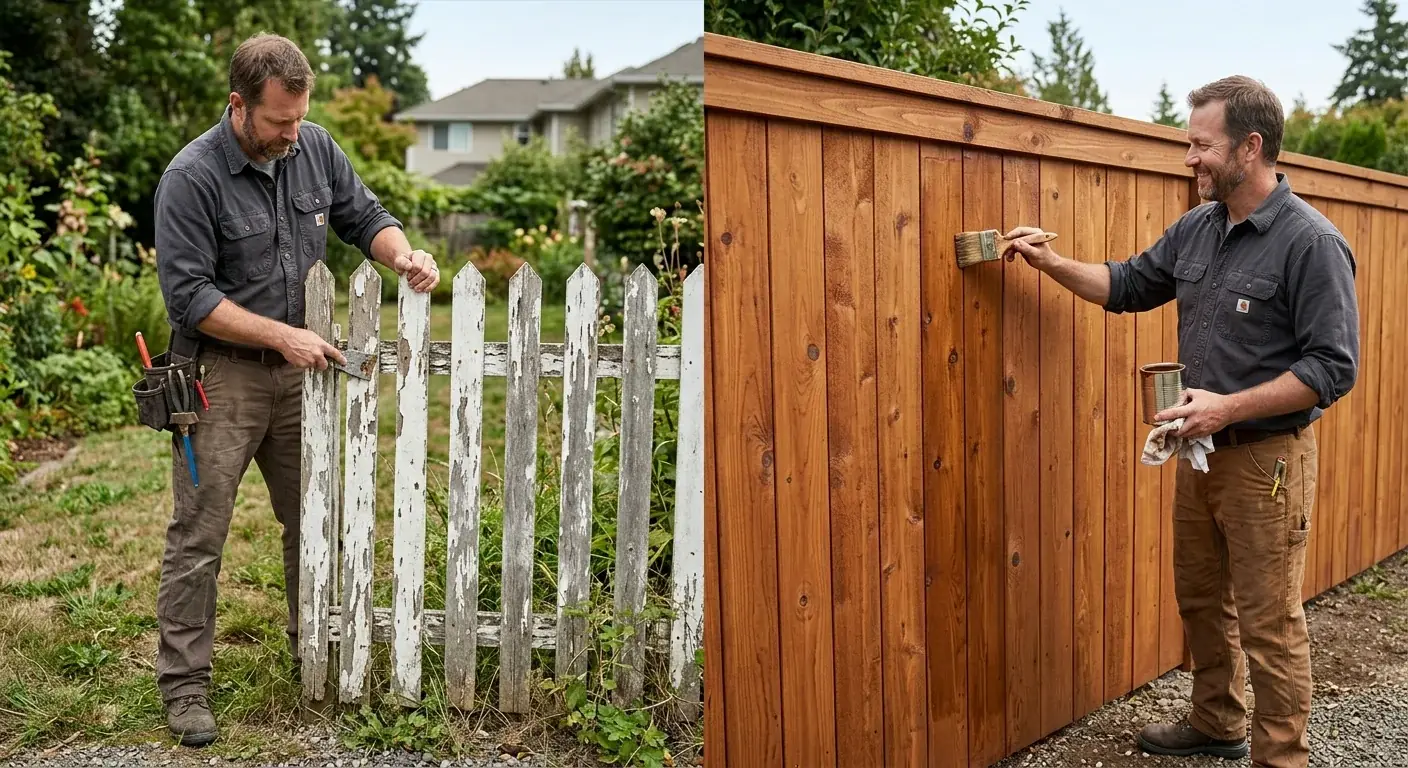
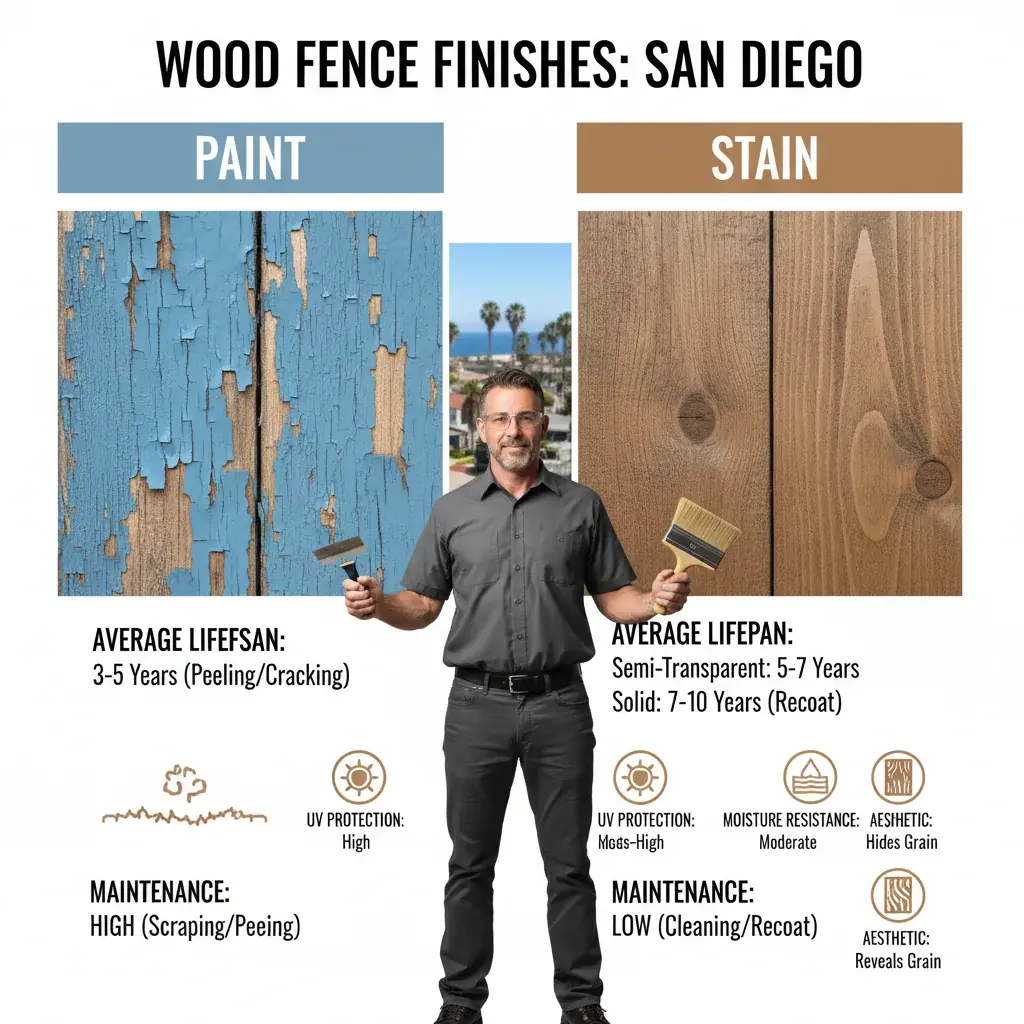
For most San Diego wood fences, staining beats painting. Stain penetrates the wood fibers rather than coating the surface, so it won’t crack, peel, or trap moisture the way a paint film does in our coastal salt air and intense inland UV. It also costs less to maintain over time, since reapplication is a clean-and-coat job with no scraping. That said, paint isn’t always the wrong answer, and this guide walks through when each option makes sense for your wood fence and your specific San Diego microclimate.
How paint and stain protect wood differently
The fundamental difference between paint and stain lies in how they interact with the wood. Paint creates a solid film on the surface, completely covering the wood grain. This film acts as a barrier, blocking UV rays and moisture from reaching the wood underneath. Think of it like a protective shell. While this shell provides strong initial defense, it’s also susceptible to cracking, peeling, and blistering over time, especially with temperature fluctuations and moisture exposure. Once compromised, that protective layer can actually trap moisture, leading to rot and decay if not addressed quickly.
Stain, on the other hand, is designed to penetrate the wood fibers. Rather than sitting on top, it soaks in, becoming part of the wood itself. This means it doesn’t form a thick surface film that can peel or chip. Stain still offers excellent protection against UV radiation and moisture, but it allows the wood to breathe more naturally. Most stains contain pigments that color the wood while letting its natural grain and texture show through, which many San Diego homeowners prefer for their natural aesthetic. Clear sealers offer pure protection without changing the wood’s color, while semi-transparent and solid stains provide varying degrees of color while still allowing some grain visibility.
The way these products interact with wood also impacts their long-term performance. Paint’s thick film means that when it eventually fails, it often flakes or peels away dramatically. This requires extensive preparation, like scraping and sanding, before reapplication. Stain, because it penetrates, tends to fade gradually over time. When it needs refreshing, you can often clean the fence and apply a new coat, with much less intensive preparation. This difference in failure mode is a key factor in maintenance and appearance, particularly for fences exposed to the harsh San Diego sun and occasional coastal moisture.
Longevity in coastal salt air vs. inland sun
San Diego County boasts incredibly diverse microclimates, and your fence’s location significantly impacts how paint or stain will perform. The coastal areas, from La Jolla to Oceanside, experience consistent marine layers, fog, and the pervasive effects of salt air. Inland communities like Poway, Escondido, and El Cajon face intense, dry heat, higher UV exposure, and wider temperature swings. Each of these environments presents unique challenges for wood finishes.
In coastal areas, paint struggles with the constant humidity and salt. The moisture can get trapped underneath the paint film, especially on the shaded side of a fence, leading to blistering and peeling. Salt air also accelerates the breakdown of paint’s surface, causing it to dull and chalk prematurely. Stain, by penetrating the wood, is far less prone to these issues. It allows the wood to breathe, reducing the risk of trapped moisture that leads to peeling. While salt air will still affect stain over time, it tends to fade evenly rather than cracking and flaking. This means a stained fence maintains a more consistent appearance and requires less invasive maintenance in salty, humid conditions. Coastal homes do need refreshing more often, which is why we lay out how often to stain a fence in San Diego by microclimate.
For inland properties, the primary enemy is the sun’s relentless UV radiation and extreme heat. Intense UV rays quickly degrade the pigments and binders in both paint and stain. However, paint’s surface film can become brittle and crack under the constant expansion and contraction of wood in direct heat, leading to premature failure. Stains, particularly those with strong UV inhibitors, penetrate deeply, offering more resilient protection against sun damage. They might fade more quickly in direct, harsh sunlight compared to a coastal area, but they won’t typically crack or peel off. When it’s time for reapplication, a stained fence in an inland area just needs a good cleaning before a fresh coat, avoiding the tedious scraping associated with failing paint. Our experience throughout San Diego County shows that staining generally provides superior long-term performance and easier upkeep across all our diverse climates.
The cost difference for professional application
When comparing the cost of painting versus staining a fence, it’s essential to look beyond the initial material price and consider the entire lifecycle, especially for professional application. Initially, the material cost for high-quality exterior paint and a premium wood stain can be comparable. However, the labor involved in applying each product, both initially and for future maintenance, is where the significant cost differences emerge.
Professional painters typically charge more for fence painting than for staining, primarily due to the extensive preparation required. Painting a fence, especially if it’s an older fence or has existing paint, demands meticulous scraping, sanding, and often priming to ensure the paint adheres properly and lasts. This labor-intensive prep work can easily add 25-50% to the initial project cost. Applying multiple coats of paint also adds to the time and material expenses. While the finished look can be striking, the upfront investment is often higher.
Staining, on the other hand, usually involves less intensive preparation. For a new fence, it often just requires a thorough cleaning and drying. For an existing stained fence, the process is similar: clean, allow to dry, and then apply a fresh coat. There’s typically no need for scraping or heavy sanding, as stain doesn’t peel. This reduced prep work means professional fence staining is generally more cost-effective in terms of labor. While a second coat of stain might be recommended for optimal protection and color depth, the overall application process is quicker and less complex than painting. Over the lifespan of your fence, this translates to significant savings. The simpler maintenance cycle for stain means you’re investing less time and money into keeping your fence looking great and well-protected. When you hire an experienced crew, you ensure the job is done correctly from the start, avoiding costly mistakes. You can check any contractor’s license with the CSLB.
Why we almost always recommend staining for fences
At Fence Pros San Diego, our extensive experience with countless fences across San Diego County has led us to a clear preference: we almost always recommend staining over painting for wood fences. This isn’t just a preference; it’s a recommendation rooted in practicality, long-term performance, and the unique challenges of our local climate.
First and foremost, the San Diego climate is tough on exterior finishes. Our combination of intense UV radiation, varied humidity levels from coastal fogs to inland dry heat, and occasional Santa Ana winds creates conditions where paint often fails prematurely. Paint’s tendency to peel, crack, and blister under these stresses leads to frequent, expensive, and labor-intensive maintenance. Stain’s ability to penetrate the wood, rather than just coat it, provides a much more resilient barrier that flexes with the wood and withstands environmental stressors without dramatic failure. You get consistent protection without the eyesore of peeling paint.
Beyond durability, many homeowners prefer the natural aesthetic that stain offers. Staining enhances the natural beauty of the wood grain, giving your fence a rich, classic look that complements San Diego’s architectural styles and natural landscapes. With paint, you lose that connection to the natural material. If you’ve already decided you want a solid painted finish, say, to match painted trim or a stucco accent wall, that’s really a job for a house-painting crew like Paint Pros San Diego rather than a fence builder. Stain colors can range from clear and natural tones to rich solid colors that still hint at the wood beneath, allowing for versatile design choices. If you’re looking for inspiration, explore some of the best fence stain colors for San Diego to see how different hues can transform your yard.
Finally, the maintenance cycle for a stained fence is simply superior. When a stained fence needs refreshing, it typically requires only a thorough cleaning and a new coat of stain. There’s no scraping, sanding, or primer needed, which drastically reduces the time, effort, and cost of upkeep. This makes it a more sustainable and budget-friendly option over the lifespan of your fence. We specialize in comprehensive fence staining services that ensure your fence receives the best possible protection and looks fantastic for years to come.
Frequently asked questions
Is staining or painting a fence cheaper in San Diego?
Staining is typically cheaper over the life of the fence. Professional staining costs less upfront than painting because prep is lighter, and when it’s time to refresh the finish, staining skips the scraping and sanding required for peeling paint. That simpler maintenance cycle adds up to real savings over a fence’s 15- to 20-year lifespan.
How long does fence stain last in San Diego’s climate?
A quality semi-transparent or solid stain lasts two to four years in most San Diego locations, with coastal properties near the ocean needing refreshing closer to every two years due to salt air and humidity. Inland communities like Poway or Escondido may get three to four years between coats because the lower humidity slows moisture-driven breakdown, even though the UV load is higher.
Does a painted fence last longer than a stained fence?
Not in practice, no. Paint’s surface film provides strong initial protection, but once it starts to crack or blister, it often fails faster than stain because moisture gets trapped underneath. A well-maintained stained fence that’s refreshed on schedule will typically outlast a painted fence that has been allowed to peel, because stain’s gradual fading is far easier to address before damage sets in.
Do I need a permit to paint or stain an existing fence in San Diego?
No permit is required to paint or stain an existing fence in San Diego County. Permits only come into play when you’re installing a new fence or replacing a structure. If you’re also doing repair work at the same time, check with your local jurisdiction, but a cosmetic refinishing project on its own doesn’t trigger the permit process. For repairs alongside staining, our fence repair and fence staining crews can advise on what applies to your situation.
Can I paint over a stained fence, or stain over a painted fence?
You can paint over a stained fence, but the surface needs to be clean and fully dry, and you may need a bonding primer if the stain is oil-based. Going the other direction is harder: stain won’t penetrate wood that still has an intact paint film on it. To stain a previously painted fence, you’d need to strip or sand the paint off first, which is a significant job. If your fence is currently painted, it’s usually easier to keep painting it than to switch to stain.
What’s the best stain color for a San Diego fence?
Warm brown tones like cedar, redwood, and medium oak are the most popular in San Diego because they complement our stucco homes and drought-tolerant landscaping. Grays and driftwood tones are also common in coastal neighborhoods. Solid stains give you the most color control while still allowing some wood texture to show through, while semi-transparent stains highlight the grain more but offer fewer color options. The right choice depends on your home’s exterior and the look you want.
When to call us
Deciding on the right finish for your fence is a big choice, and ensuring its proper application is even more critical for long-term protection. If you’re ready to protect your fence with a professional stain or need expert advice tailored to your specific San Diego property, it’s time to call the pros. Our team understands the nuances of our local climate and has the expertise to deliver a durable, beautiful finish.
Call us at (858) 925-5546 for a same-day estimate.