Paint doesn’t peel off a wood fence for no reason. It peels because moisture, sunlight, or the surface it was applied to pushed back against a coating that can’t flex with the wood underneath.
That’s the part most homeowners miss when they see curling strips on a west-facing run or a fence line that backs up to a slope. The paint is a symptom. Fixing it well means figuring out what’s happening in the wood first, then deciding whether the answer is a repaint, a switch to stain, or a section of repair before either one goes on.
Why fence paint peels, bubbles, or separates
Paint is a film. It sits on top of the wood and forms a continuous skin that has no give. Wood, on the other hand, expands and contracts as it absorbs and releases moisture through the seasons. When the wood moves and the paint can’t move with it, the bond breaks and you get bubbling, cracking, or full sheets of paint lifting away.
Three things drive that movement in San Diego yards. The first is moisture coming from behind the board, not the front. A fence line next to irrigated landscaping, a sprinkler that overspray hits daily, or a slope that holds runoff after a rare heavy rain keeps the back face of the boards damp long after the front looks dry. The second is direct UV exposure on west-facing and south-facing runs, where afternoon sun bakes the paint film until it goes brittle and starts to crack at the grain lines. The third is application over wood that wasn’t ready for it: unseasoned lumber that was still shedding moisture when it was painted, or an old coat that was painted over instead of stripped, both of which trap moisture under the new film and guarantee it fails early.
Any one of these can cause peeling on its own. Most failing fences show two or three at once, which is why a quick recoat over the same problem tends to fail again within a season or two.
How to tell whether the wood beneath is sound
Before deciding how to fix the finish, it helps to know what’s underneath it. Press a screwdriver or your thumbnail into a board where the paint has lifted. Wood that’s still firm and holds its shape is a finish problem. Wood that’s soft, spongy, or crumbles under light pressure is a moisture problem that’s moved past the surface.
Check the bottom of each picket separately from the rest of the board. That zone sits closest to soil, sprinkler spray, and standing water after rain, and it’s almost always the first place rot sets in even when the top of the same board looks fine. Gray, powdery wood under a paint chip usually means UV breakdown of exposed grain. Dark staining that smells musty points to ongoing moisture intrusion, which is a different and more serious problem than a finish that simply wore out.
A fence with scattered peeling but sound wood underneath is a refinishing job. A fence with soft, discolored, or crumbling boards in more than a few spots is heading toward a repair conversation before anyone talks about paint color.
What preparation a fence pro may recommend before refinishing
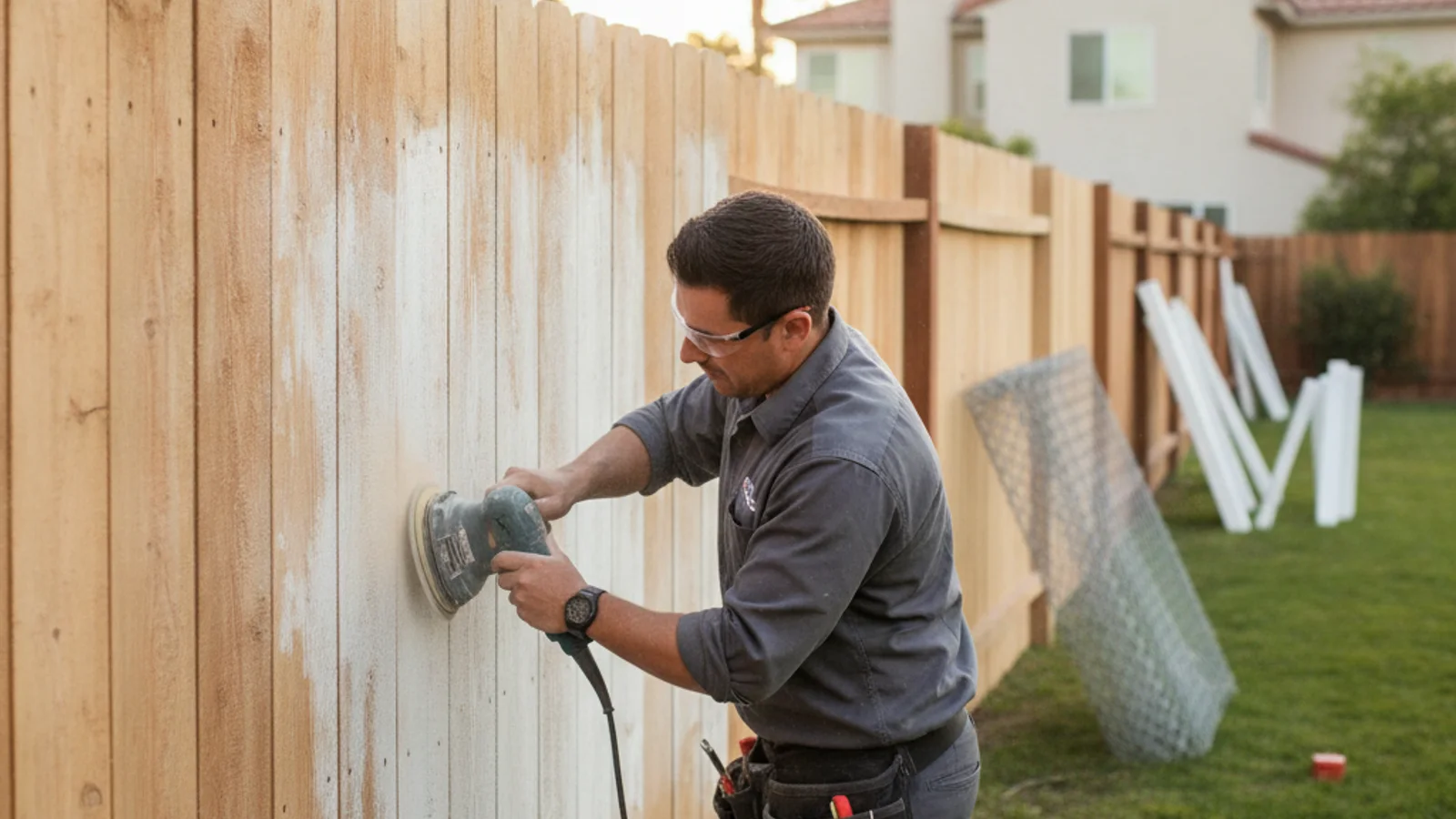
Refinishing over failed paint without prep is the single most common reason a new coat fails again within a year. A fence pro assessing the job will typically want to remove the loose and failing paint entirely, not just the flaking edges, because any old film left in place becomes a weak point the new coat has to bridge.
That usually means scraping and sanding down to bare or tightly-adhered wood, letting the boards dry out fully if moisture was part of the problem, and addressing the moisture source itself, whether that’s a sprinkler head aimed at the fence line or grade that slopes water toward the posts instead of away from them. Skipping that last step is why some fences peel again in the exact same spots within a year or two of a repaint.
When stain, paint, or board replacement fits the condition
Once the wood is confirmed sound, the choice is usually between paint and a penetrating stain, and it’s worth understanding why so many fence pros steer clients away from paint on a second attempt. Paint forms a surface film that has to be scraped and reapplied whenever it fails, and on a fence exposed to sun and yard sprinklers on both faces, that failure cycle tends to repeat. A penetrating stain soaks into the wood fiber instead of sitting on top of it, so it wears rather than peels, which means the next maintenance pass is a light reapplication instead of a full strip-down. Fence Pros San Diego has covered painting versus staining a wood fence in more depth if you’re deciding between the two from scratch.
Board replacement enters the picture when the diagnosis in the earlier section turns up soft or rotted wood, not just failed finish. Patching a paint problem onto a structurally compromised board doesn’t fix anything. It’s also worth knowing that new replacement boards, even in a matched species, won’t take stain or paint identically to the weathered boards next to them right away, so a pro may recommend refinishing the full run rather than just the swapped sections for a consistent look.
Questions to ask before approving a refinishing quote
A refinishing quote should tell you more than a price per linear foot. Ask what the prep scope actually includes: full strip to bare wood, spot-scraping only, or something in between, since those produce very different results at very different labor totals. Ask whether the quote separates any board replacement from the refinishing work, since mixing the two into one number makes it hard to know what you’re actually paying for.
It’s also worth asking what’s driving the moisture, if that’s part of the diagnosis, and whether that source gets addressed before the new finish goes on. A fresh coat over an unresolved sprinkler or grading issue is money spent on a problem that will resurface. Fence Pros San Diego is a referral service. Verify the named contractor on the CSLB license check. A pro who walks the full run before quoting, rather than pricing from a photo, is giving you a more complete scope, not a guaranteed number.
Frequently asked questions
Can I just paint over the peeling spots instead of stripping the whole fence?
Spot-painting over peeling paint usually fails faster than a full strip and recoat, because the old film at the edges of the patch is often already loosening and takes the new paint with it when it goes.
Is peeling paint a sign my fence needs to be replaced?
Not usually. Peeling is most often a finish problem, not a structural one. Replacement only makes sense where the wood itself has gone soft or rotted, which a physical check can confirm.
Does the color or brand of paint matter as much as application?
Application and prep matter more than brand in most peeling cases. A premium paint applied over damp or unprepped wood will fail on roughly the same timeline as a budget one applied the same way.
When to call us
A fence with widespread peeling, soft wood in more than a few spots, or a moisture source you can’t identify is worth a licensed pro’s assessment before you spend money on a finish that might fail again. Call us at (858) 400-4906 and we’ll connect you with a licensed fence contractor.