A pool fence for a rental property needs more than a quick appearance check. Owners should review every access point, document current conditions, and confirm requirements for the exact address. That record helps separate routine repairs from a larger replacement decision.
How tenant access and shared yard use shape the barrier review
Start by mapping how people actually move through the property. A pool may sit behind a clear perimeter fence, yet daily traffic can create overlooked access points. Walk the routes from parking areas, side yards, patios, laundry rooms, and shared outdoor spaces.
This review matters even more at duplexes and small apartment properties. One tenant may reach the yard through a private patio. Another may enter through a common gate. Landscapers, cleaners, guests, and maintenance workers may use different routes.
Write down who controls each gate and door. Note whether tenants receive keys, codes, remotes, or other access devices. Record any route that avoids the main walkway. Don’t assume a gate is rarely used because it looks secondary.
The layout should also be reviewed after a tenancy changes. Outdoor furniture, storage bins, planters, and play equipment can alter how someone approaches the barrier. A contractor can evaluate the fence itself, but the owner or property manager knows how the yard is used.
Properties in Chula Vista, City Heights, El Cajon, Encinitas, and Escondido may have very different lot layouts. The city name alone doesn’t answer the access question. A useful plan follows the actual paths at that address.
For an existing barrier, begin with a full pool fence and safety barrier review. Don’t ask a pro to inspect only the gate shown in a tenant’s photo. Ask for the full enclosure, adjoining structures, and every practical route into the pool area.
What to document around gates, doors, patios, and equipment
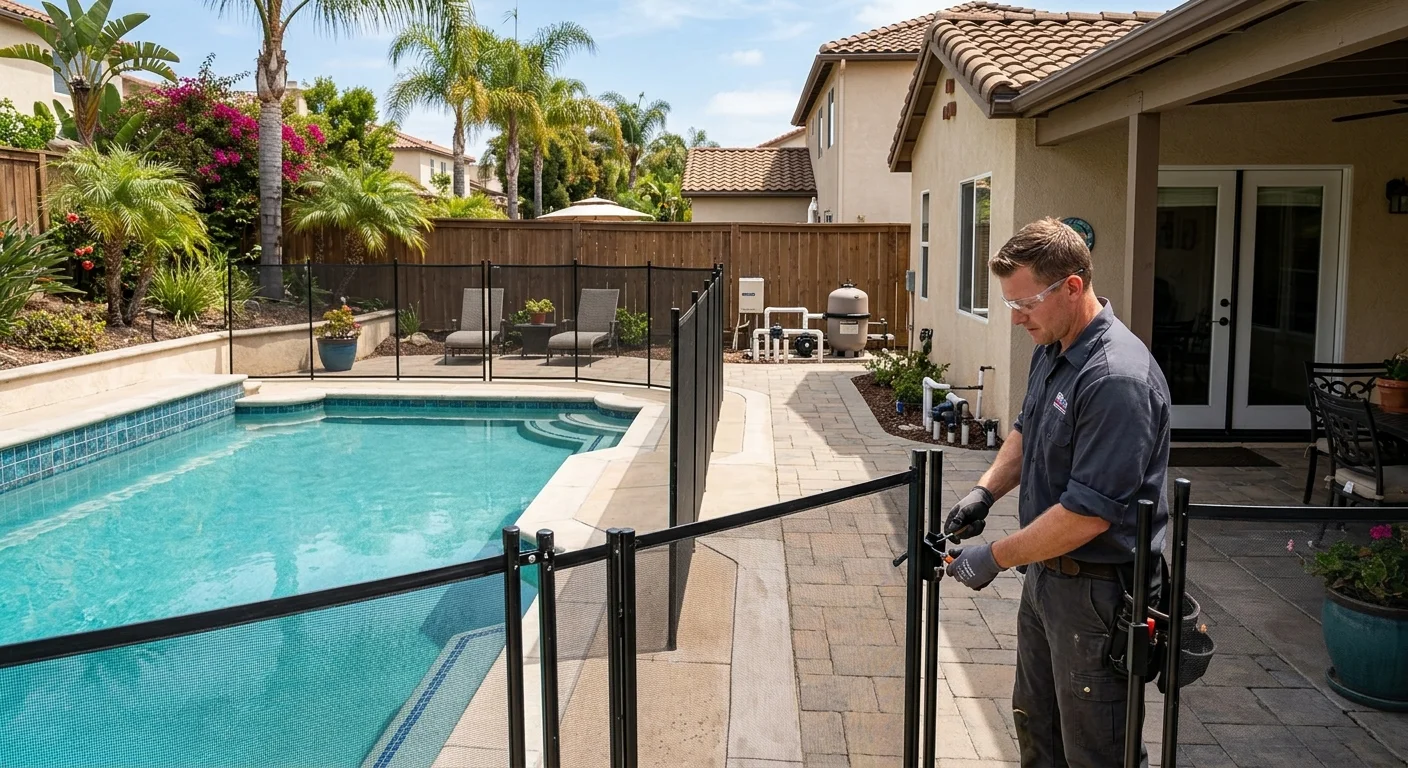
Good documentation gives the owner and contractor the same starting point. Take wide photos from both sides of the barrier. Then capture close views of gates, hinges, latches, posts, panel connections, and ground conditions.
Label each access point in a simple sketch. “Gate A” and “patio door B” are easier to discuss than “the one near the chairs.” Include the pool, building walls, fence lines, equipment area, storage areas, and tenant paths.
For each gate, record how it moves during normal use. Note whether it drags, binds, swings unevenly, or needs a push to reach its closed position. If the pool gate won’t self-close, record when the problem began and whether it changes after ordinary use. Don’t adjust hardware before the site review if doing so could hide the condition.
Doors and patios deserve the same attention. Show where each door opens and where its path meets the pool area. Include screen doors, sliding doors, side-yard doors, and openings from detached living spaces. A fence pro needs the complete layout, even when a door isn’t part of the fence.
Document nearby equipment without declaring it acceptable or unsafe. Include pumps, utility cabinets, air-conditioning equipment, hose storage, steps, walls, and fixed objects near the barrier. Their location may affect a proposed layout or access for future maintenance.
Keep dated copies of photos, contractor proposals, invoices, product information, and communications about reported damage. This isn’t proof of code compliance. It’s a practical property record showing what was observed, what was proposed, and what work was authorized.
Which current requirements the property owner needs to confirm
Do not declare a rental pool barrier compliant from photographs or appearance. California Health and Safety Code section 115923 is the sourced enclosure list (gate away from the pool, self-close, self-latch, latch no lower than 60 inches, 60-inch height, 2-inch bottom clearance, 4-inch sphere, climbable-face rule for a child below age five). Section 115922’s two-of-seven feature rule applies when a building permit is issued for a new or remodeled private single-family pool or spa. A rental duplex or apartment may sit under a different occupancy path. Ask the building official which statute and which local amendments apply to this address. This page does not publish landlord-tenant notice clocks.
First, identify the authority serving the address. A property inside the City of San Diego may have a different point of contact than one in National City, La Mesa, Carlsbad, or an unincorporated part of San Diego County. Contact the permitting or building authority for that location. For a City of San Diego address, start with Development Services. City Table 142-03A and County PDS 070 remain fence-construction notes, not a rental-pool form.
Ask the authority direct, written questions. Describe whether the project involves repair, partial replacement, a relocated gate, or an entirely new barrier. Provide the property address and explain whether building doors, walls, or shared areas form part of the enclosure.
Our California pool fence code guide can help organize your questions. It doesn’t replace current direction from the authority reviewing that address. Keep the written response with the property file when possible.
A fence contractor can assess construction conditions and propose a scope. The contractor shouldn’t be expected to interpret a lease or decide tenant-notice obligations. Direct those questions to the property manager or an attorney familiar with the property.
Before hiring, verify the contractor through the California Contractors State License Board license check. California’s C-13 fencing classification covers constructing, altering, and repairing fences, gates, railings, barriers, and related structures. It excludes masonry walls, so a project involving a wall may need a separate scope and qualified trade.
When repair and replacement deserve separate proposals
A single gate, loose fitting, or isolated damaged section may suggest repair. Widespread movement, an unsuitable layout, or several connected problems may point toward replacement. The right choice depends on the observed condition and the requirements confirmed for that property.
Ask for separate written proposals when both paths appear possible. A repair proposal should identify the exact components being repaired. It should also state which existing components remain. A replacement proposal should define the new fence line, gates, posts, hardware, removals, and any areas excluded from the work.
Separate scopes make hidden assumptions easier to spot. One contractor may propose correcting a gate problem while retaining the enclosure. Another may find that the gate, adjacent panel, and supporting post need to be treated together. The proposals aren’t comparable until their boundaries match.
Our guide to a pool fence inspection before a home purchase offers a useful inspection mindset for rentals too. Treat every visible concern as something to document and verify, not as a conclusion based on appearance.
For localized damage, a fence repair contractor can inspect posts, panels, gates, and connections. Ask whether the repair changes dimensions, access, or the existing barrier layout. Those changes may need another conversation with the authority serving the address.
Don’t approve a repair merely because its proposal has fewer line items. Don’t approve replacement merely because it sounds more complete. Compare what each scope addresses, what it leaves in place, and which unresolved questions still require official confirmation.
What a pool fence pro needs for the site review
Send the contractor a concise property packet before the visit. Include the address, clear photos, a basic site sketch, and a list of reported problems. State whether the property is occupied and which spaces are private or shared.
Explain how the contractor may enter the yard. Don’t assume a tenant can provide access. The owner or property manager should arrange entry under the process that applies to the tenancy. The contractor needs practical access instructions, not responsibility for deciding whether notice was adequate.
Share these details:
- Every gate, door, patio, and path reaching the pool area
- Known dragging, binding, latching, alignment, or post movement
- Recent yard, deck, patio, door, or equipment changes
- Areas that tenants use for storage, play, parking, or maintenance
- Written guidance already received from the responsible authority
- Whether you want repair and replacement priced as separate scopes
Tell the pro about planned changes too. A future patio project, equipment relocation, or altered walkway may affect the proposed fence line. It’s better to show those plans during the review than after a proposal is prepared.
Ask the contractor to identify assumptions in writing. The proposal should make clear which fence segments, gates, and hardware are included. It should also distinguish observed damage from questions awaiting official confirmation.
Don’t remove warning signs of a problem before the review. Temporary photos and notes can preserve context if an immediate property-management decision changes the area. Avoid representing any temporary measure as a confirmed permanent solution.
The goal is a proposal tied to the actual rental property. Clear records help the contractor see the whole access pattern and help the owner compare scopes without guessing.
When to call us
Call when a rental pool barrier has a failing gate, damaged section, unclear access route, or possible replacement need. A licensed fence pro can inspect the site and prepare a property-specific scope while you confirm current requirements with the responsible authority. Call us at (858) 400-4906 and we’ll connect you with a licensed fence contractor.