You typed PVC fence because that is the word on the bag at the yard. The quote that comes back may say vinyl, composite, or WPC, and those are separate products with separate posts, rails, gates, and finish rules. Before you sign, make the names on the paper match the boards in your hand.
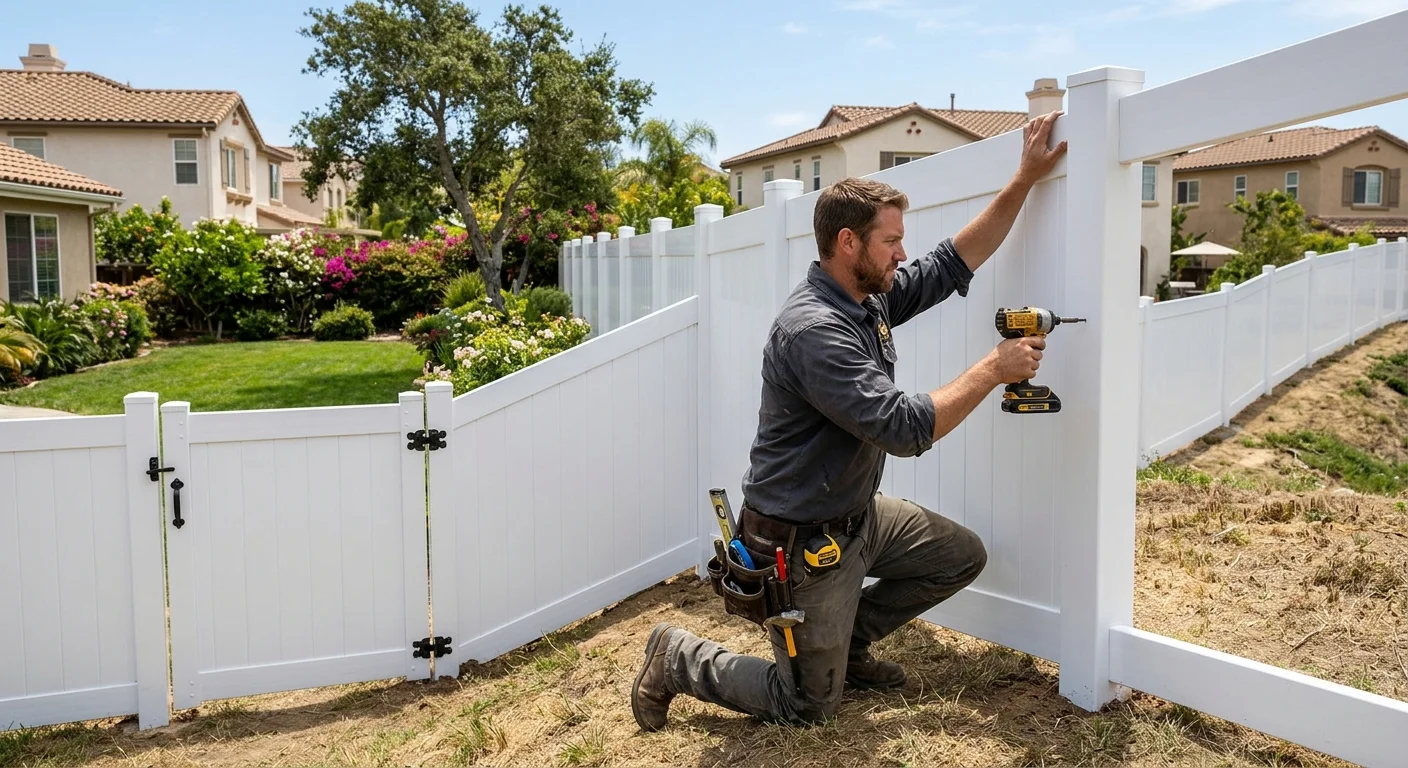
What homeowners mean when they search PVC fence
Most San Diego County searches for a PVC fence are looking for a plastic privacy line, a picket front, or a ranch rail. The intent is a finished fence on a real lot: a Mira Mesa side yard, a Chula Vista rear line, a Ramona horse paddock, or a coastal walkway in Encinitas. People use PVC because that is the hardware-store name. Independent fence contractors often write vinyl on the same job. Catalogs mix both words on one product card. Your job is to pin down the actual system, not to win a chemistry argument.
A pvc vinyl fence listing can be a hollow privacy panel, a tongue-and-groove board, a ranch rail with two or three boards, or a kit with its own posts and caps. A pvc privacy fence is a style choice on top of that. Privacy, semi-privacy, shadowbox, picket, and ranch rail are different assemblies. They share a plastic look and they do not share the same posts, rail count, or gate kit. Ask the matched contractor to name the style in the first line of the proposal.
San Diego County is several climates on one map. Salt air along the coast, inland heat in El Cajon and Escondido, and canyon winds in East County all hit a plastic fence. How a given brand handles sun, salt, and impact is a manufacturer claim. Get that claim in writing from the maker, with the exact product code on your quote. A figure you heard from a neighbor in Clairemont does not travel to Alpine.
Height and location still control the job. Inside the City of San Diego, Municipal Code Chapter 14, Article 2, Division 3, Table 142-03A treats fences below 7 feet as needing no building permit under that division, and 7 feet or greater as Building Permit, Process One. Zoning and design rules still apply. A solid fence on the front or street-side line is generally 3 feet, with setback-based provisions. Required side and rear yards allow up to 9 feet when the portion above 6 feet is open. In unincorporated county areas, County PDS070 (revised 2023-01-01) lists a permit exemption for fences and walls no higher than 6 feet if the work is zoning compliant, with a zoning summary of 42 inches at the front and exterior side and 72 inches at the rear and interior side. Confirm the current rule with the city or County PDS for your parcel. Material name does not change those limits.
If the run sits on a shared line, California Civil Code §841 presumes adjoining landowners share equal benefit and, unless a written agreement says otherwise, equal responsibility for reasonable construction, maintenance, or necessary replacement costs. Thirty days’ written notice with the problem, the proposed work, estimated costs, a sharing plan, and a timeline comes first. A PVC label on the panel does not skip that notice.
How PVC naming differs from vinyl, composite, and WPC in a proposal
Treat each name as its own line item. PVC, vinyl, composite, and WPC show up in the same Google results and they are sold as different systems. A proposal that says “plastic fence” is unfinished. A proposal that lists a brand, a series, a color code, a panel style, and a post size is a document you can compare.
Vinyl, in local contractor language, usually means a formed privacy, picket, or rail system sold as vinyl fence. That is the common match for a residential PVC search in San Diego. Walk a vinyl privacy fence sample next to any board labeled PVC. Same color family is not the same extrusion, the same wall thickness, or the same gate hardware.
Composite is a separate category. Many composite products mix plastic with wood fiber or another filler. They weather, fasten, and cut differently from a hollow vinyl panel. WPC is its own comparison again. If a quote slides from PVC to WPC in the fine print, stop and split the paper. Read WPC versus vinyl as a different decision, with its own posts and finish.
Wood is a third path. A cedar or redwood run on an East County slope is a different maintenance plan, a different post detail, and a different look from any plastic system. Price talk belongs on a written bid, not on a guess. This site has no verified average cost for a PVC fence, a vinyl fence, or a 200-foot run. Fence Pros San Diego is a referral service. It sets no prices. If you searched a materials yard instead of an installer, see fence supply versus contractor. Use wood versus vinyl for the material choice, then get numbers from the contractor you are matched with.
Watch these naming traps on San Diego quotes:
- One line that says PVC and a second line that ships vinyl panels from a different maker.
- A ranch-rail picture with privacy-panel quantities.
- “White” with no manufacturer color code, so a replacement board in five years comes from a different batch.
- A coastal Encinitas lot quoted with the same hardware list as an inland Santee lot.
- A pool-adjacent run described as privacy PVC with no enclosure spec. California Health and Safety Code §115923 sets enclosure rules for covered private pools and spas (minimum 60-inch height, maximum 2-inch ground clearance, no 4-inch-or-larger sphere passage, gates that swing away from the pool, self-closing and self-latching hardware with the latching device at least 60 inches, and an exterior that lacks child climb features). A privacy panel is a privacy panel until the manufacturer and the building department say it meets that enclosure. Confirm it in writing.
If two contractors use two names for boards that look alike in the driveway, ask each one to write the manufacturer, the SKU, and the style. Side-by-side paper beats a sidewalk debate.
Which posts, rails, gates, and finish details belong in writing
A PVC fence is a kit of parts. The panel is the part people photograph. The post, the rail, the cap, the gate, and the footing are the parts that fail first on a San Diego grade.
Put these items on the proposal, each with a size and a count:
- Post size and wall thickness, line posts versus end and gate posts.
- Post length for the finished height plus the bury depth the installer plans to use on your soil.
- Steel inserts or stiffeners, if the system uses them, and which posts get them.
- Rail count, rail size, and whether rails lock into routed posts or use brackets.
- Panel style: tongue-and-groove privacy, picket, shadowbox, ranch rail.
- Panel width and how cuts get capped or channeled.
- Color code and finish (smooth, woodgrain, or other), matched to a physical sample in daylight.
- Caps, trim, and lattice or picket toppers as separate lines.
- Gate width, swing direction, hinges, latch, drop rod, and whether the gate is rackable on a slope.
- Footing method and concrete, in the contractor’s words, for each post type.
- Hardware finish, especially on coastal lots from Imperial Beach through Oceanside, where salt air eats cheap metal.
Vinyl fence installation is its own sequence: layout, post centers, footings, racking or stepping on a slope, then panels and gates. A kit that “snaps together” still needs square posts and a gate that does not sag. San Diego lots are rarely flat. Canyons in La Mesa, pad grades in Carmel Valley, and downhill rear yards in El Cajon all force a choice between rackable panels and stepped panels. Write that choice down.
Gates deserve their own paragraph. A matching vinyl gate is a different assembly from a panel. Hinges, latch height, and a drop rod on a double gate are where callbacks start. If the gate sits near a pool, the latch and swing rules above apply. If it sits on a shared line, Civil Code §841 notice still applies before you spend.
Finish is more than color. Ask the manufacturer, in writing, what cleaning it allows, what attachments it forbids (screws through a rail, a hose bib through a post), and how a replacement board is ordered. Do not rely on a lifespan number you saw in an ad. This site has no verified government standard for how long PVC, vinyl, wood, or composite lasts. Warranty language is the manufacturer’s. Get the current sheet with your product code on it.
A C-13 fencing contractor license, per the California Contractors State License Board, covers constructing, erecting, altering, or repairing fences, gates, posts, and related work, and it excludes masonry walls. Check the person on the CSLB license lookup before you sign. California Business and Professions Code §7048 sets a $1,000 aggregate threshold (labor, materials, and all other items) for the licensing exemption on casual, minor work that does not need a building permit. Splitting contracts to duck that number does not count. Advertising as a contractor also takes the exemption off the table.
When a vinyl privacy run and a different plastic product deserve separate quotes
One backyard can hold two systems. A solid vinyl privacy fence along the neighbor in City Heights and a low picket at the street are two assemblies. A ranch rail along a Valley Center drive and a privacy screen at the house are two assemblies. Mixing them on a single lump-sum line hides the expensive parts.
Ask for separate quotes, or at least separate sections, when any of these show up:
- Privacy panels on one elevation and picket, ranch, or composite on another.
- A vinyl run with a WPC or composite gate, or the reverse.
- A wood gate in a plastic opening.
- A pool enclosure segment next to a standard privacy segment.
- A street-facing height that must stay at the City’s front-yard solid-fence limit while the rear goes taller.
- An HOA-reviewed street face and a utility side the association never sees. Confirm the association’s current rule with the association. This page does not publish HOA standards.
Separate paper makes the post and gate counts honest. Privacy posts, picket posts, and gate posts are different lengths and different reinforcements. A contractor who is quoting vinyl fence work can still price a second product. They need a second takeoff to do it.
This is also where cost questions go off the rails. “Is PVC cheaper than wood” and “what does 200 feet cost” have no verified average on this site. Length times a rate plus gates is arithmetic you can run on your own numbers. Market rates change by neighborhood, access, slope, and demolition. The matched contractor writes the figure that belongs on your lot. A kit price from a national catalog omits digging in decomposing granite, hauling old redwood out of a Clairemont easement, and setting posts on a grade.
If the two products meet at a corner, write the transition: whose post, whose cap, whose color. Corners are where mixed systems look cheap even when each run is fine on its own.
What to confirm with the manufacturer and the matched contractor
Hold two documents before you buy. One is the manufacturer’s spec and warranty sheet for the exact SKU. The other is the contractor’s proposal with quantities, heights, gate hardware, footings, and permit responsibility.
From the manufacturer, in writing:
- Product name, series, and SKU for panels, posts, rails, caps, and gates.
- Color code, and how a future replacement board is ordered.
- What the warranty covers and who honors it if the maker changes hands. Do not copy a year-count from memory. Use the current sheet.
- Cleaning and attachment rules.
- Any coastal, sun, or impact language they will put on letterhead for your product. If they will not write it, leave it off your expectations.
- Whether a given panel is sold as a pool enclosure, with the model named.
From the matched contractor, in writing:
- The same SKUs, with quantities.
- Finished heights by elevation, tied to City or County rules for your address.
- Who pulls the permit, if one is required.
- Post centers, footing notes, and slope method (rack or step).
- Gate schedule: width, swing, hinges, latch, drop rod.
- Demo, haul-away, and repair of irrigation or hardscape if the trench hits it.
- That they hold a current C-13 (or other applicable) license. Verify it on the CSLB site yourself.
Downsides of a PVC-named fence show up in this paperwork, not in a slogan. Vague names. Mixed products on one line. Gates quoted as panels. Hardware that is wrong for salt air. A privacy run sold as a pool barrier. A front-yard solid height that the City will not accept. A shared-fence cost split started without the §841 notice. Those are the problems you can prevent on the table in your kitchen.
Walk the property with the contractor: the pad, the slope, the dog run, the side-yard gate to the cans. North County infill lots in Vista and San Marcos squeeze those clearances. South Bay lots in National City and Chula Vista often stack a short street face against a tall rear. Name each face on the page.
Fence Pros San Diego matches you with licensed, independent local fence professionals. You contract with the pro directly. The brand does not install, does not own the trucks, and does not set the price.
When to call us
Call when you have a PVC search, a vinyl sample, or a mixed quote and you want a licensed fence contractor to put one system on paper for your San Diego County lot. Call us at (858) 400-4906 and we’ll connect you with a licensed fence contractor.