Vinyl fence installation in San Diego runs roughly $35 to $55 per linear foot installed. A standard 150-foot backyard fence with one gate lands around $6,000 to $8,000. Vinyl holds up well near the coast, needs almost no maintenance, and passes most HOA reviews in white. Here’s the full breakdown on cost, climate, and approval.
You’re replacing a weathered wood fence and vinyl keeps coming up in conversations with neighbors, contractors, and the internet. It looks clean, everyone says it’s low-maintenance, and a handful of your friends have it. But you’re not sure what it actually costs to install in San Diego, whether it holds up near the coast, or if your HOA will approve it. Here’s a straight answer to all three.
Why vinyl works well in San Diego’s UV and salt environment
San Diego throws two things at fences that wood struggles with: intense UV exposure and, for anything within a few miles of the water, airborne salt. Vinyl handles both better than most materials.
The key is titanium dioxide. Quality vinyl fence panels are formulated with UV inhibitors baked into the PVC compound. That’s what keeps a white vinyl fence from yellowing or going chalky after a few seasons of San Diego sun. Budget-grade vinyl skips these inhibitors to cut cost, and those fences look dingy within three or four years. When you’re getting quotes, ask specifically whether the product is virgin PVC with UV stabilizers, not recycled material. It’s a fair question and any reputable installer will answer it without hesitation.
Salt air is the other challenge. Coastal neighborhoods like Ocean Beach, Encinitas, and Carlsbad see salt deposits on every surface. On wood, that moisture and salt accelerates rot. On aluminum, it can cause oxidation on cheaper alloys. Vinyl is non-porous, so salt has nowhere to go except the surface, where a garden hose washes it off. Our post on coastal fence hardware and salt air covers why the same logic applies to your hinges and gate hardware, vinyl panels survive but cheap zinc hardware corrodes fast.
One more San Diego-specific point: the ground. Much of the county sits on expansive clay or decomposed granite. Vinyl posts set in shallow or undersized footings can rack and shift when soil moves. A good installer accounts for that during layout, more on that when we get to common failure points.
What vinyl fence installation costs per linear foot in San Diego
Straight numbers, as of early 2026: vinyl fence installation in San Diego runs roughly $35 to $55 per linear foot installed, depending on style, height, and site conditions. A standard 6-foot privacy fence on a flat lot with straightforward access sits in the $38–$48 range. Add lattice tops, dog-eared pickets, or a routed scallop, and you’re toward the higher end.
Here’s how San Diego vinyl pricing breaks down by style and height, installed cost per linear foot:
| Vinyl fence style | Typical height | Installed cost per linear foot |
|---|---|---|
| Picket / scalloped picket | 3–4 ft | $30–$42 |
| Semi-privacy (shadowbox, lattice top) | 5–6 ft | $36–$48 |
| Full privacy (tongue-and-groove) | 6 ft | $38–$52 |
| Tall privacy / sound screen | 8 ft | $48–$65 |
| Ranch rail (2-rail or 3-rail) | 3–4 ft | $22–$34 |
For comparison, regional 2025 data puts average San Diego vinyl installs near $51 per foot and average wood near $55 per foot, so vinyl sits right in line with wood upfront while costing far less to maintain. A typical San Diego fence project across all materials averages around $4,300, with most jobs landing between $2,600 and $6,200. Larger privacy runs and sloped lots push past that.
Here’s how the variables move the number:
Height. 4-foot picket fencing is cheaper than 6-foot privacy, fewer materials, lighter posts. 8-foot panels, which some properties need for sound or visual screening, push costs up because posts need to be deeper and heavier.
Terrain. A sloped yard in Rancho Bernardo or Santee adds labor. Racking a vinyl fence (stepping it down a slope) takes more time than running it on flat ground. Expect a 10–20% labor premium on significant slopes.
Gate count. A standard single swing gate adds $300–$600 depending on width. Double drive gates or automated systems run more. See our gate installation service page for what’s involved.
Site access. Post-setting equipment needs room to move. Tight side yards or difficult vehicle access adds hand-digging labor that shows up in the quote.
Demo and haul-away. If there’s an existing fence, factor in $3–$6 per linear foot to demo and dispose of it.
For a 150-linear-foot backyard fence with one walk gate on a flat lot, a realistic all-in budget is $6,000–$8,000. That’s a wide range, which is why getting at least two itemized quotes matters. Our broader fence cost guide for San Diego in 2026 breaks down costs across all fence types if you want to compare.
Where vinyl fails and how installers prevent it
Vinyl has real weaknesses. Knowing them helps you evaluate whether an installer is cutting corners.
Post failure. This is the most common problem we see on pre-existing vinyl fences. Vinyl is not rigid enough to act as a structural post on its own. Every post should have a steel sleeve or galvanized insert inside it, typically 1.5” square steel. Without it, a 6-foot privacy fence flexes and eventually leans, especially in San Diego’s occasional Santa Ana wind events. When you’re on-site during an estimate, ask to see the post insert. Walk away from any installer who treats that as an upsell.
Shallow footings. The general rule is one-third of the post length in the ground. For a 6-foot fence using 9-foot posts, that’s 3 feet of footing. On San Diego’s expansive soils, some installers go to 3.5 feet and use concrete with a slight dome on top to shed water away from the post base. Cutting this short causes leaning within a few years.
Panel cracking in cold snaps. Vinyl becomes brittle in freezing temps. San Diego rarely freezes, but the mountains and high desert areas, Alpine, Ramona, Julian, can see hard freezes. If your property is above 2,000 feet, choose a vinyl formulated for temperature variation, or consider aluminum instead.
Improper expansion gaps. PVC expands and contracts with temperature. Panels need a small gap at each post channel to allow movement. Skip it, and panels buckle or pop on a hot August day. Any experienced crew knows this; it’s in the manufacturer’s installation specs.
The good news: these are all preventable. A professional fence installation crew that works with vinyl daily won’t skip these steps because they know a callback costs more than doing it right the first time. When you’re vetting contractors, confirm they’re CSLB licensed, you can check any contractor’s license at the CSLB site in under a minute.
Vinyl vs wood vs aluminum for a coastal yard
Each material makes sense in a different situation. Here’s the honest breakdown for a San Diego coastal property.
Vinyl wins on maintenance. You don’t stain it, seal it, or repaint it. A rinse once or twice a year keeps it looking new. For a busy household or a rental property, that’s a real advantage. The cost is mid-range, more than wood upfront but less than wood over a 15-year horizon once you account for staining and sealing costs.
Wood costs less upfront and looks warmer. Redwood and cedar hold up reasonably well in San Diego’s climate, but they need maintenance every 3–5 years without fail. Skip a cycle near the water and you’re dealing with rot at the post base and checked rails. Our wood fence vs vinyl fence post goes deeper on the lifetime cost comparison, worth reading before you commit to either.
Aluminum is the right call when you need something that looks like wrought iron, or when you have a pool fence requirement. California’s Title 24 pool barrier code has specific height and self-latching requirements, you can review them at California HSC Title 24, and aluminum meets them cleanly. It’s also maintenance-free near salt air, provided you spec marine-grade powder coat. It’s not a privacy fence, though. Open picket aluminum won’t screen your yard from neighbors.
For most San Diego backyards that need a vinyl privacy fence, vinyl is the practical choice. It gives you full screening, survives the climate well, and keeps the maintenance burden close to zero.
HOA-friendly colors and styles that pass review
White is by far the most common HOA-approved vinyl fence color in San Diego County. Almost every HOA that permits vinyl explicitly lists “bright white” or “off-white” PVC as acceptable. Tan, almond, and gray are gaining ground in newer master-planned communities in Chula Vista, Otay Ranch, and 4S Ranch, where the architectural guidelines lean toward earth tones.
Before ordering anything, pull your CC&Rs or submit a request to your architectural review committee (ARC). Most San Diego HOAs require ARC approval before any fence replacement, even a like-for-like swap. The submission typically needs a site plan, material spec sheet, and color sample. We help our customers put that package together before the install date so there’s no delay. More detail on that process is in our HOA fence approval guide for San Diego.
On style: shadowbox and full-privacy tongue-and-groove are both HOA-friendly because they look the same from both sides. Lattice tops are popular in communities where solid 6-foot walls aren’t permitted, they add height while technically allowing light to pass through. Scalloped picket fences work well for front yard applications where HOAs want a decorative rather than solid barrier.
Note that San Diego’s municipal fence code limits most residential fences to 6 feet in rear and side yards without a permit, and 3.5 feet in front yards. The specifics vary by zone, the San Diego County zoning and setback rules are the authoritative source. Getting this wrong means tearing out a new fence, so confirm before you break ground.
How a vinyl fence install actually goes
Most San Diego vinyl jobs follow the same path from quote to finished fence. Knowing the steps helps you spot a crew that rushes.
- On-site measure and quote. A crew walks the line, checks slope and access, and gives you an itemized estimate by linear foot. Ask for it in writing with the post-insert spec included.
- HOA and permit prep. If your community needs ARC approval, you submit a site plan, spec sheet, and color sample. Rear and side yards over 6 feet need a city permit.
- Utility marking. Call 811 before any digging. The crew locates gas, water, and electrical lines so post holes stay clear.
- Layout and footings. Posts get set in concrete, roughly one-third of the post length in the ground, with steel inserts inside privacy posts.
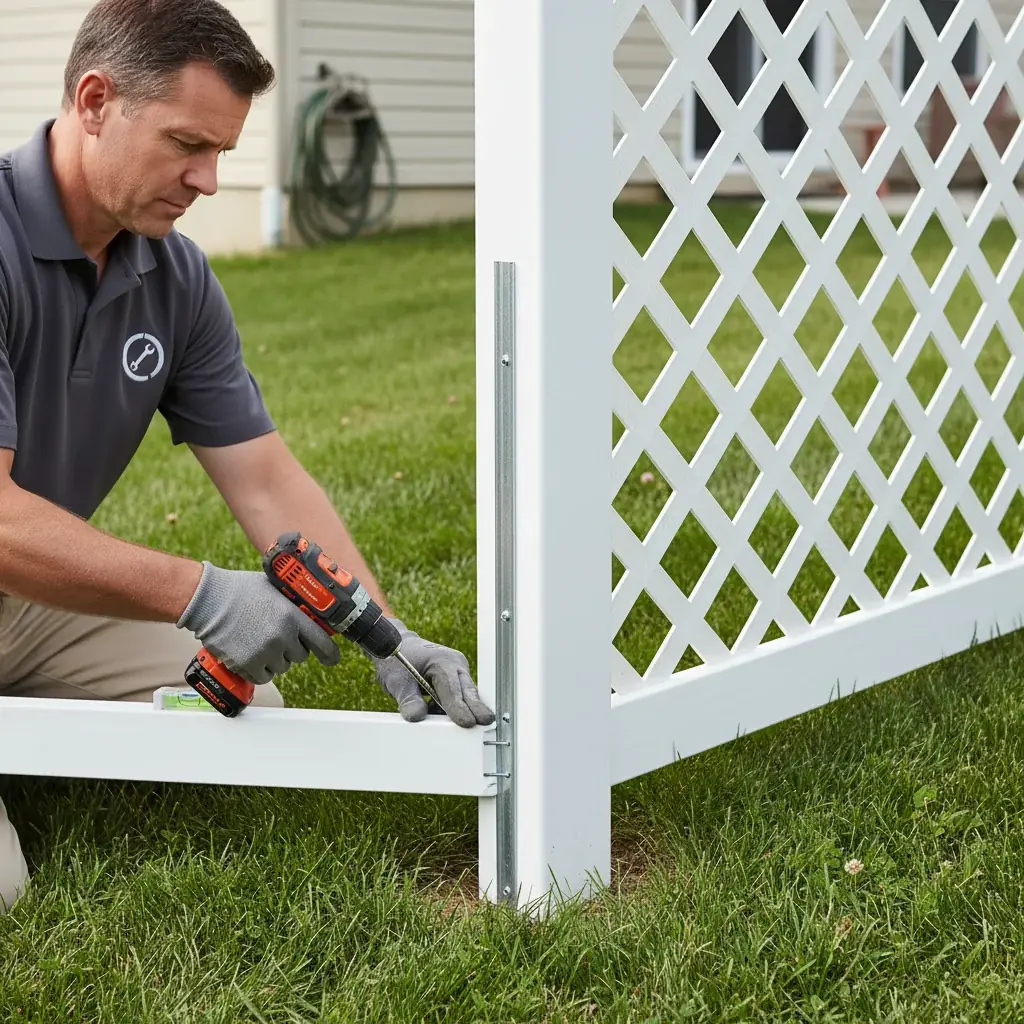
- Panel install and gates. Rails and panels lock in once footings cure, then gates get hung and latched. A standard backyard run takes one to two days.
San Diego areas we cover
We install vinyl fencing across San Diego County, coast to inland. Coastal neighborhoods like Encinitas, Carlsbad, Ocean Beach, Del Mar, Solana Beach, and La Jolla get our salt-air hardware spec. Inland communities including Poway, Rancho Bernardo, Santee, El Cajon, Escondido, San Marcos, Chula Vista, and 4S Ranch get footings sized for expansive clay and decomposed granite. Higher-elevation areas like Alpine, Ramona, and Julian get a cold-rated vinyl recommendation. Wherever you are in the county, the climate and soil drive the spec.
Frequently asked questions
How much does vinyl fence installation cost in San Diego? Expect $35 to $55 per linear foot installed. A 150-foot backyard fence with one gate on a flat lot runs about $6,000 to $8,000. Slopes, tall privacy panels, and demo of an old fence push the number up.
Is vinyl fence cheaper than wood in San Diego? Upfront they’re close, around $51 per foot for vinyl versus $55 for wood in recent regional data. Vinyl wins over a 15-year horizon because you never stain, seal, or repaint it.
Does vinyl fencing hold up near the coast? Yes. Vinyl is non-porous, so salt rinses off with a hose instead of causing rot like it does on wood. Spec UV-stabilized virgin PVC and corrosion-resistant gate hardware near the water.
Do I need a permit for a vinyl fence in San Diego? Most rear and side-yard fences up to 6 feet don’t need a permit, and front-yard fences are capped near 3.5 feet. Taller fences and some zones do. Confirm with San Diego County zoning before you build.
How long does a vinyl fence installation take? A standard backyard run is one to two days of on-site work once footings cure. The bigger timeline is HOA approval and permit prep, which can add a few weeks before the crew breaks ground.
What color vinyl fence does my HOA allow? White and off-white pass almost everywhere in San Diego County. Tan, almond, and gray are accepted in many newer master-planned communities. Always pull your CC&Rs and get ARC approval first.
When to call us
Vinyl fence installation sounds simple until you’re dealing with sloped terrain, an HOA submittal, steel post inserts, and concrete footings that actually hold. That’s the point where a crew that does this daily earns its cost. We give free upfront quotes, respond fast, and cover all of San Diego County. Call us at (858) 925-5546 for a same-day estimate.