A rattlesnake fence is a different job from a coyote run or a deer line. You are trying to keep a slender animal from sliding through, under, or over a short climb of debris. University of California IPM Pest Notes 74119 (Rattlesnakes) says snakes can be excluded with a snake-proof fence, that gates must fit tight, and that vegetation piled against the fence gives them a ramp. It does not publish a mesh catalog for San Diego County, and this site will not invent one.
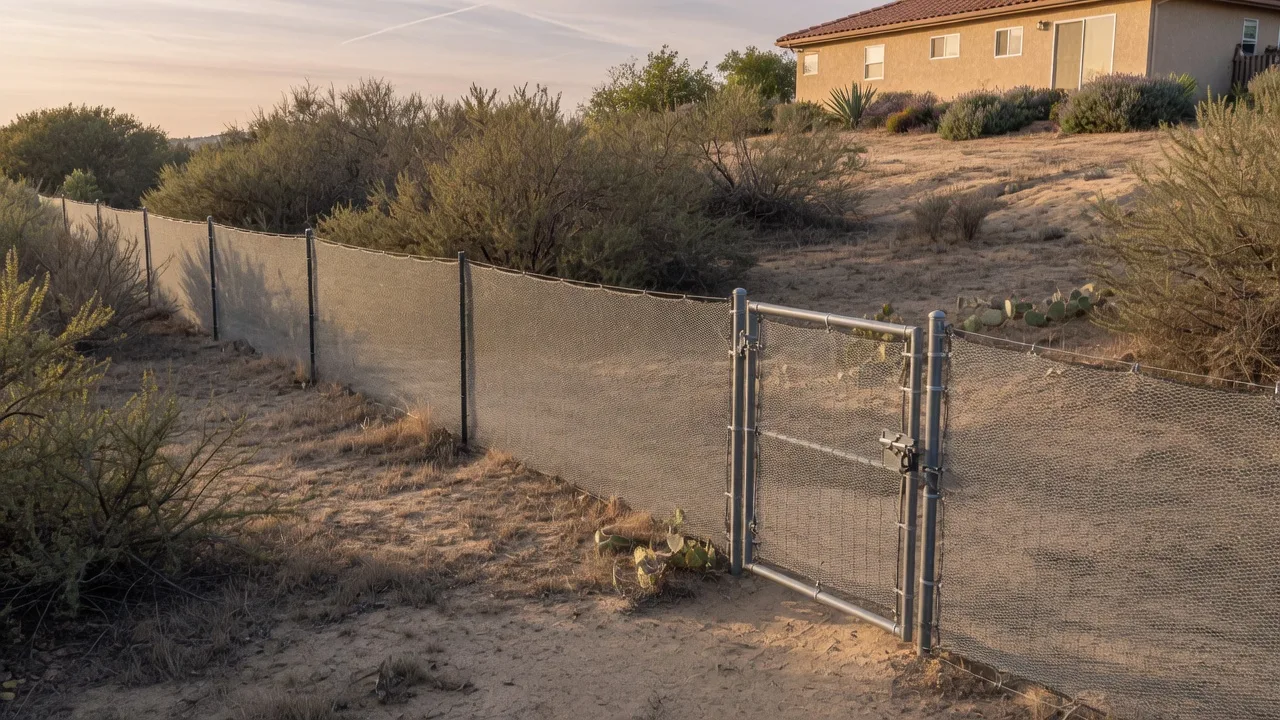
What the rattlesnake question actually is on a County lot
People call from Jamul, Alpine, Valley Center, Ramona, Lakeside, and canyon edges in Tierrasanta and Scripps Ranch after they see a snake on the patio, in a play area, or along a trail that cuts the back of the lot. The ask is usually “keep them out of this yard,” not “build a six-foot privacy wall.”
UC IPM 74119 is the named source for the exclusion idea. It also says rattlesnakes cannot dig their own burrows but will use rodent holes, that you should fill those holes after rodent control, and that cracks and openings greater than 1/4 inch can let snakes into a building. That 1/4-inch figure is about sealing a structure, not a published fence-mesh specification. Put the fence mesh, the bury or apron, and the gate gap on the contractor’s paper as measured details. Do not treat a hardware-store bag labeled “snake mesh” as a code.
Coastal Southern California includes the Southern Pacific rattlesnake (Crotalus helleri). The red diamond rattlesnake (C. ruber) is found in southwestern California south of Los Angeles. California Department of Fish and Wildlife rules, as summarized in that Pest Note, prohibit taking or killing the red diamond rattlesnake. A fence proposal is not a take permit. If a snake is on the lot and you want it moved, UC IPM points you to a professional who removes snakes. Do not pick it up.
This page is not coyote-proof fencing. Coyotes climb and dig. It is not deer fence. Deer are a height and jump problem. Mixing those three jobs on one line item is how a play-yard exclusion gets quoted as a ranch rail.
What belongs on the proposal besides the mesh
Ask the matched C-13 fencing contractor to walk the line you actually want closed: play area, pool equipment pad, dog run, or the whole rear. Then write:
- The product: manufacturer, mesh opening as measured, wire gauge, coating, and whether the mesh is on the animal side of the posts.
- Height of the exclusion run, separate from any privacy fence above it.
- How the bottom meets grade: bury, apron, or a concrete mow strip, with the method named for your soil. Decomposed granite in East County and irrigated clay in a valley lot do not take the same bottom detail.
- Every grade break, step, and washout. Snakes use the gap under a stepped panel the same way a coyote does, just through a smaller hole.
- Gates as their own schedule: clear opening, swing, bottom gap, latch, and how the leaf meets the strike. UC IPM calls out tight-fitting gates. A 2-inch dog-gate gap is not tight.
- Vegetation and debris: who keeps brush, wood piles, and rock stacks off the fence. UC IPM says snakes climb that pile to the top.
- Rodent work as a separate conversation. Filling burrows is pest work. It is not automatically inside a C-13 fence bid.
- Building gaps: garage door, crawl-space vents, pump enclosures. Those are exclusion too, and they may need a different trade.
A C-13 license covers fences, gates, posts, and related work. It excludes masonry walls. If someone quotes a block “snake wall,” that is a different classification. Check the person on the CSLB license lookup. California Business and Professions Code §7048 sets a $1,000 aggregate threshold for the licensing exemption on casual, minor work that does not need a building permit. Advertising as a contractor takes that exemption off the table.
Height and location still follow the same fence rules as any other run. Inside the City of San Diego, Municipal Code Chapter 14, Article 2, Division 3, Table 142-03A treats fences below 7 feet as needing no building permit under that division, and 7 feet or greater as Building Permit, Process One. Zoning still applies. In unincorporated county areas, County PDS070 (revised 2023-01-01) lists a permit exemption for fences and walls no higher than 6 feet if the work is zoning compliant, with a zoning summary of 42 inches at the front and exterior side and 72 inches at the rear and interior side. Confirm the current rule for your parcel. Wildlife intent does not skip it.
If the run sits on a shared line, California Civil Code §841 still requires 30 days’ written notice before you spend on a dividing fence, with the problem, the proposed work, estimated costs, a sharing plan, and a timeline.
How this fence fails, and when to call
The common failures are not mysterious. A beautiful mesh panel with a 3-inch gap at the gate. A washout after one storm. Ivy or firewood stacked on the outside face. A pump-house door that never got a sweep. A privacy fence that stops at grade because the exclusion mesh was “included” and never installed.
Repellents, mothballs, sulfur, and “snake plants” are not a substitute. UC IPM 74119 says those home remedies do not work and that commercial snake repellents have not been shown to work well enough to recommend.
Fence Pros San Diego is a referral service. The brand does not install, does not trap snakes, and does not set a price. We match you with licensed, independent local fence professionals. You contract with the pro directly.
Call when you want a licensed fence contractor to spec an exclusion run for a San Diego County play area, canyon-edge yard, or rural lot, with the mesh, the bottom, and the gates written down. Call us at (858) 400-4906 and we will connect you with a licensed fence contractor.