No fence is fully coyote-proof, and any contractor who tells you otherwise is overselling the job. What a well-designed fence does is close off the specific weaknesses coyotes actually exploit: climbing, digging under, and slipping through gaps that a dog or cat couldn’t manage. That’s a design problem, not a height number, and it looks different on a canyon-edge lot in Tierrasanta than it does on a rural half-acre outside Ramona.
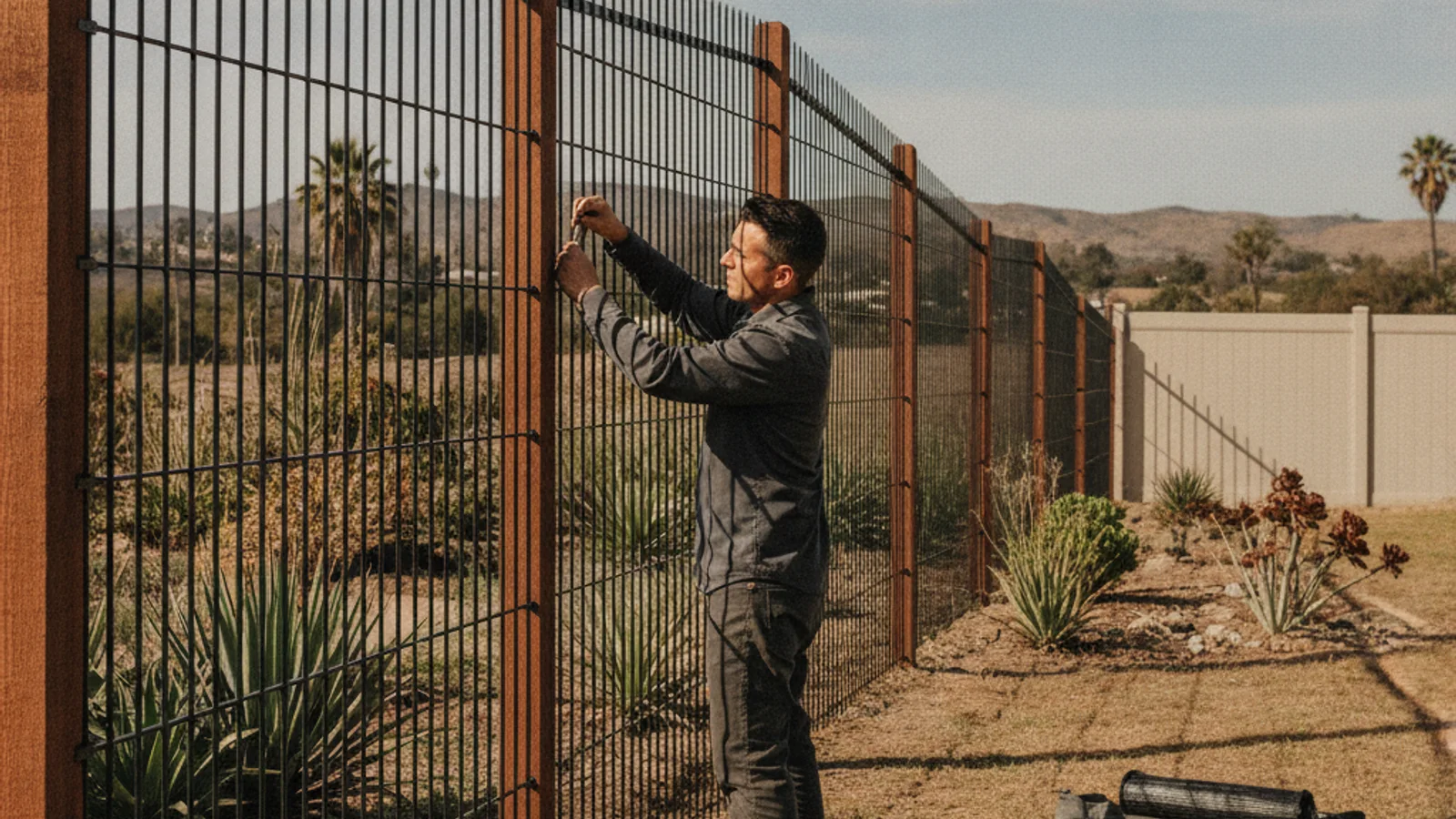
San Diego County has coyote pressure in places most people don’t expect. It’s not only the obvious backcountry towns like Julian or Descanso. Canyon-adjacent neighborhoods across the county, from Mission Trails-facing yards to the open space edges around Poway and Scripps Ranch, see regular coyote activity because the animals move along the canyon corridors between hunting grounds. Rural East County and the north county backcountry add a second pressure: larger, often unfenced or partially fenced parcels where coyotes have more room to test a property’s weak points before committing to a route in.
Where coyote pressure changes the fence plan
A standard residential fence is built to keep a dog in or a stranger out at eye level. Coyote pressure adds two problems that a normal fence doesn’t solve: climbing ability and digging ability. Coyotes are capable climbers, especially when a fence has horizontal rails, a sloped top, or anything that gives a foothold on the outside face. They’re also diggers, and a fence that stops at grade with no buried resistance gives them an easy way under, particularly in the county’s looser inland soils.
This means the fence line itself matters less than the details at the top, the bottom, and anywhere the ground isn’t flat. A fence that looks solid from the street can still have a gap at a slope transition or a low spot where water has washed out the base, and that’s exactly where a coyote will test first.
Gaps, grade changes, and gates: the weak points
Grade changes are the most common failure point in canyon and hillside lots. When a fence follows sloped terrain, builders sometimes step the panels instead of following the slope continuously, and the resulting gaps at each step are wide enough for a coyote to squeeze through even when the fence height looks adequate everywhere else.
Gates are the second common failure point. A gate that doesn’t close flush with the fence line, or that’s left propped for yard access, undoes the rest of the barrier. Self-closing hardware on gates matters as much here as it does on a pool fence, for a different reason: it removes the human error of a gate left open.
The third weak point is anywhere a fence meets a wall, a shed, or another structure. Coyotes will follow a fence line looking for the seam where two materials meet, since that’s often the easiest place to find a gap or a foothold.
Comparing solid, wire, and mixed-material barriers
Solid fencing, like a wood privacy fence or a vinyl panel fence, removes visual access, which can reduce a coyote’s interest in a yard simply because it can’t see what’s inside. It doesn’t inherently stop climbing unless the design avoids horizontal rails on the outside face.
Wire and mesh options, including certain chain link fence configurations, can be built with smaller openings and outward-angled toppers that make climbing over the top much harder, since a coyote pushing against an outward lean tends to fall back rather than gain purchase. The tradeoff is that wire fencing offers no visual privacy and needs regular inspection for stretched or bent sections.
Mixed-material approaches, a solid base with a wire or roller extension at the top, or a solid fence paired with a buried apron at the bottom, tend to address both the climbing and digging problems at once rather than solving one and ignoring the other. This is usually the more realistic answer for a property with real coyote pressure, rather than betting everything on one material doing the whole job.
A buried apron or L-footer, extending the fence material outward or downward below grade, is the standard answer to digging, but the depth and configuration that actually works depends on your soil and the animal pressure on your specific lot, which is a conversation to have directly with the fence installation pro who walks your property.
What a fence alone doesn’t solve
Even a well-built barrier is only part of the answer. Coyotes are opportunistic, and a fence that’s excellent everywhere except one neglected gate, one low spot, or one section overgrown with brush is still a fence with a way in. Trimming vegetation away from the fence line on both sides removes hiding cover and makes weak points easier to spot. Securing anything that draws coyotes toward the fence in the first place, like pet food left outside or an accessible trash can, matters as much as the fence itself.
If you keep small pets, our dog fence guide covers containment fencing for pets specifically, which overlaps with coyote-resistant design but isn’t identical to it. Properties dealing with deer pressure as well as coyotes should also see our deer fence guide for San Diego County, since the two problems sometimes call for different solutions on the same fence line.
Because there’s no single verified height or design standard specific to coyote exclusion that we can point to here, if your property is in an area with documented coyote conflict, it’s worth checking current guidance from your city’s animal services department or San Diego County before finalizing a design, and discussing your specific site with a matched fence pro who can walk the terrain with you.
Backcountry vs canyon-adjacent: not the same problem
The rural backcountry around Julian, Descanso, and Pine Valley and the canyon-edge suburbs closer to the urban core face coyote pressure for different reasons, and that changes what a fence needs to do. Backcountry properties tend to have long, unfenced perimeters, larger lots, and coyotes that are simply part of the everyday landscape rather than occasional visitors. A fence plan out there often has to cover far more linear footage, which shifts the calculation toward wire and mixed-material options that are less expensive to run long distances than a fully solid fence.
Canyon-adjacent suburban lots, by contrast, usually have a shorter perimeter to secure but face coyotes moving along a specific, predictable corridor, the canyon or open space edge itself. That means the fence section facing the canyon deserves more attention to climbing and digging resistance than the rest of the property’s perimeter, which may already be adequately fenced for other reasons.
Questions to ask a fence pro about pets and wildlife
Before signing a proposal, ask how the design handles grade changes on your specific lot, whether the gate hardware is self-closing, and what happens at the base of the fence in areas with loose or sandy soil. Ask whether the quote includes a buried apron or a mow strip, since that’s often left out of a basic proposal and added later as a change order. If you have small dogs or cats, ask how the design accounts for both keeping pets in and keeping coyotes out, since those aren’t always the same fence.
Frequently asked questions
Can coyotes really climb a fence?
Yes. Coyotes can scale fences that offer footholds, such as horizontal rails, chain link mesh, or a sloped top edge. A smooth vertical surface or an outward-angled extension at the top makes climbing significantly harder.
How do I stop coyotes from digging under my fence?
A buried apron or L-footer, where the fence material extends below grade and angles outward, is the common approach. The depth needed depends on your soil type and local conditions, which is worth discussing directly with an installer who can assess your yard.
Is a solid privacy fence better than chain link for coyotes?
Each has tradeoffs. Solid fencing blocks visual access, while properly configured wire fencing with an anti-climb topper can be harder to scale. A mixed approach that addresses both climbing and digging often works better than either material alone.
Are canyon-edge homes in San Diego at higher risk for coyote activity?
Yes, canyon corridors give coyotes a natural travel route between open space and residential yards, which is why properties near canyons and open space preserves across the county tend to see more activity than interior lots.
When to call us
If your property backs up to a canyon, open space, or rural land and you’re seeing coyote activity near your yard, a proper barrier assessment is worth having before you commit to a material. Call (858) 400-4906 with your address and a description of where you’re seeing activity, and we’ll connect you with a licensed and insured local fence contractor.