A retaining wall holds back soil. A fence marks a boundary and gives you privacy. On a sloped yard, the question isn’t which one looks better, it’s whether your slope is actively moving or eroding. If it is, you need a wall. If it’s just a gentle grade with stable soil, a fence alone is usually fine. Most steep San Diego properties end up using both.
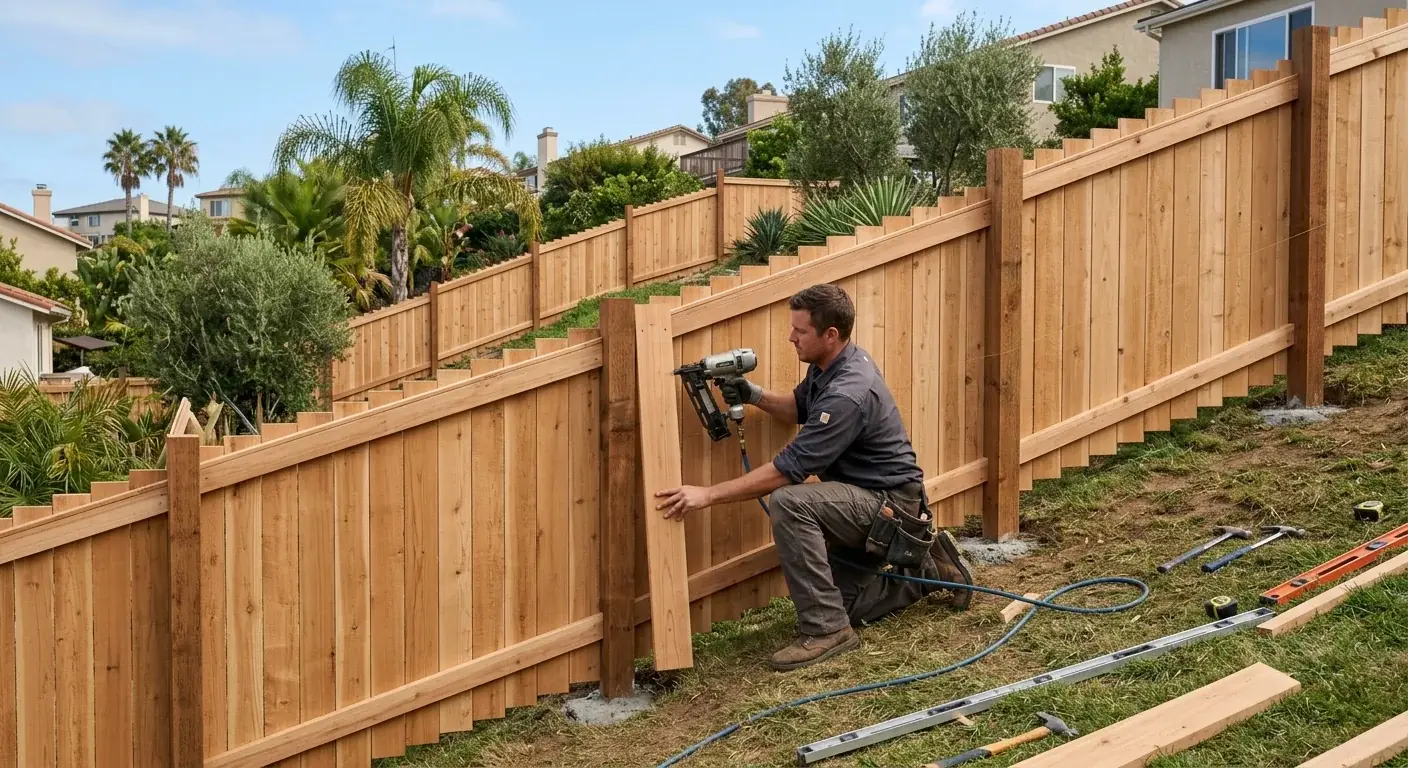
This is a different question than “how do I fence a slope”
We get asked about sloped yards two different ways, and they’re not the same problem. One is about how to build a fence line that follows an angled grade (stepped panels, racked rails, that kind of thing). We cover that separately in our post on fencing on a sloped yard.
This post is about something that comes before that: does your slope need a structural wall at all, or can a fence handle the whole job. Get this wrong and you either pay for engineering you didn’t need, or skip a wall your property actually needed and watch your yard erode into your neighbor’s for the next five years.
When you actually need a retaining wall
A retaining wall is a structural fix. Build one when:
- The soil is actively moving. Visible slumping, cracks forming in the slope face, or soil sliding toward a fence line after rain are all signs the grade isn’t stable on its own.
- You’ve got real erosion. Bare dirt washing out during winter rain, exposed roots, or a slope that’s visibly lower than it used to be.
- You’re holding back more than about two feet of grade change. Below that, a fence and some groundcover usually manage fine. Above it, the soil needs something engineered to actually hold it, not just gravity and root systems.
- You’re planning to level part of the yard. Cutting into a slope to create a flat patio or lawn area removes the natural angle of repose the soil was relying on. That cut needs a wall or it will eventually slump back toward its natural grade.
This is the situation we see most in East County and North County Inland, in places like El Cajon, Alpine, Ramona, Santee, Escondido, Poway, and Fallbrook. Those areas have real hillside lots with clay and decomposed granite soils that move more than people expect, especially after a wet winter. If you’re in one of those areas and your slope has any of the signs above, don’t skip a soils conversation before you build anything.
When a fence alone is genuinely fine
Not every sloped yard needs engineering. Skip the wall and just build a fence when:
- The grade is gentle, a gradual rise or fall you’d barely call a slope.
- There’s no visible erosion or soil movement, even after rain.
- You’re not planning to cut into the grade or flatten any part of it.
- The fence’s only job is a property line and privacy, not holding anything back.
In this case, spending money on a retaining wall is solving a problem you don’t have. A properly set fence, with posts set to the right depth for the grade, does the job on its own.
What a retaining wall actually costs in San Diego
Retaining wall pricing runs by square face foot (the visible height times the length of the wall), and it varies a lot by material:
| Material | Cost per square face foot | Notes |
|---|---|---|
| CMU block | $70 to $130 | Most economical structural option, needs a proper footing |
| Interlocking modular block | $90 to $160 | Common for shorter walls, good drainage built in |
| Poured concrete | $130 to $220 | Strongest option, more labor and form work |
| Boulder / natural stone | $150 to $260 | Best for hillside lots that want a natural look, cost varies with stone access |
These are real ranges, not a flat number, because site access, soil type, and drainage requirements change the labor on every job. A wall on a tight side yard with poor equipment access costs more than the same wall on an open backyard.
Permits and engineering
This is where a lot of homeowners get surprised. In California, retaining walls over about 3 to 4 feet generally require a building permit, and taller walls, or walls holding back a significant slope, often need a soils report and engineered drawings before the city will sign off. That adds cost and time, but skipping it isn’t worth the risk. An unpermitted wall that fails after heavy rain is a liability problem, not just a landscaping one.
A fence, by contrast, usually doesn’t need a permit under 6 feet in most San Diego jurisdictions, though HOA approval and setback rules still apply. That’s part of why fences alone are the right call whenever the slope doesn’t actually need structural support: less cost, less time, less red tape.
The combo most East County properties actually build
The most common setup on a real sloped lot isn’t wall-only or fence-only, it’s a short retaining wall doing the structural work, with a fence installation on top of it for the privacy and boundary line. A 2 to 3 foot wall handles the grade change and stays under most permit thresholds, and the fence above it gets you back to normal height without needing a much taller (and much more expensive) wall to do both jobs at once.
This combo also solves a drainage problem walls create on their own. A wall without a fence on top still leaves the top of the slope exposed. Pairing them lets you run the fence posts on the flat ground above the wall, instead of trying to anchor posts into a slope, which is a real problem stepped and racked fence layouts are built to solve.
Drainage matters either way
Whichever way you go, don’t skip drainage. A retaining wall needs weep holes or a drain line behind it, or water pressure builds up and pushes the wall out over time. A fence on a slope needs posts set below the frost-free depth appropriate for the soil, with concrete footings that account for water runoff during San Diego’s rainy months. If you’re already dealing with a block wall as part of your property line, our post on block wall fence covers how that pairs with a standard fence on top.
Frequently asked questions
How do I know if my slope needs a retaining wall?
Look for active soil movement, visible erosion, cracking in the slope face, or more than about two feet of grade change you’re trying to hold back. If you see any of those, get a wall evaluated. A gentle, stable slope usually doesn’t need one.
Do I need a permit for a retaining wall in San Diego?
Generally yes, once the wall is over about 3 to 4 feet, and taller or load-bearing walls often need engineering and a soils report. Check with your specific jurisdiction since requirements vary slightly across San Diego County.
Does a fence need a permit on a sloped lot?
Usually not, if it’s under 6 feet, which covers most residential fences. HOA rules and setback requirements still apply, so check those separately from the building permit question.
Can I put a fence on top of a retaining wall?
Yes, and it’s one of the most common setups on sloped San Diego properties. A short wall handles the grade, and the fence on top handles privacy and the property line, without needing one very tall structure to do both.
What’s cheaper, a retaining wall or a fence?
A fence is almost always cheaper, because it’s not holding back soil. But that comparison only matters if a fence can actually do the job your yard needs. If the slope requires structural support, a fence alone won’t solve the problem regardless of cost.
Which San Diego areas deal with this decision most often?
East County and North County Inland communities like El Cajon, Alpine, Ramona, Santee, Escondido, Poway, and Fallbrook have the most hillside lots where this is a real decision, thanks to grade changes and clay or decomposed granite soils that move more than flatter coastal lots.
Not sure if your slope needs a wall or just a fence? Call Fence Pros San Diego at (858) 400-4906 and we’ll take a look.