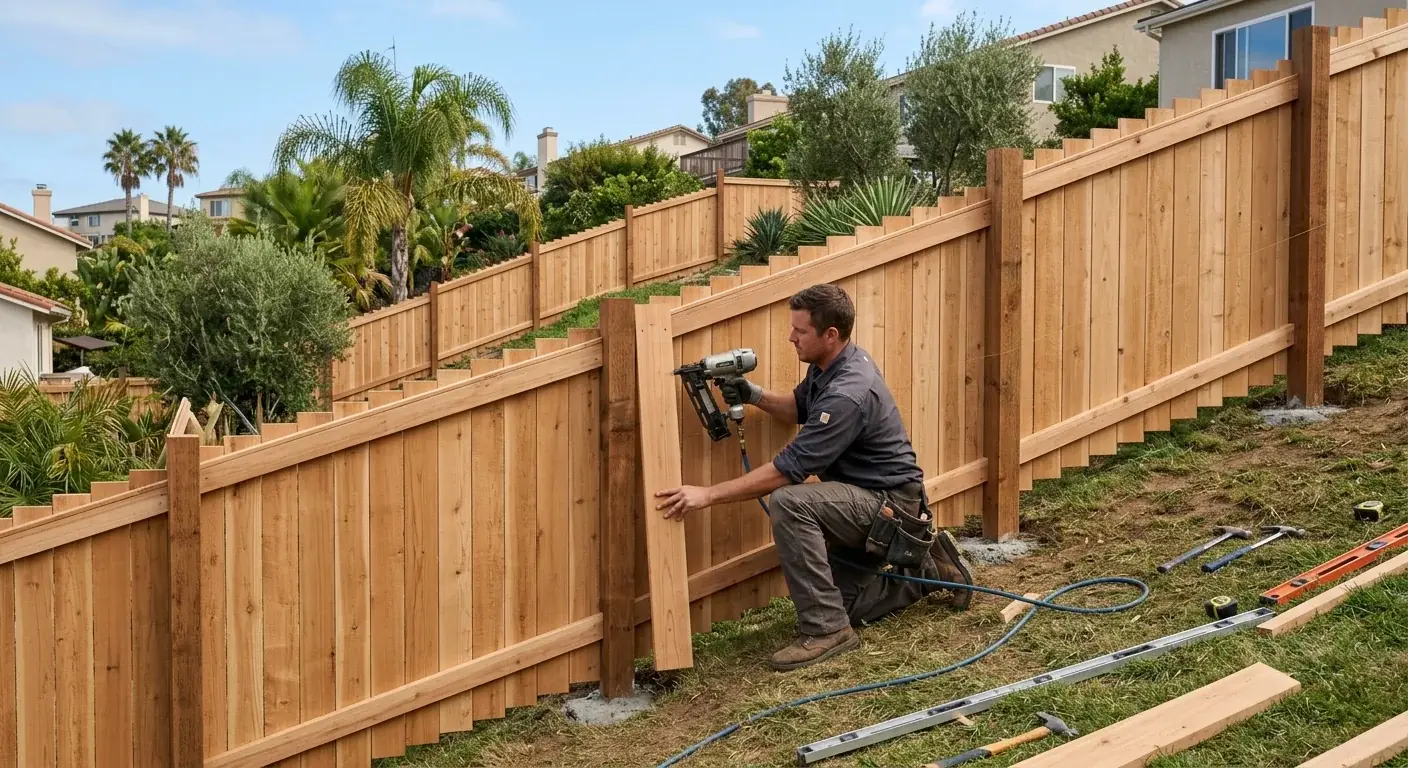
San Diego’s beautiful, rolling terrain often means homeowners have sloped yards. While these hillsides offer stunning views, they also present unique challenges when you’re planning a new fence. Installing a fence on uneven ground isn’t as straightforward as on a flat lot. It requires careful planning, specific techniques, and a deep understanding of how different methods impact aesthetics, function, and longevity. Ignoring the slope can lead to gaps, instability, and a fence that just doesn’t look right.
Understanding these nuances is key to getting a fence that not only defines your property but also enhances its value and curb appeal. For homeowners in communities like La Jolla, Poway, or Encinitas with varied topography, knowing your options helps you make informed decisions. We’re going to break down what you need to know about fencing on a slope, from installation methods to material choices and cost implications.
Stepped vs. raked fences: choosing the right method for your hill
When you’re installing a fence on a sloped yard, the primary decision you’ll face is between a “stepped” fence and a “raked” (or “sloped”) fence. Each method has its distinct look, advantages, and ideal applications. Understanding the difference is crucial for achieving the desired outcome for your San Diego property.
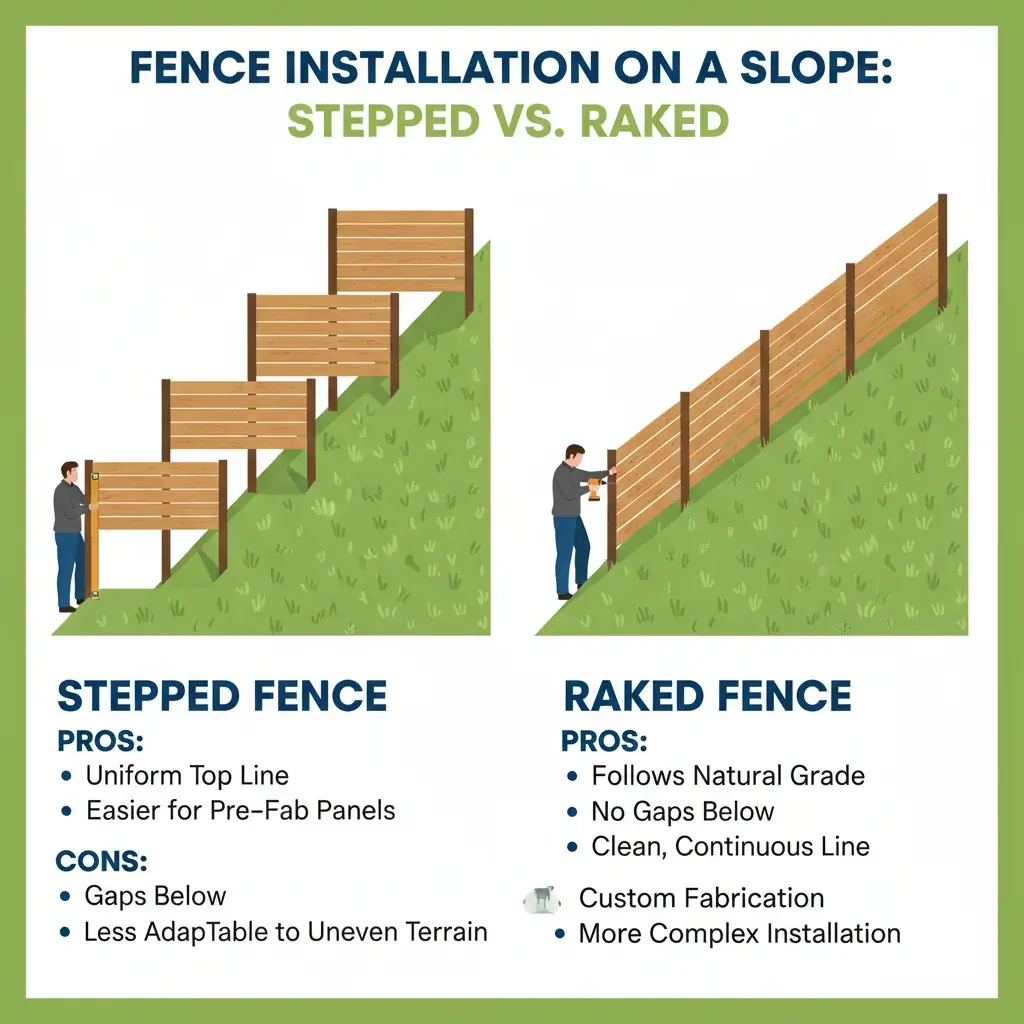
Stepped Fences: A stepped fence is built by installing individual fence panels horizontally, much like a fence on flat ground. However, at certain intervals, typically at each post, the fence panel “steps down” to accommodate the slope. This creates a staircase-like appearance where each panel maintains a consistent height above the ground at its ends, but the bottom edge of the panel progressively gets closer to the ground as it moves down the hill.
- Pros of Stepped Fences: They offer a clean, uniform top line, which many homeowners find aesthetically pleasing. The panels maintain their standard rectangular shape, making them suitable for pre-fabricated sections, especially for privacy fences. Stepped fences are excellent for maximizing privacy, as the panels maintain a consistent height. They also work well for containing pets, though the “steps” at the bottom can create small triangular gaps that may need to be filled if you have very small animals.
- Cons of Stepped Fences: The most significant drawback is those triangular gaps created beneath each step. These gaps can allow small pets or critters to pass through, and they may require additional landscaping or infill solutions (like small sections of mesh or gravel) to close them off. This method can also be more labor-intensive to ensure each step is perfectly level and aligned.
Raked Fences: A raked fence is designed to follow the natural contour of your sloped yard. Instead of stepping down, the fence panels are angled or cut to run parallel to the ground. This means the top and bottom lines of the fence follow the slope of the land, creating a continuous, uninterrupted line.
- Pros of Raked Fences: The primary advantage of a raked fence is that it eliminates gaps underneath, making it ideal for pet containment and preventing wildlife from entering or exiting. It often blends more naturally with the landscape, creating a seamless appearance that complements the terrain rather than contrasting it. This method can be particularly effective on very steep slopes where stepping would create excessively large gaps.
- Cons of Raked Fences: Raked fences can be more challenging and costly to install, especially with pre-fabricated panels like solid wood fence or vinyl. Each panel typically needs to be custom cut and fitted on-site to match the exact angle of the slope. This requires more skilled labor and can lead to more material waste. The varying height of the fence relative to the ground can also be less desirable for some privacy applications, as the effective privacy height changes along the slope.
Choosing between these methods often comes down to your priorities: aesthetics, budget, privacy needs, and the specific characteristics of your slope. For many San Diego homeowners, especially with gentle to moderate slopes, the stepped method is a popular choice for its clean look and privacy benefits, even if it requires gap mitigation. For steeper grades or when a seamless ground line is paramount, raked can be the superior, albeit more complex, option. A professional assessment from Fence Pros San Diego can help determine the best approach for your specific property and goals.
Why proper post depth is critical on a slope
The foundation of any strong, long-lasting fence lies in its posts. On a sloped yard, the importance of proper post depth and installation is magnified significantly. San Diego’s geology, with its varied soil types and occasional seismic activity, means that poorly set posts can lead to fence failure much faster than on flat ground. When a fence post isn’t deep enough or properly secured on a slope, it can quickly lean, sag, or even collapse.
One of the main challenges on a slope is achieving consistent and adequate post depth. Gravity is constantly pulling things downhill, and a fence post on a slope experiences more lateral pressure than one on flat ground. This pressure is exacerbated by soil erosion, which can undermine post footings over time, especially during heavy rains typical of our winter months. Without deep, well-anchored posts, your fence won’t stand a chance against these forces.
Proper post depth means digging holes that extend well below the frost line (though less of a concern in San Diego, it’s still about reaching stable soil) and are deep enough to provide substantial lateral support. For a typical residential fence, this often means posts buried 2 to 3 feet deep, or at least one-third of the post’s total length. On a slope, these depths might need to be increased, especially for posts at the lowest points or those supporting longer fence sections. Each post hole must be wide enough to allow for a generous concrete footing, ensuring the post is firmly encased and won’t shift.
At Fence Pros San Diego, our professional fence installation process takes these factors into account. We understand that on a slope, consistency is key. We ensure that each post hole is excavated to the appropriate depth, taking into account the grade, soil composition, and the type and height of your fence. We use high-quality concrete mix and proper techniques to cure the footings, creating a solid base that resists shifting and settlement.
Moreover, uneven terrain means that simply digging to a uniform depth from the existing ground line won’t always work. Our expert fence installers calculate the correct depth relative to the true grade and the fence line, ensuring that even as the ground rises or falls, each post has the same amount of secure embedment. This meticulous approach prevents issues like:
- Leaning or Sagging: Posts that aren’t deep enough will inevitably start to lean downhill, causing the fence panels to sag and the entire structure to lose its integrity.
- Erosion Damage: Shallow posts are more susceptible to soil erosion around their base, exposing the footing and weakening the support.
- Premature Failure: A fence is only as strong as its weakest post. If even a few posts fail due to improper depth on a slope, it can compromise the entire fence line, leading to costly repairs or even full replacement.
Investing in proper post installation on a sloped yard isn’t just about adhering to building standards; it’s about securing your investment and ensuring your fence remains stable and attractive for decades. A specialized fence contractor like Fence Pros San Diego knows exactly how to handle these challenges, providing the expertise needed for a durable, long-lasting fence.
Cost implications of installing a fence on uneven ground
Installing a fence on a sloped yard almost always costs more than installing the same fence on flat ground. This isn’t due to arbitrary pricing, but rather the increased complexity, labor, and often, materials involved. San Diego homeowners with hilly properties should be prepared for these additional expenses, understanding that they represent a necessary investment in the longevity and stability of their fence.
The primary driver of increased cost is labor. Uneven ground means more challenging excavation for post holes. Digging on a slope is physically harder and takes more time than on flat land, especially if specialized equipment is needed to create level footings or maneuver materials. Our crews spend more time carefully measuring and cutting panels to accommodate the slope, whether it’s a stepped or raked design. A raked fence, in particular, requires custom cuts for almost every panel, significantly increasing on-site fabrication time.
Material costs can also rise. When installing a stepped fence, the triangular gaps at the bottom of each step might require additional materials for infill, such as custom-cut wood pieces, mesh, or even small retaining elements. For raked fences, the custom cutting of panels can lead to more material waste, as sections might not be perfectly utilized. Furthermore, on steeper slopes, longer posts or more substantial concrete footings may be required, adding to the material expense.
Increased planning and engineering also factor into the overall project cost. Proper fence installation on a slope isn’t just about digging holes; it’s about understanding soil mechanics, drainage patterns, and how the fence will interact with the natural grade over time. Professionals from Fence Pros San Diego spend more time in the planning phase, designing a solution that ensures stability and proper water runoff, which is crucial in a region prone to erosion. This expertise prevents costly mistakes down the line.
Consider also the potential for site preparation. Extremely steep or uneven slopes might require some minor grading or the installation of small retaining walls at the fence line to create a stable base, which adds another layer of cost. These factors directly contribute to the overall fence cost you can expect.
While the initial investment for a sloped yard fence might be higher, it’s crucial to view it as an investment in a durable, safe, and aesthetically pleasing solution. Trying to cut corners on a sloped installation often leads to a fence that fails prematurely, requiring more expensive repairs or replacement later on. For accurate pricing, we always recommend getting a detailed estimate from a reputable local company. Be wary of estimates that seem too low for a sloped property, as they might indicate a lack of understanding of the complexities involved.
Material choices that work best for sloped installations
The choice of fencing material is always important, but on a sloped yard, certain materials offer distinct advantages for adapting to uneven terrain. Your decision will depend on factors like the degree of the slope, your budget, desired aesthetic, and functional requirements like privacy or pet containment. Fence Pros San Diego works with a wide range of materials, each with its own strengths for tackling San Diego’s hills.
Wood Fencing: Wood fence installation is incredibly versatile for sloped yards, making it a popular choice. Wood panels can be easily cut and customized on-site, which is a major advantage for both stepped and raked installations.
- Stepped Wood Fence: This is a very common approach. Standard wood fence panels are installed horizontally, with each section stepping down. The gaps created underneath can be filled with additional wood pieces or landscaping.
- Raked Wood Fence: While more labor-intensive, wood can also be custom-cut to follow the slope precisely. This allows for a seamless look without gaps, though it requires more skill and time. Wood is also aesthetically pleasing and can be stained or painted to complement your home. For San Diego’s climate, choosing durable wood types like cedar or redwood is recommended for longevity.
Vinyl Fencing: Vinyl fences offer low maintenance and can also be adapted to slopes.
- Stepped Vinyl Fence: Many vinyl fence manufacturers offer specific kits or components designed for stepping, making it a relatively straightforward process. The clean lines of vinyl lend themselves well to a stepped appearance.
- Raked Vinyl Fence: Raking with vinyl is more challenging. Standard vinyl panels are rigid and often cannot be angled without custom fabrication, which can be expensive. However, some manufacturers offer “rackable” vinyl fence panels specifically designed to flex and follow a slope, though these might come at a higher price point. If you’re considering vinyl for a raked look, inquire specifically about rackable options.
Chain Link Fencing: Chain link is perhaps the most adaptable and cost-effective material for heavily sloped yards, particularly for raked installations.
- Raked Chain Link: Chain link mesh is inherently flexible. It can easily follow the natural contour of the land without needing to be cut or stepped. The posts are set, and the mesh is stretched along the grade, resulting in a continuous barrier with no gaps. This makes it an excellent choice for security, pet containment, and very steep or irregular slopes where other materials would be impractical or prohibitively expensive.
Wrought Iron or Ornamental Aluminum Fencing: Both wrought iron and aluminum fences can be beautiful choices for sloped properties, offering durability and an elegant look.
- Stepped or Raked: Both materials can be custom-fabricated to either step down the slope or, more commonly, to be raked. Ornamental aluminum often comes in “rackable” sections that can pivot at the post to follow the grade. Wrought iron, being custom-welded, can be specifically designed to match any slope precisely, offering a truly bespoke solution. While these options tend to be at the higher end of the cost spectrum, they provide exceptional beauty and strength.
When selecting a material, consider the slope’s severity, your aesthetic preferences, and your budget. For moderate slopes where privacy is key, stepped wood or vinyl often works well. For very steep grades or when pet containment is paramount with a tighter budget, raked chain link is a practical choice. For an elegant, custom solution, rackable aluminum or custom wrought iron can elevate your property’s appeal. Our team at Fence Pros San Diego can guide you through the best material and installation method for your unique sloped yard.
When to call us
Fencing on a sloped yard is a specialized task that requires precision, experience, and the right tools. While some DIY enthusiasts might tackle minor slopes, the complexities of proper post depth, consistent panel alignment, and adapting to varying grades mean it’s usually best left to licensed professionals. Incorrect installation can lead to a host of problems, from an unstable fence to unsightly gaps and premature wear.
When you’re dealing with San Diego’s unique terrain, ensuring your fence meets local codes and stands strong against elements like erosion is paramount. Our expert fence installers at Fence Pros San Diego have years of experience navigating the challenges of sloped properties, providing durable and beautiful fencing solutions. Call us at (858) 925-5546 for a same-day estimate.