Planning self storage facility fencing starts with the property’s daily movement. Owners need a layout that addresses vehicles, pedestrians, deliveries, gates, and damaged perimeter sections. Each proposal should also separate confirmed work from details awaiting local approval.
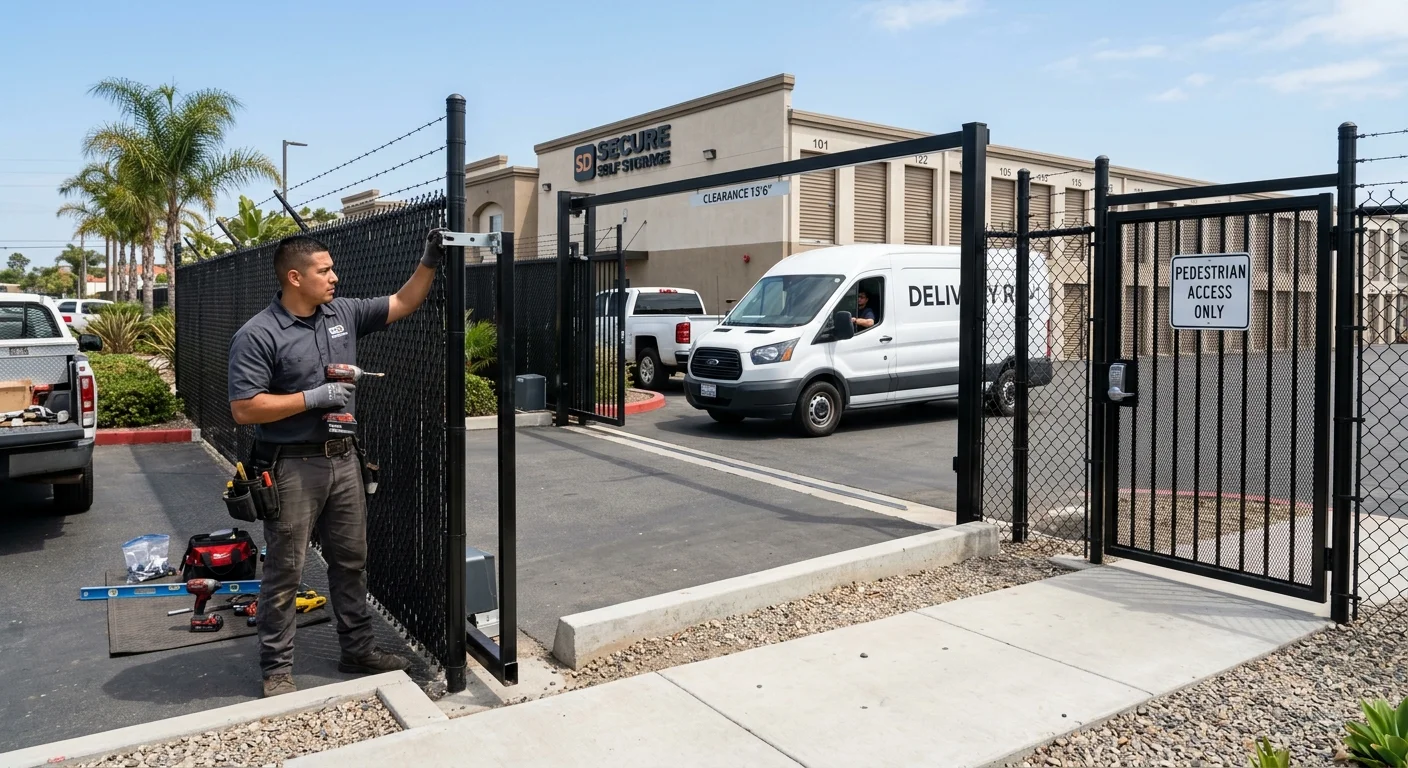
How vehicle, pedestrian, and delivery access shape the layout
Begin with a marked property plan, not a material sample. Show every driveway, pedestrian entrance, building corner, and existing gate. Mark any perimeter section shared with another parcel. Contractors can then compare the same boundaries and access points.
Walk the property during normal operations. Record how customers enter, reach their units, turn around, and leave. Note the largest delivery vehicle the facility accepts. Include moving vehicles, maintenance access, waste collection, and any separately managed entry.
The plan should answer several practical questions:
- Which gate handles customer vehicles?
- Is pedestrian access separate from vehicle movement?
- Where can a vehicle wait without blocking another entrance?
- Which areas need controlled access outside the main perimeter?
- What happens when a gate is unavailable during service?
These answers shape the gate location and opening style. They also affect post placement, fence transitions, control equipment, and protective clearances. Ask each contractor to mark those details on the proposal drawing.
Avoid treating every opening as the same kind of gate. A vehicle entrance, employee opening, and pedestrian gate serve different users. They may need different hardware and access controls. The written scope should identify each opening by location and purpose.
A self storage security fence is only one part of the property plan. Lighting, cameras, staffing, and operating procedures sit outside the fence scope unless specifically included. Don’t accept language claiming that fencing guarantees security. Compare what each proposal actually provides.
For a broader view of perimeter options, review commercial and security fencing and our guide to security fencing for San Diego businesses.
How sites near I-5 and I-8 change staging questions
San Diego route access belongs in the planning conversation. A Chula Vista or National City property reached from I-5 has a different approach than an El Cajon property reached from I-8. The proposal should reflect the actual driveway, surrounding streets, and usable work area.
Map the final route from the nearest major road to the facility entrance. Then identify where contractor vehicles, materials, removed fencing, and equipment could be placed. Don’t assume that space inside the gate will remain available. Storage customers, employees, deliveries, and existing operations may still need it.
For sites along the I-5 corridor, review approaches through Chula Vista, National City, central San Diego, Old Town, and Sorrento Valley as applicable. Along I-8, examine the route through Mission Valley, La Mesa, or El Cajon. The nearby freeway isn’t the complete staging plan. The final turns and driveway conditions matter more once work reaches the property.
Ask each bidder to state these assumptions in writing:
- The proposed material delivery point
- Areas needed for equipment and removed materials
- Any entrance expected to close during a work phase
- The planned location for temporary separation
- Access that the property manager must keep clear
Those items help expose differences between proposals. One contractor may plan work from inside the perimeter. Another may base the scope on access from an adjoining area. Neither assumption should remain hidden.
Don’t treat a staging sketch as official approval. Questions involving public streets, sidewalks, rights-of-way, or controlled access need confirmation from the authority responsible for that location. Keep those approvals separate from the contractor’s physical work scope.
Which fence, gate, finish, and control details belong in writing
A useful proposal names the system being offered. “Commercial fence and gate” isn’t enough. The document should let an owner compare materials, dimensions, hardware, controls, preparation, and exclusions without guessing.
For each fence section, request the proposed material and configuration. The scope should identify posts, rails, panels or fabric, terminal points, corners, and transitions. It should also explain how the new work meets retained fencing. If privacy screening or other attachments are proposed, list them separately.
Finish details need the same treatment. Ask for the finish type, color, surface preparation, and treatment of field cuts or welded areas. If two proposals use different finish systems, that difference should remain visible during review.
Each gate needs its own line item or labeled scope. Record the opening type, approximate location, operating method, frame, hinges or rollers, latch, lock provisions, and related posts. For powered gates, identify the proposed operator and control equipment. Keypads, card readers, intercoms, remotes, and management software shouldn’t be grouped under a vague “access control” label.
Ask who provides electrical work, data connections, trenching, programming, and user credentials. If those items aren’t included, the exclusions should say so. The property manager can then coordinate separate vendors without mistaking an allowance for completed work.
Our gate installation and automation service explains how we connect owners with independent local professionals. The guide to security gates in San Diego offers more questions for comparing access systems.
A proposal should also define testing and handoff. Request a list of controls the contractor will demonstrate. Ask what documents, keys, codes, and product instructions will be delivered. Product warranties, if offered, should identify the manufacturer and applicable terms. Fence Pros San Diego doesn’t set warranty terms or provide warranties.
How to separate phased repairs from replacement work
A mixed-condition perimeter rarely fits one broad scope. Divide it into labeled sections before comparing proposals. Use a site plan, numbered photos, or both. Each contractor can then price and describe the same areas without relying on different interpretations.
Mark every section as retain, repair, replace, or pending evaluation. Apply the same method to gates and controls. A serviceable gate opening may still have a separate hardware or control issue. A damaged fence section may also meet a corner, wall, or gate post that needs its own decision.
For repairs, ask the contractor to identify which components remain. The scope should name the posts, rails, panels, fabric, fittings, or hardware being replaced. It should also explain how repaired areas will connect with retained materials.
For replacement, request clear start and end points. “Replace the rear fence” can mean different things on a long storage property. Labeled endpoints reduce disputes and make later phases easier to track.
A phased plan should cover temporary conditions too. Ask how each work area will be separated while the perimeter is open. Identify which gate or entrance remains available during that phase. These are planning details, not promises that a fence will prevent every unauthorized entry.
Keep optional work apart from the base scope. Examples include replacing an additional run, adding a pedestrian gate, or upgrading a control component. Separate entries make it easier to approve work without changing unrelated sections.
Finally, record who decides when hidden or uncertain conditions change the scope. The licensed contractor should document the condition, proposed response, and contract change before added work proceeds. Fence Pros San Diego doesn’t set prices or contract terms. The owner contracts with and pays the independent professional directly.
Which current requirements need official confirmation
The approved claims ledger doesn’t confirm one self-storage-specific fencing standard for every San Diego County property. It also doesn’t confirm countywide fence heights, permit rules, fire-access dimensions, or gate-control requirements. Don’t let a proposal present those unresolved items as settled facts.
Start by identifying the governing jurisdiction. A property within the City of San Diego should take zoning, fence, and permit questions to the City of San Diego Development Services Department. For a site in Chula Vista, National City, La Mesa, El Cajon, or another city, contact that city’s building or planning authority. An unincorporated address should be checked with the County of San Diego.
Ask the applicable authority about the exact property and proposed scope. Provide the parcel address, fence location, proposed height, gate arrangement, and relationship to streets or sidewalks. If the plan raises fire access, egress, electrical, or pedestrian-access questions, direct each issue to the responsible authority. Request written confirmation when possible.
Shared property lines need separate attention. California Civil Code Section 841 presumes adjoining private landowners share equal benefit and reasonable fence costs unless they agree otherwise in writing. It also requires 30 days’ advance written notice before incurring shared-fence costs. The notice must describe the problem, proposed solution, estimated costs, cost-sharing approach, and proposed timeline. Government entities are excluded from that statute’s definition of landowner.
California’s C-13 fencing classification covers fences and gates but excludes masonry walls. Before signing a contract, confirm the professional’s license details through the CSLB license check. Ask the contractor and the governing authority who should handle any wall, electrical, access-control, or permit work outside the fencing scope.
When to call us
Call when a self-storage project needs commercial fencing, gate work, or a licensed professional to compare repair and replacement options. Fence Pros San Diego matches property owners with licensed, independent local fence professionals. Call us at (858) 400-4906 and we’ll connect you with a licensed fence contractor.