The remote clicks and the leaf barely moves, or it starts, then dies halfway across a Rancho Bernardo driveway. That stall is the moment to decide whether the sliding gate opener is failing, or whether the gate, track, or rollers are dragging it down. A licensed fence contractor in our network inspects the whole travel path before anyone prices a new operator.
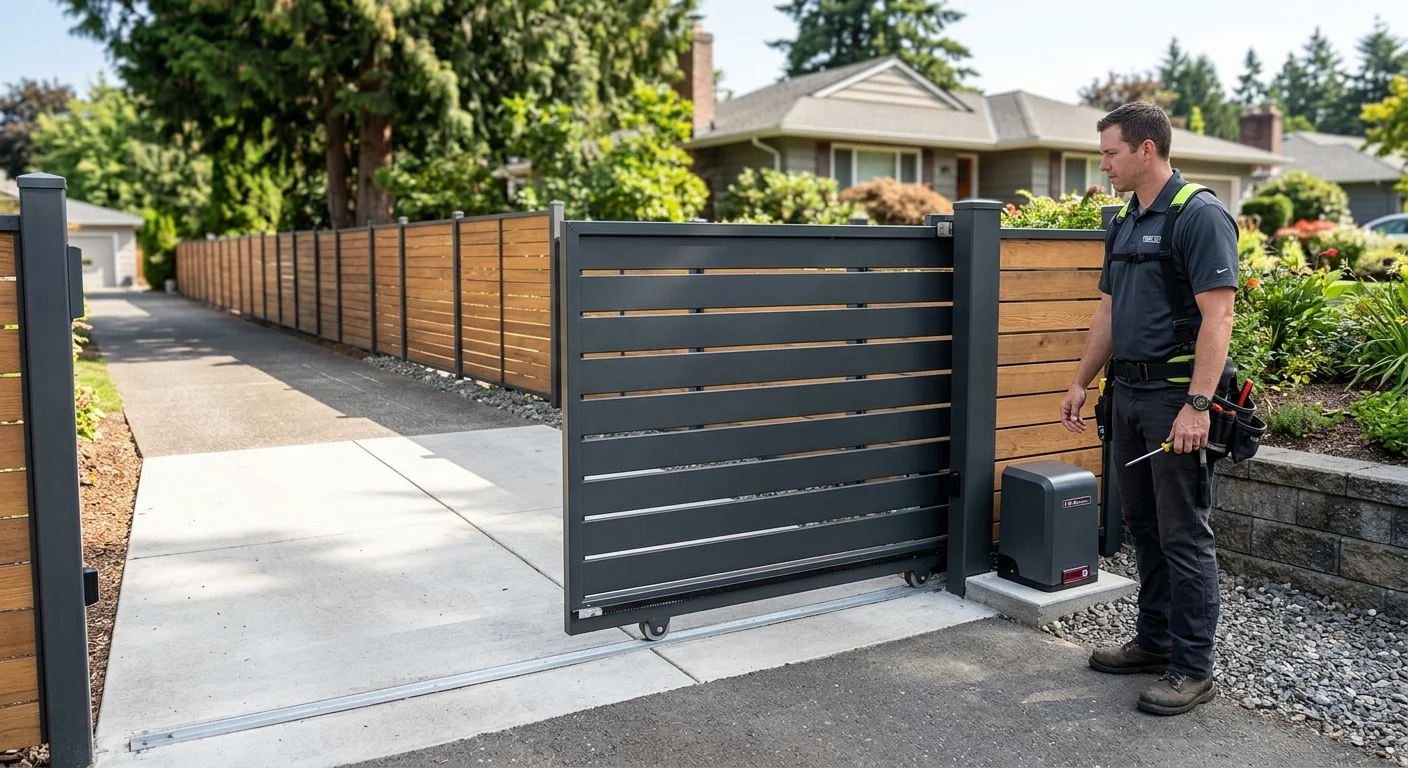
What symptoms may point to the opener, track, or gate hardware
A noisy or stuck automatic sliding gate opener is easy to blame on the motor. On San Diego County driveways, the leaf, the hardware, and the travel path fail just as often. The contractor you get matched with starts by splitting those three.
Opener-side clues sit at the cabinet. The unit hums and the chain or rack stays still. The board lights, then dies when you press the remote. Limits drift so the leaf never quite reaches the catch. The gearbox growls on every cycle. Those point at the operator, not the fence line.
Track-side clues live on the ground. The leaf hops, chatters, or binds at the same spot every time. Sand from Imperial Beach and Coronado packs into the rail. East County dust and crushed granite do the same after Santa Ana winds. Irrigation overspray in Chula Vista and Escondido leaves mineral crust on the wheels. A bent rail, a low spot in asphalt, or a heaved concrete joint will stop a healthy motor.
Cantilever layouts have no ground track. The leaf hangs from truck rollers on a rear beam and rides a catch at the far post. If those rollers flatten, the beam sags, or the guide rollers walk, the operator fights a crooked load. That fight sounds like a dying motor. It is not.
Hardware clues sit on the leaf itself. A sagging frame. Loose rack bolts. A stretched chain. Worn nylon rollers. A post that leaned after a wet winter in Fallbrook or Lakeside. Coastal salt at La Jolla and Oceanside rusts chains, racks, and fasteners faster than inland heat alone.
Write down what you hear and where the leaf stops. That note helps the contractor. It is not a diagnosis. Sliding gate opener repair starts with that split: operator, path, or leaf. Treat a dead remote, a dirty photo eye, and a dragging wheel as different problems until someone has watched a full cycle on site.
Why alignment, rollers, and travel path need checking first
An opener that is even a little undersized will look failed if the gate drags. Alignment work is cheaper to inspect than a new operator, and it tells you whether a replacement would last. That is why a careful pro does not start at the circuit board.
They watch a full open and close by hand, with the operator released, if the leaf will still roll. Binding, a dip, or a twist in the frame shows up there. They check post plumb at both ends of the opening. They look at roller wear, rack mesh, and chain sag. They walk the travel path for debris, grade change, and anything the leaf could hit: a trash enclosure, a low limb, a new planter.
San Diego lots are not one condition. A hillside opening in Encinitas or La Mesa can put the rail on a slope the original installer never fully accounted for. A long, flat drive in Poway or Santee is kinder to a track, until crushed rock migrates into the channel. Coastal openings collect salt and sand. Inland openings cook the operator cabinet and bake grease out of rollers.
Track and cantilever each have a job. Neither is the required layout for every property. Track systems need a clean, stable rail for the full slide. Cantilever systems need a clear rear runout for the counterbalance beam, plus sound truck rollers. If you are still choosing the leaf itself, our guide to a sliding gate in San Diego covers those layouts without treating them as interchangeable.
Do not skip this pass because the opener is old. A new automatic sliding gate opener on a crooked leaf will fail the same way. If the symptoms bounce between power, remotes, and motion, the broader notes on troubleshooting automatic gate problems are useful context. This page stays on the slide operator and the hardware it has to pull.
What power, photo eyes, and access details a pro documents
Once the leaf can travel, the contractor documents how the system is powered and how it is told to move. That list is what later proposals should match.
Power first. Some pads have a dedicated outdoor circuit. Some operators run on a solar-charged battery. Some mix both. Solar-charged sliding operators exist, and they show up on long rural drives in Ramona, Jamul, and unincorporated pockets where trenching power is ugly. Coastal fog in Del Mar and Encinitas is a different solar conversation than a full-sun pad in El Cajon. The pro notes what is there, whether the cabinet still holds a charge, and whether a replacement would keep the same feed. They do not guess a kit from a catalog photo.
Photo eyes and other reversing devices come next. Dirty lenses from salt spray, a post that leaned, or a beam aimed into afternoon glare will make a healthy opener reverse or refuse to close. The contractor records mounting height, aim, wiring path, and whether the devices still talk to the board. They also note loops, edges, and any extra sensors already on the opening.
Access details matter because a new operator that cannot talk to your keypad is not a finished job. Remotes, wireless keypads, wired stations, intercoms, and vehicle loops should be listed by location and condition. So should the manual release. Most sliding operators have a keyed or lever disconnect so you can roll the leaf by hand during an outage. The contractor documents that release on your model. Do not force a locked drivetrain. If you are unsure how to disengage it, wait for the inspection.
They also match the operator to the leaf: length, estimated weight class, cycle use, and whether the opening is one household or a shared drive. There is no single best sliding gate opener. The right unit is the one sized to that gate, that layout, and that power. For new automation on a rebuild, see gate installation and automation. Confirm the contractor’s license on the CSLB license check before you sign.
When repair and replacement each deserve a proposal
Repair is the right ask when the failure is isolated and the operator still fits the gate. A failed photo eye. A stretched chain. A limit that walked. A roller set that is chewing the rail. A board that can still be sourced for that cabinet. Sliding gate opener repair should be written as a defined scope: the part, the related adjustment, and a retest of a full cycle.
Replacement deserves its own proposal when the motor is burned, the housing is cracked, parts for that model are no longer sold, or the operator was never sized for the leaf. A light residential unit on a heavy steel slide along an East County wind corridor is a mismatch, not a tune-up. So is a thin cabinet that has sat in Oceanside salt for years. Ask the contractor to say so in writing.
Keep the swing-gate conversation on its own page. Hinges, arms, and a sliding rack are different loads. If the other opening on the property is a swing leaf, use the swing gate opener repair or replacement guide for that hardware. Do not let one proposal blur both.
Solar comes up here too. If the pad has no AC, a solar-ready replacement may be the cleaner path. If the pad already has power, adding solar is a choice, not a requirement. The proposal should say which feed the new unit uses.
Do not use an online kit price as the job price. Catalog listings skip pads, trenching, roller work, photo eyes, and programming. A current installed figure has to come from the contractor who measured your opening. We do not publish one. Confirm it on the proposal before you pay.
Two written options beat a verbal swap-it-out. One repairs what failed. One replaces the operator and any hardware that would kill the new unit. Then you can compare.
How to compare two sliding gate opener proposals
Line the two packets up on the same scope. If one includes track repair, new rollers, photo eyes, and programming, and the other is only a motor, they are not competing bids.
Check these items on both. The operator model and how it is rated for your leaf, not a generic heavy-duty line. Drive type: chain, rack and pinion, or another listed method. Power: AC, solar-charged, or both, matching what the inspection found. Reversing devices listed by type and count. Access: how many remotes, whether the keypad stays, whether loops get reused. Pad, conduit, and whether an electrician is in the scope. Manual release documented. Disposal of the old unit.
Ask who does the sliding gate opener replacement if the leaf also needs welding, a new catch post, or a rebuilt cantilever truck. A C-13 fencing contractor is authorized to construct, erect, alter, or repair gates. Electrical feed work may sit with a different license. The proposal should not leave that seam implied.
Ignore brand loyalty as a scoring system. The catalogs that rank for this search sell kits. Your job is an opening on a specific San Diego lot: salt or dust, slope or flat, track or cantilever, one household or a shared drive. The better proposal names those conditions and prices the work that matches them.
Verify license status on the CSLB site for each firm. The customer contracts with that independent contractor directly. Fence Pros San Diego is a referral service. We do not own the operator, set the price, or perform the work.
If the numbers still feel far apart, ask each contractor to restate the same line items. The gap is usually missing hardware, not a secret discount.
When to call us
Call when the leaf binds, the operator hums without moving, or you have two proposals that do not describe the same job. A licensed fence contractor should inspect the opener, the track or cantilever hardware, and the travel path together. Call us at (858) 400-4906 and we’ll connect you with a licensed fence contractor.