A wood privacy fence on a Fletcher Hills side yard can look even from the street and still be walking downhill. The pickets stay in line while the posts tilt toward the low neighbor. That downhill lean is a post-and-footing problem, and East County grades show it differently than a flat city lot.
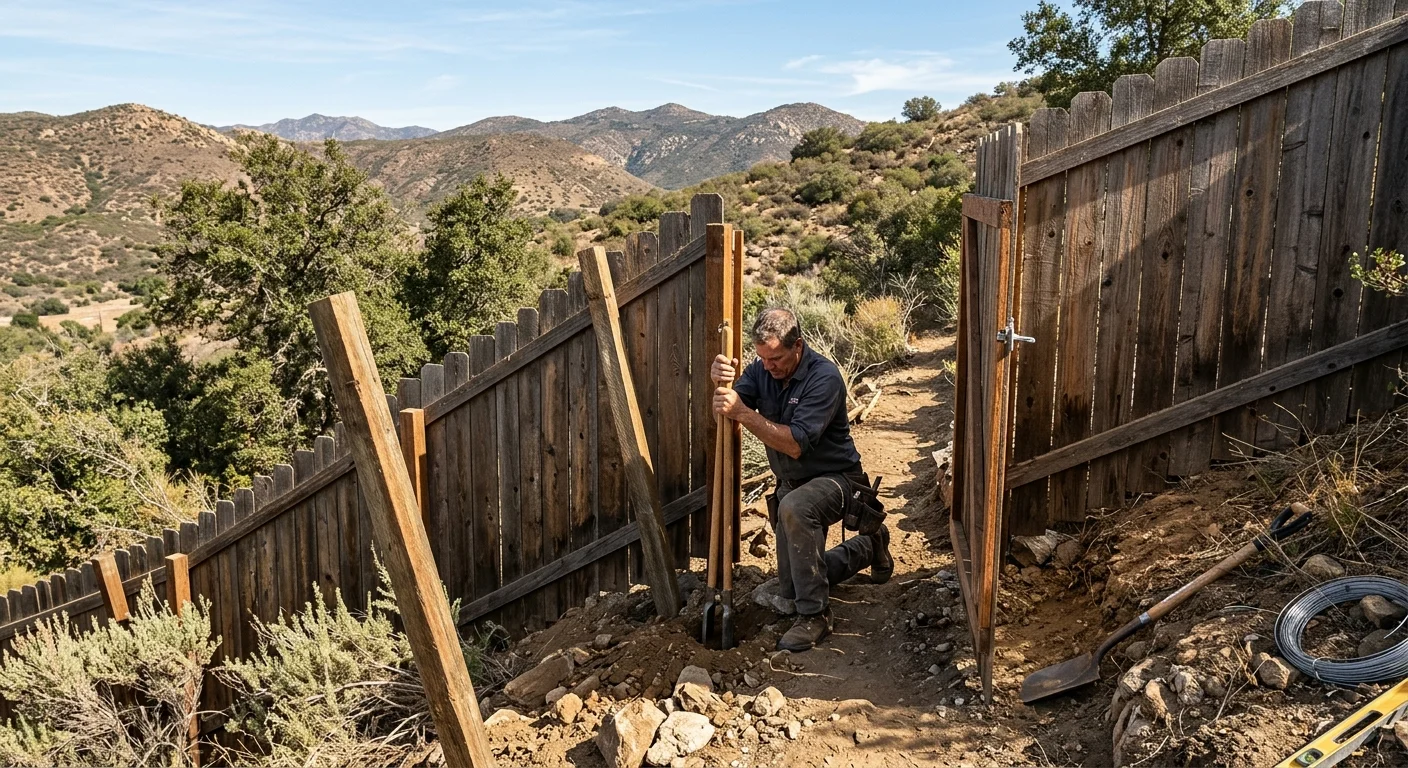
What a downhill lean can reveal about posts and footings
On a hillside, gravity has a direction. Soil, water, and the fence itself want to move toward the low side. A wood fence leaning downhill often means a post that is no longer plumb, a footing that has shifted, or wood that has softened right at grade.
Independent fence contractors start below the boards. They look at the post where it meets the dirt. They look at whether any concrete has lifted, cracked, or washed out on the downhill face. They look at whether the post is rotting in a ring at the soil line while the top still feels firm.
A cosmetic tilt in one panel is not the same as a run that has started to rack. If several posts lean the same way, the line is moving as a system. Rails then pull. Fasteners loosen. The next post takes load it was never meant to carry. Do not yank the fence upright to see if it will stay. That can split posts, break rails, and hide how far the movement has already traveled.
Have a licensed C-13 fencing contractor walk the line. The CSLB describes a C-13 license as covering construction, alteration, and repair of fences, posts, and gates. It excludes masonry walls. If the wood fence sits on a block wall, that wall is a separate trade. Confirm the license on the CSLB site before anyone digs.
The high side of a post can look buried and tight. The low side can show a gap, a hollow, or soil that has pulled away. After winter storms, water often runs along the fence line instead of across the yard. That flow scours the downhill face of a footing. Summer irrigation on a slope can keep the same post wet at the base while the top bakes in inland heat. A mapped soil type for El Cajon, Santee, or Lakeside could not be confirmed here. Lots on the same street can differ. Point the contractor at standing water, drip lines against posts, and any cut-and-fill bench you can see. For soils or grading history, ask the City of El Cajon, the City of Santee, or the County of San Diego for that address.
A downhill lean can also be leftover from how the fence was built. A stepped run leaves triangular gaps on the low side. A racked run follows the grade with rails that are not level. Neither layout is a diagnosis by itself. Both can still fail at the posts. For how those layouts are supposed to work on a new build, see fencing on a sloped San Diego yard. This page is about a fence that already exists and is already leaning. Countywide notes on a fence that has started to tilt live in our leaning fence guide. East County lots add grade, runoff, and longer downhill runs that change what the inspector watches.
How El Cajon, Santee, and Lakeside grades change the inspection
East County is not one hillside. El Cajon, Santee, and Lakeside sit inland of the marine layer, on hotter lots, with more grade change than a typical coastal tract.
In El Cajon, many wood fences run along side yards that drop from Fletcher Hills or Grossmont toward a lower pad. Older cut-and-fill lots can put one post on native grade and the next on fill. The contractor you are matched with will walk both the high street side and the low backyard, because the lean often shows first where the fill meets the slope. Bostonia and the Broadway corridor have short, steep side-yard drops. Those short runs still punish the lowest two or three posts.
Santee mixes river-adjacent flats with sudden rises. Along the San Diego River and Mast Boulevard, a backyard can sit well below the street. Carlton Hills and Fanita-side lots reverse that, with the fence climbing away from the house. A fence leaning downhill on those lots may be leaning toward the river corridor or toward a neighbor’s lower pad. The inspector should note which way water leaves the yard after rain, not only which way the boards tilt.
Lakeside is unincorporated. Longer ranch and horse-property lines along El Monte Road, Wildcat Canyon, and the Winter Gardens and Los Coches area mean more posts, more corners, and more chances for one failed stretch to pull the next. County rules apply here, not a city fence handout. The County of San Diego’s publicly posted PDS070 (revised 2023-01-01) lists a permit exemption for fences and walls no higher than 6 feet if the work is zoning compliant. That same summary lists 42 inches at front and exterior-side yards and 72 inches at rear and interior-side yards. It is not a substitute for a check on your address. Confirm current applicability with County Planning & Development Services before anyone assumes a repair is exempt.
El Cajon and Santee each run their own permit counters. Specific fence-height and permit triggers for those two cities could not be confirmed in the claims ledger used for this site. Do not borrow City of San Diego numbers and apply them in East County. Call the City of El Cajon or the City of Santee with the property address, or have the licensed contractor do that as part of the review.
If the leaning run is a boundary fence, California Civil Code section 841 still matters. Adjoining landowners are presumed to share equally in the reasonable costs of construction, maintenance, or necessary replacement of a dividing fence, unless they have a written agreement that says otherwise. Before costs are incurred, the statute requires 30 days’ advance written notice. That notice has to describe the problem, the proposed work, estimated costs, a cost-sharing approach, and a timeline. Government-owned land is outside that statute. A downhill lean that has started to cross a line is a neighbor conversation and a contractor inspection, in that order.
Why the low side, gates, and corners need one review
A leaning fence on a slope rarely fails in the pretty middle of a panel. Stress collects at three places: the lowest posts, the gate opening, and the corners.
The low-side posts hold the downhill end of every rail. Uphill soil and the weight of the fence push toward them. If those posts move, the whole run follows. An inspector should treat the lowest post in each drop as a primary, not an afterthought. Look for soil that has washed out on the downhill face, a footing that has tilted, or a post that rocks when the rail is loaded. Fence post repair is often the work that actually stops the lean. Panel patches without post work often look straighter until the next wet stretch, then walk again.
Gates need a square opening. On a hill, that opening is already fighting grade. A downhill lean throws the latch out of plane. The gate starts to drag, or it swings and will not catch. Hinge-side posts take extra load every time the gate is used. If the gate sits on the low side of the lot, that hinge post is doing two jobs at once. Have the same contractor look at the gate and the run together. Splitting that into two visits hides how the lean and the sag are related.
Corners transfer movement. A lean on the downhill side yard can rotate into the rear fence. Once a corner post is out, two directions of rail are out. That is why a request to fix one panel can undershoot the real work. Ask for one review that covers the low side, every gate, and every corner on the sloping run.
Do not ignore the uphill face. Roots, a raised planter, or grade filled against the fence can load posts from above. The visible lean is still downhill. The cause can be pressure from the high side. The contractor should look at both faces of the same post.
Pets and kids use the low side of a sloped yard. A wood fence leaning on a hill can open a gap at the bottom on the downhill end while looking closed from the house. That is a containment issue, not just a looks issue. Keep people off a run that moves when you stand next to it. Photograph it. Then get the line inspected as one system.
When repair and a longer replacement run deserve separate quotes
Some downhill leans are a few posts. Some are the whole hillside run. Those are different jobs, and they should be quoted as different jobs by the contractor, not bundled into one number you cannot unpack.
A contained problem looks like this. One or two posts are out. Neighboring posts are firm. Rails and pickets are still sound enough to reuse. The gate still hangs on a solid hinge post. In that case, repairing fence post footings or selective post replacement can be the right path. The licensed contractor still has to deal with the failed post and reset a footing that can stand on that grade. How that footing is built is the contractor’s call on site. This page does not publish hole depths, concrete mixes, or timelines. Those figures are not in our verified ledger, and they change with the lot.
A longer replacement run starts to make sense when the lean has traveled. Several posts move. Rails have pulled from more than one bay. Pickets are weathered past a clean match. The gate opening is no longer a rectangle. Or the original layout fought the slope so hard that resetting two posts would leave the rest of the line in the same pattern. Matching new boards to sun-baked East County wood is hard. Inland heat and dry summers grey a fence fast. A short patch can read as a bright stripe on a brown hill.
Ask the contractor for separate quotes: post-and-footing work on the failing stretch, and a replacement price for the full sloping run. You are asking to see the fork. Fence repair and a new run are both legitimate. What this referral service will not do is set those prices. You contract with the licensed pro directly.
Do not treat a shared boundary as a solo decision. If Civil Code 841 applies, the 30-day notice and the cost-share presumption come before work, not after anyone is on site. A written agreement with the neighbor can change that split. If you do not have one, assume the statute’s presumption until a contractor and, if needed, the neighbor’s own review say otherwise.
Warranty language, material life spans, and claims that a hill repair will last a set number of years are not something we can publish. Manufacturers warrant products. Contractors warrant their own work in their own contracts. Fence Pros San Diego does not.
If the lean is tied to a failing retaining wall, stop treating it as fence-only work. C-13 fencing does not cover masonry walls. Get the wall reviewed by the right trade, then decide what the wood fence can attach to.
What photos help a fence pro judge the lean
A good photo set keeps you from describing a downhill lean with your hands. It also helps the fence pro you are matched with see grade before anyone walks the lot.
Shoot the full run from the low side of the yard, then from the high side. Include a bit of house, a driveway, or a neighbor’s roof so the slope reads. A tight crop of boards hides the hill.
Stand at each leaning post and photograph the soil line. Get the downhill face of the footing if it is visible. Get the uphill face too. Wet soil, a hollow, exposed concrete, or a post with a dark ring at grade all matter.
Photograph every gate closed, then open. Show the gap at the latch and any drag mark in the dirt. Photograph corners from both directions.
If you can do it safely, take one shot after a rain and one when the yard is dry. Do not wait in a storm. Do not climb the fence. A phone camera from standing height is enough.
Mark which way is downhill in the photo or in a text with the pictures. East County lots confuse people who have not been there. Left and right fail. Toward Los Coches, or toward the lower neighbor on the Grossmont side, does not.
Skip the tape-measure theater unless you already have numbers. A contractor will re-measure. What they cannot re-create from memory is how far the lean has traveled since last year. If you have an older photo of the same line, send that too.
Bring the city or County name with the address. El Cajon, Santee, and Lakeside do not share one permit desk. East County fence post repair still starts with that address, then a walk of the posts. This is diagnosis, not a weekend straightening project.
When to call us
When a wood fence is leaning downhill on an El Cajon, Santee, or Lakeside lot, the next step is a licensed fence contractor walking the posts, footings, gates, and corners together. Fence Pros San Diego is a referral service that matches you with licensed, independent local pros. Call us at (858) 400-4906 and we’ll connect you with a licensed fence contractor.