Choosing a steel gate for a San Diego commercial property starts with traffic and space. A useful proposal should explain the layout, operation, finish, hardware, controls, and excluded work before you sign.
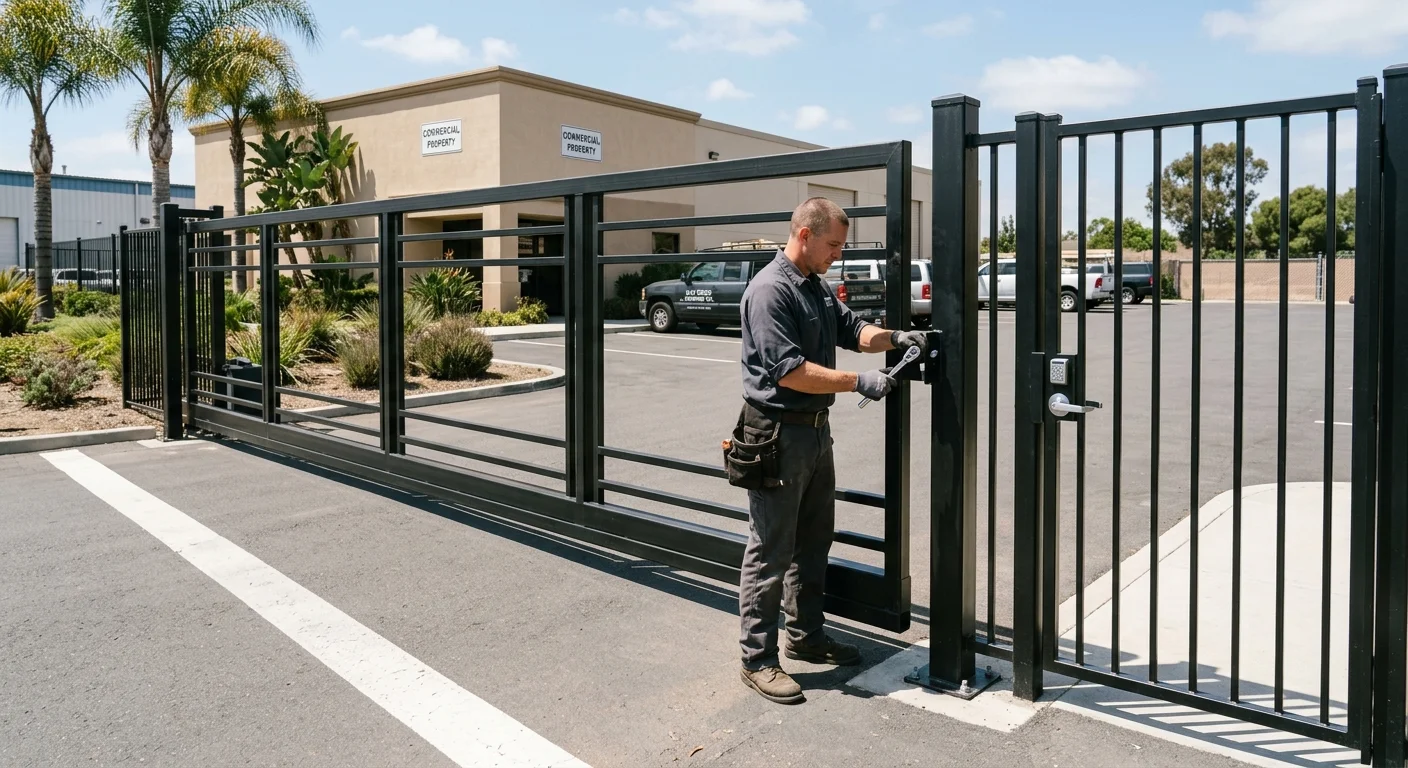
How vehicle, pedestrian, and service access shape the gate layout
Start with how people and vehicles already move through the property. Map each entrance before comparing gate styles or decorative details. A commercial steel gate should fit the opening’s daily purpose, not a generic site plan.
Record the vehicles using each entrance. Include employee cars, delivery trucks, maintenance vehicles, waste collection, and occasional oversized loads. Note their approach direction, turning path, stopping point, and exit route. The contractor can then draw the proposed gate in both open and closed positions.
Pedestrian access deserves its own line in the proposal. Identify where employees, visitors, vendors, and tenants enter. If they’ll use a separate walkthrough gate, show its location and hardware. If they’ll share a vehicle entrance, ask each bidder to explain that layout clearly.
Service access can change the whole design. A gate near a loading area may operate differently from a front customer entrance. Dumpster enclosures, utility areas, storage yards, and secondary driveways also need individual notes. Don’t assume one gate specification belongs at every opening.
San Diego County properties vary widely in shape and use. Walk each site instead of relying only on an aerial image. That applies in Otay Mesa, Barrio Logan, Kearny Mesa, Escondido, Oceanside, and properties near the I-5, I-805, or State Route 78 corridors. Photograph every opening and record visible obstacles.
For broader perimeter planning, review the available commercial and security fencing options. If access management is the main concern, our San Diego security gate guide offers additional questions for the proposal stage.
When swing, sliding, and manual designs fit different sites
A swing gate moves through an arc. Its proposal should show the full path of every leaf. Ask the bidder to mark nearby parking spaces, curbs, walls, posts, landscaping, and equipment. The drawing should also show where vehicles wait while the gate moves.
A sliding gate moves beside the opening instead. This layout deserves consideration when a swing arc conflicts with regular site use. The proposal should identify the gate’s travel direction, available runback area, support design, and any track or guide components. Those details shouldn’t be left to a single phrase like “sliding gate included.”
Site grade also belongs on the drawing. Don’t accept a layout based only on opening width. Ask the contractor to document the pavement and ground conditions across the gate’s full movement. Any proposed surface work should appear as included work or a clear exclusion.
Manual operation may fit an entrance used occasionally by authorized staff. The proposal should still name the latch, lock, drop rods, stops, and hold-open method. It should also explain how the gate will be secured when open and closed.
Powered operation adds another group of decisions. Ask who supplies the operator, controls, electrical work, data connections, trenching, and final setup. The proposal should distinguish contractor work from work assigned to another trade or the property owner. Our gate installation and automation service can help you connect with a contractor for that scope.
For buyers searching for a steel driveway gate in San Diego, appearance shouldn’t decide the layout first. Compare the working space, access pattern, opening method, and supporting work before choosing the gate’s final design.
Which finish, hardware, and control details belong in the proposal
“Painted steel gate” isn’t a complete finish specification. Ask each bidder to name the surface preparation, primer, finish system, color, and application method. The proposal should also address exposed areas created during cutting, drilling, welding, adjustment, or field repair.
Use the conditions observed at the actual property. If the site team sees salt residue, irrigation spray, standing water, dust, or repeated contact from carts and equipment, document it. A manager in Oceanside, Imperial Beach, Point Loma, or inland San Diego County should compare recommendations against the property itself. A vague coastal or inland label isn’t enough.
The steel description should be equally clear. Ask for the frame, posts, infill, decorative elements, and visible fabrication details. Each bidder should state what will be fabricated off-site and what will be completed at the property. Our San Diego metal fence guide can help you organize material and finish questions.
Hardware often separates two proposals that initially look similar. Look for an itemized schedule covering hinges, rollers, tracks, guides, stops, latches, locks, handles, and protective housings. Each item should be tied to a specific gate. Product names or supporting documents make later comparisons easier.
Control details need the same treatment. List any keypad, card reader, remote receiver, intercom, timer, vehicle detection device, or connection to an existing system. The proposal should identify who supplies each component and who coordinates related electrical or data work.
No universal access, fire, safety, or permit rule was confirmed for this guide. Have the contractor identify the authority for the exact address and confirm current requirements before approval. For a City of San Diego property, check with Development Services. For another location, contact the city or county office responsible for that parcel.
What site managers should compare before choosing a contractor
Compare proposals side by side, using the same site notes and requested scope. A low total doesn’t explain whether two contractors included the same gate, finish, controls, or supporting work. Differences should be resolved in writing before selection.
Each proposal should identify the exact openings covered. Match those openings to labeled photographs or a site drawing. Confirm the number of vehicle gates, pedestrian gates, fixed fence sections, posts, and control points. An unlabeled quantity can create confusion when a property has several entrances.
Review the scope in practical groups:
- Gate type, dimensions, movement, and operating method
- Steel frame, infill, posts, and fabrication details
- Surface preparation, finish system, color, and touch-up process
- Hinges, rollers, tracks, guides, stops, latches, and locks
- Operators, access controls, electrical work, and data connections
- Demolition, removal, surface work, cleanup, and excluded items
- Drawings, product documents, approvals, and project coordination
Ask bidders to explain every allowance, alternate, and owner-supplied item. If a proposal mentions a warranty, request the written terms. Confirm who provides it, what product or work it covers, and which exclusions apply. Fence Pros San Diego doesn’t provide warranties or set contractor terms.
Contractor verification belongs in the comparison. California’s CSLB C-13 fencing classification includes gates within its scope and excludes masonry walls. Check the proposed contractor through the CSLB license lookup, then confirm that the listed business and license details match the proposal.
Fence Pros San Diego matches customers with licensed, independent fence contractors. The customer contracts with and pays the selected professional directly. That separation matters when reviewing price, scope, schedule, product documents, and responsibility for related trades.
The best comparison ends with one written scope that someone unfamiliar with the discussions can understand. It should show what’s being provided, where it goes, how it operates, and what remains outside the contract.
When to call us
Bring in a licensed fence pro when the project includes a new commercial steel gate, altered gate posts, custom fabrication, or gate automation. Fence Pros San Diego will refer you to an independent local professional, and you’ll contract with that professional directly. Call us at (858) 400-4906 and we’ll connect you with a licensed fence contractor.