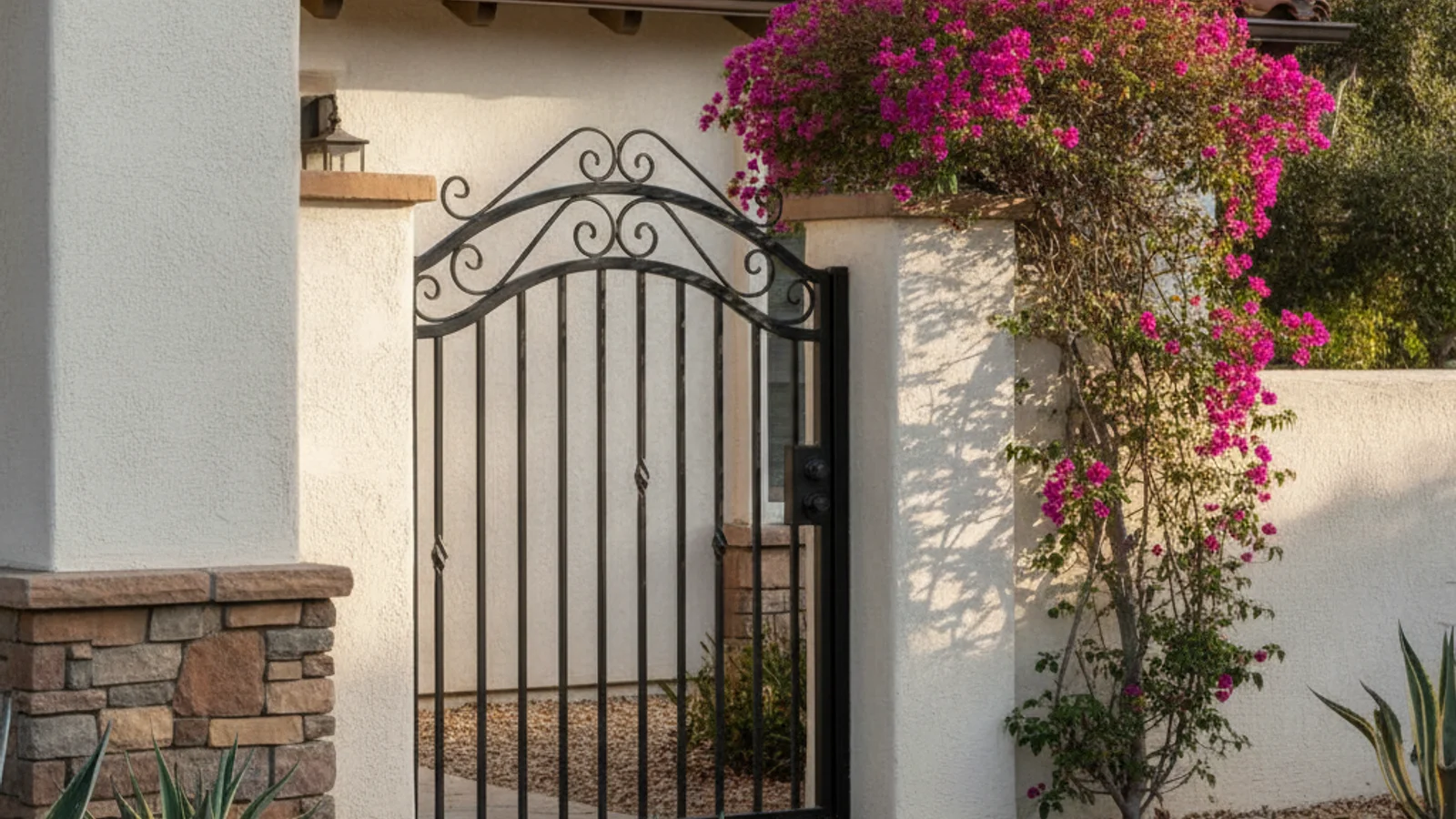
A welded gate is a custom metal entrance built by welding steel or aluminum components together. Unlike prefabricated gates that come in standard sizes, welded gates are fabricated to fit your exact opening and design preferences. They’re common at driveways in coastal neighborhoods, estate properties, and commercial sites across San Diego County where security, permanence, and aesthetic control matter.
Welded gates hold up better than most wood gates in our salt air and sunshine. Steel welded gates are heavier and more resistant to being forced open than chain link or vinyl. They also let you choose the exact look, from minimalist modern bars to ornate scrollwork that mirrors Spanish Colonial architecture. The tradeoff is cost: a quality welded gate costs more upfront than a standard chain link gate, and installation requires a skilled ironworker.
What makes a welded gate different from other gate types
Most gates fall into a few categories: chain link fences hang from hinges and roll on tracks, vinyl gates are bolted together from pre-made panels, and welded gates are built from scratch to order. When you choose a welded gate, a fabricator measures your opening, designs the frame and infill pattern you want, then welds each piece together at their shop. The completed gate arrives at your home as one finished piece (or two pieces if it’s wider than what fits on a truck), ready to hang.
Steel is the traditional welded gate material because it’s strong, affordable relative to other metals, and can be shaped into detailed designs. Aluminum is lighter and won’t rust in salt air, which is why many coastal properties near Coronado, Ocean Beach, and La Jolla choose aluminum welded gates. Both materials can be powder-coated in any color. A third option, wrought iron, is technically welded as well, but it’s forged rather than fabricated from rolled steel, and it costs more because of the handwork. For ornamental gate options, gate installation services can include custom wrought iron designs.
How much does a welded gate cost in San Diego
A basic steel welded gate for a driveway runs 3000 to 8000 dollars installed in San Diego, depending on size and design complexity. A single-wide gate (up to 12 feet) with a simple design costs less than a double-wide gate (up to 24 feet) with ornate scrollwork. Gates with solid infill (no gaps) cost more to weld than open-bar designs because they use more material and welding labor.
Aluminum welded gates cost 4000 to 10000 dollars because aluminum is more expensive than steel, but they’re chosen for coastal properties where rust resistance is the priority. If your gate needs to open and close automatically, add 1500 to 3000 dollars for an operable hinge system, hinges, and hardware. A sliding welded gate on a track costs 5000 to 12000 dollars because the track installation is labor-intensive.
Installation labor in San Diego runs 800 to 2000 dollars depending on site difficulty. If your existing fence posts are strong and properly spaced, installation is quick. If the posts need to be reinforced or reset, expect higher labor. Delivery of a finished gate from the fabricator to your home is typically included in the gate price or costs 150 to 400 dollars.
Choosing materials and design for a welded gate
Steel is the most common choice because it’s affordable and versatile. A stainless steel welded gate resists rust even in salt air, but it costs more than plain steel. Plain steel gates are typically powder-coated black or a custom color to protect the metal and achieve the look you want.
Aluminum welded gates are rust-proof, which makes them popular on properties near the coast or in salt-spray zones. They’re lighter than steel, so some homeowners prefer them for very large gates. Aluminum can’t be powder-coated as durably as steel, so longevity can be slightly shorter if the coat gets scratched.
Design options are nearly unlimited. A modern welded gate might feature vertical bars with consistent spacing, creating a clean, contemporary look. A classical design might incorporate scrolls, curves, or a focal point like a sunburst or geometric pattern at the top. Many San Diego homeowners choose designs that complement the architecture of their house: Spanish Colonial homes pair well with curved or scrollwork designs, while modern homes suit straight-line patterns.
Infill choices affect both cost and function. An open-bar gate allows visibility through the gate and costs less because less material is welded. A solid infill gate (flat panels or close spacing) blocks visibility and provides more privacy and security, but costs more. A mixed design (bars at the bottom, solid upper section) balances privacy with sight lines.
Installation and maintenance of welded gates
A welded gate is hung on hinges attached to concrete footings or steel posts. The posts must be strong enough to support the gate’s weight without shifting. If you’re installing a new gate where no post exists, the fabricator will recommend digging postholes at least 2 feet deep, setting the posts in concrete, and waiting 7 days before hanging the gate. For automatic operation, driveway gate openers provide convenient push-button or remote access.
Preventive maintenance keeps a welded gate functioning well for 20 years or longer. Oil the hinges and lock mechanisms twice a year, especially if you live near the coast. Inspect the welds and powder coat for damage after storms. If salt spray or condensation causes small rust spots, sand and repaint affected areas immediately to prevent rust from spreading.
For automatic gates with operable hardware, service the opener annually. Hinges should be checked for tightness before the gate drifts or swings unevenly. If the gate begins to sag or stick, the hinges or posts may need adjustment or repair.
Why choose a welded gate for your San Diego property
Welded gates offer several advantages over prefabricated options. You control the exact design, size, and finish, so your gate can match your home’s character rather than settling for generic options. Welded gates are built to handle the specific width and height of your opening, eliminating gaps or spacing issues. Steel and aluminum welded gates are more secure and harder to force open than vinyl or chain link alternatives.
Welded gates also hold their appearance longer in San Diego’s climate. A quality steel gate properly powder-coated or a stainless steel gate won’t fade, warp, or degrade like wood or vinyl gates do under constant sun exposure. Welded gates require less maintenance than wood and outlast vinyl in our coastal environment.
Frequently asked questions about welded gates
How long does a welded gate last?
A properly installed and maintained welded steel gate lasts 15 to 25 years. Aluminum welded gates last 20 to 30 years because aluminum doesn’t rust. Coastal properties (within 1 mile of the ocean) may see slightly shorter lifespans because salt spray accelerates wear on hardware and powder coatings, but annual maintenance extends the life significantly. Stainless steel gates last 25 to 40 years because the material itself resists corrosion.
Can a welded gate be painted a different color?
Yes. Most welded gates arrive powder-coated in a standard color like black, bronze, or white. If you want a custom color, specify it when the gate is fabricated and the powder coat applied at the shop. Repainting an existing gate is possible but expensive because the powder coat must be removed and the gate sanded down before a new coat is applied. It’s simpler to choose your final color during initial fabrication.
Do welded gates require a permit in San Diego?
Most residential welded gates do not require a permit if they’re under 6 feet tall and located at least 2.5 feet behind the property line. Gates taller than 6 feet, gates that span the full front setback, or gates in specific neighborhoods may need approval. Contact Fence Pros San Diego for help determining permit requirements for your property. Our team is familiar with San Diego’s fence and gate regulations across all 67 communities we serve, from Coronado to Ramona and everywhere in between.
What’s the difference between a welded gate and a wrought iron gate?
A welded gate is fabricated from rolled steel or aluminum shapes joined together by welding. A wrought iron gate is forged by hand from solid iron stock, creating thicker, more durable joints and allowing for more intricate designs. Wrought iron gates are more expensive and take longer to build, but they’re considered more artisanal and refined. Both are custom-built and secure. Welded steel is a practical choice for most properties; wrought iron is chosen when the aesthetic is the priority.
How do automatic openers work with welded gates?
An automatic gate opener (also called an actuator) is a motor that pulls or pushes the gate open or closed on a schedule or via remote control. The opener mounts inside the gate frame or to the hinge post, with a linkage connecting the motor to the gate. Access can be controlled by a keypad, a remote transmitter, or a smartphone app. Openers are available for swing gates (hinged gates) and sliding gates. Installation adds significant cost but provides convenient access and enhances security.
Welded gates in San Diego represent a permanent, secure, and design-forward choice for homeowners and businesses. Whether you need a straightforward driveway gate or an architectural focal point, a welded gate built to your specifications will perform reliably for decades with standard maintenance.