A cat-proof fence in San Diego runs $8 to $25 per linear foot to retrofit, depending on whether you add a roller system or an angled mesh topper. Height alone does nothing, since cats climb rather than jump. The fix is always at the top of the fence, not the height of it.
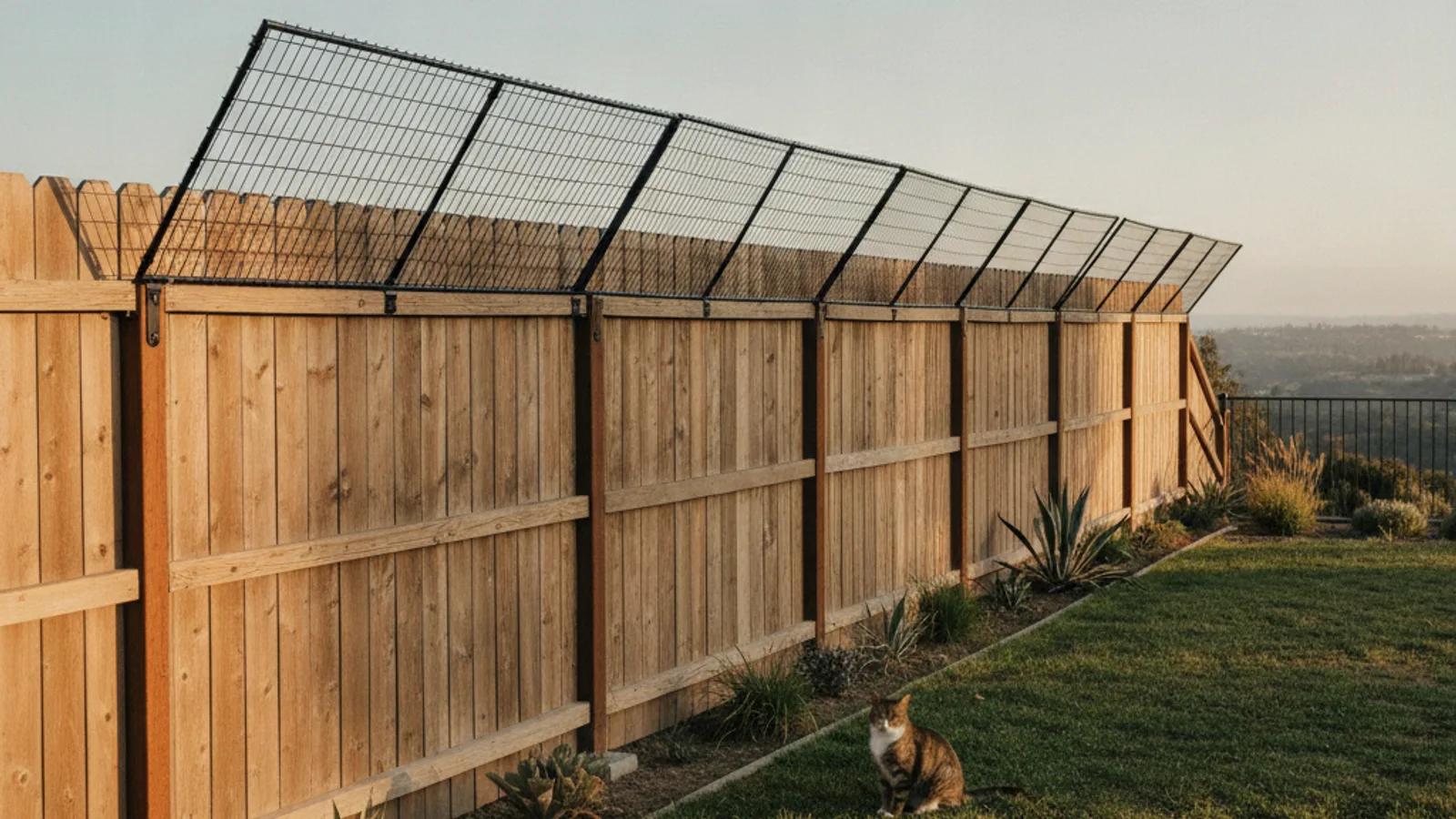
Most homeowners who search for this already tried a taller fence and watched a cat scale it anyway. Cats are built for climbing, and a standard 6-foot privacy fence or wood fence gives them plenty of grip along the boards or posts. The upgrade that actually works is a top treatment that turns a stable climbing surface into an unstable one, the same principle behind commercial cat-containment systems, just scaled to a backyard budget. It’s a different problem than keeping a dog inside a yard, since our dog fence guide deals mostly with digging and gaps at ground level, not climbing. This guide covers what works, what it costs installed in San Diego, and the local wrinkle that matters here more than almost anywhere else: coyotes.
What actually keeps a cat from climbing a fence?
A top treatment that removes the paw’s grip, not extra height. Three approaches work: a rolling bar system (the fence topper spins under the cat’s weight, so it can’t pull itself over), an angled extender that tilts 45 degrees back into the yard with mesh attached, or a full mesh “cat fence” kit that wraps the top few feet of the entire perimeter. Adding two more feet of solid fence without one of these treatments buys a homeowner very little, since a healthy cat can scale a smooth 6-foot wood or vinyl panel in a few seconds and jump the rest.
Roller systems (the category commercial brands like Oscillot popularize) mount a spinning bar or paddle wheel along the top rail. A cat gets a paw up, the bar rotates, and there’s nothing solid to push off of. Angled toppers work on a simpler principle: the top foot or two of the fence leans inward at 45 degrees with mesh or netting stretched across it, so a climbing cat runs out of vertical surface and hits an overhang it can’t get past. Both approaches only need to go around the property’s perimeter, not every yard feature, and both retrofit onto a fence that already exists.
How much does it cost to cat-proof a fence in San Diego?
| Method | How it works | Typical installed cost (per linear ft) | Best for |
|---|---|---|---|
| Roller/spinning bar system | Bar rotates under the cat’s paw, removing grip at the top edge | $10-$25 | Existing wood, vinyl, or block fences that are otherwise sound |
| Angled inward mesh topper | 45-degree extender plus mesh creates an overhang a cat can’t climb past | $8-$20 | Chain-link and wood fences, and yards that also need a visual barrier |
| Full mesh cat-containment kit | Mesh wraps the top of the entire fence line, sometimes with netting over open runs | $12-$25 | Yards with mixed fence types or gaps between sections |
| Adding height only, no top treatment | More fence, same climbable surface | Cost of standard fence extension, but rarely solves the problem | Not recommended as a standalone fix |
These are retrofit costs added to a fence that’s already standing. A brand-new fence built with cat containment designed in from the start costs less overall than fence plus a later retrofit, since labor doesn’t have to happen twice. If the existing fence also needs repair or replacement first, fence installation pricing is a separate line item on top of these ranges. A cat-proof topper isn’t the same product as a standard privacy fence topper, which is built for screening a view, not stopping a climb, so don’t expect one to double as the other.
Does the fence material matter?
Yes. Solid wood and vinyl panels are the easiest surfaces to top, since the flat panel gives a roller or angled extender a clean, continuous mounting line. Smooth vinyl fence is actually one of the harder materials for a cat to climb on its own, because there’s no grain or texture to grip, which makes it a strong baseline before adding a topper at all. Wood is grippier by comparison. Textured boards and any horizontal rail on the outside face give a cat a foothold, similar to the climbing problem seen in our coyote-proof fencing guide.
Chain-link and wrought iron are the hardest starting points. The mesh diamonds in chain-link fence are essentially a built-in ladder, and iron pickets give a cat’s claws something to hook. Both materials need a full mesh wrap or a roller system to work at all, since there’s no smooth section to rely on. A property with mixed fence types, say wood on two sides and chain-link on the back, needs the topper to run continuously across the seam, or the cat just finds the gap.
How do I keep cats in and coyotes out in San Diego?
Run the same fence line to do both jobs, since the two threats point in opposite directions. Cats need a top treatment that stops them from climbing out. Coyotes need height plus a dig barrier to stop them from getting in. Neither upgrade interferes with the other, and a lot of San Diego yards need both at once.
This matters more here than in most parts of the country because canyon-adjacent neighborhoods put coyotes within a few hundred feet of ordinary backyards, not just rural lots. Scripps Ranch, Tierrasanta, Poway, and Rancho Santa Fe all back onto canyon or open-space systems where coyote traffic through a yard is routine, and an outdoor cat is exactly the kind of animal coyotes hunt. Our full coyote-proof fencing guide covers the height, roller, and buried-mesh spec for keeping coyotes out; layer a cat-containment topper on the same fence and the perimeter handles both directions at once instead of solving one problem and leaving the other wide open.
Frequently asked questions
How high does a cat-proof fence need to be?
Height isn’t the deciding factor. A standard 6-foot fence with a roller or angled mesh topper stops a cat just as well as an 8-foot fence with no top treatment, since cats climb rather than jump straight up. Most installers work with whatever fence height already exists and add the top treatment rather than building taller; see our fence height guide if the existing fence falls short of San Diego’s standard limits for other reasons.
Will rollers hurt the cat?
No. A cat roller, the same passive spinning bar used to keep coyotes out, has no motor, no shock, and no trap mechanism. It simply spins when weight is applied, so the cat loses its grip and drops back into the yard instead of climbing over. It’s a physical deterrent, not a device that injures the animal.
Can you cat-proof an existing fence without replacing it?
Yes, and that’s how most of these jobs get done. Roller systems and angled mesh toppers both mount onto an existing fence’s top rail or posts, as long as the fence itself is structurally sound. A fence that’s leaning, rotted, or missing sections needs repair first, since a topper only works if what it’s attached to is solid.
Do cat-proof toppers need a permit in San Diego?
Generally no, since a topper added to an existing fence within the standard residential height limit is a minor modification, not new construction. HOA-governed properties can have their own material or appearance rules for visible toppers, so check the HOA guidelines before installing one on a fence that’s shared with a neighbor or fronts a common area.
Do these work for cats that already escape regularly?
Yes, that’s the exact scenario these systems are built for. A cat that’s already found a weak point in the fence will keep testing it, so the fix is closing off the top of the entire perimeter, not just the one spot where it got out last time. Walk the full fence line for gaps, low branches near the fence, or anywhere the cat could get a running jump before finishing the topper installation.
When to call us
Cat containment is a top-of-fence retrofit, not a new fence style, and it works on wood, vinyl, or chain-link as long as the existing fence is sound. Fence Pros San Diego connects homeowners with installers across the county who handle roller systems, angled mesh toppers, and full containment kits, plus new fence builds with cat containment designed in from the start. Call (858) 400-4906 for a same-day estimate.